Artificial intelligence tools such as ChatGPT, Gemini, text-to-speech applications and adaptive learning apps gave students with mild-to-moderate intellectual disabilities new ways to join in classroom life, according to a small qualitative study of pre-service teachers in Israel. But the future teachers who took part in the research were emphatic on one point: the technology itself did not create social inclusion. In their accounts, engagement, communication and peer interaction emerged only when teachers deliberately shaped, adapted and mediated the AI-supported activities, and even then the participants distinguished carefully between mere participation and genuine belonging.
The study, published in Frontiers in Education, was conducted by researchers at Al-Qasemi Academic College of Education in Baqa al-Gharbiyye. Yasmeen Abu Mukh, Enas Majadley, Jihan Aloshi and Giana Khalifa interviewed eight third-year pre-service teachers enrolled in the college’s Bachelor’s degree program in Special Education. The participants, seven women and one man aged between 21 and 33, had each completed a 14-week teaching practicum in inclusive elementary school classrooms serving students with mild-to-moderate intellectual disabilities. The students they worked with were aged 9 to 12 years, in classes of roughly eight to twelve children.
The researchers used a qualitative interpretive design built around semi-structured interviews conducted over Zoom, each lasting approximately 40 to 50 minutes. Interviews were carried out in Arabic, the participants’ native language, audio-recorded with consent, transcribed verbatim and analyzed in Arabic to preserve linguistic and cultural nuance; representative quotations were later translated into English by bilingual team members and independently reviewed. The data were examined using reflexive thematic analysis, following Braun and Clarke’s six recursive phases, with a primarily inductive approach that allowed themes to emerge from the participants’ own accounts rather than from predetermined categories.
The analysis produced four interrelated themes. The first concerned the opportunities that AI-supported activities created for classroom participation and engagement. The second addressed how those opportunities were perceived to contribute to social inclusion through peer interaction, recognition, belonging and relationship building. The third mapped the contextual and ethical challenges that constrained implementation, and the fourth set out the conditions the participants considered necessary for effective integration: teacher mediation, professional preparation and institutional support. A conceptual model derived from the thematic analysis positions AI-supported activities as opportunities for participation whose effect on social inclusion depends on pedagogical and contextual factors rather than on the technology itself.
On the first theme, the participants consistently identified increased attention and motivation as the most immediate outcomes of AI-supported activities. Interactive and multimodal resources were reported to capture students’ interest more effectively than traditional instructional methods, producing sustained engagement and more active participation in classroom tasks. One participant, identified as P4, described how an interactive activity encouraged a usually silent student to participate simply by pressing the correct picture, and allowed a student who had difficulty speaking to answer like the other students without becoming anxious. Another, P6, reported noticing that students became more attentive and more motivated to learn than with traditional methods, with some beginning to laugh and others to ask questions. The researchers note that these were participants’ interpretations rather than objectively measured improvements: the teachers read students’ curiosity, enjoyment, sustained attention and willingness to participate as indicators of enhanced engagement.
Communication and collaboration also featured prominently in the accounts. Visual prompts, digital stories, audio supports and simplified instructions were reported to help students understand classroom tasks and respond in line with their communication abilities, with multimodal resources offering alternative means of expression through speech, images, symbols or simple actions. Group games, interactive quizzes and problem-solving tasks encouraged students to pursue shared goals and support one another, with one participant describing how each student contributed a part of a solution and classmates applauded when the group reached the correct answer. Yet the participants repeatedly stressed that none of this was automatic. They noted that students often needed teacher encouragement, simplified explanations, role assignment and repeated opportunities to participate, and that successful collaboration depended on purposeful task design and ongoing teacher support rather than on the technology alone.
The second theme revealed a distinction the participants drew consistently: between classroom participation and broader social inclusion. Increased engagement was regarded as an initial step, whereas social inclusion encompassed reciprocal peer interaction, acceptance, relationship building and a sense of belonging. AI-supported activities were perceived as facilitating opportunities for social interaction rather than directly producing inclusion. Shared digital tasks served as common reference points that made dialogue easier, prompting students to ask classmates for answers or request help with a device. Participants described classmates acknowledging one another’s contributions through encouragement and applause, a usually silent student gaining a sense of being part of the team by choosing a color or pointing to a picture, and relationships improving over repeated lessons as students began wanting to help a classmate who struggled to complete activities alone. One participant summarized the caution succinctly: AI tools may replace materials and methods, but they do not replace values, emotional understanding or human communication.
The third theme documented substantial obstacles. Participants reported limited access to digital devices, unstable internet connectivity, insufficient technological infrastructure and the additional time required to prepare AI-supported lessons; one described having to change a lesson immediately when the internet stopped working or there were not enough tablets for all students. The limited availability of Arabic-language AI applications and culturally relevant resources was a persistent difficulty, since many tools were designed primarily for English-speaking users, forcing teachers to rewrite vocabulary and examples so that materials matched students’ language level and everyday experiences. Ethical concerns also surfaced: participants emphasized that AI should complement rather than replace human interaction, raised questions about privacy and the responsible use of student information, stressed the need to review AI-generated materials thoroughly before classroom use, and observed that some students became distracted by the novelty of digital tools.
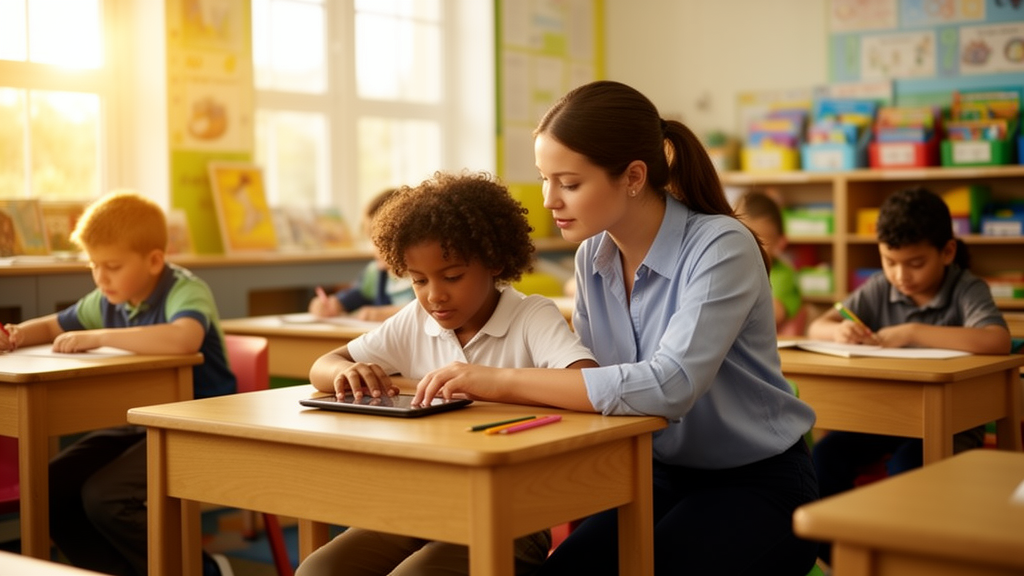
The fourth theme set out what the participants saw as prerequisites for meaningful integration. Teacher mediation was identified as the primary factor influencing success, with teachers responsible for selecting appropriate tools, adapting activities to students’ abilities, facilitating peer interaction and ensuring equitable participation. One participant put it plainly: artificial intelligence provides possibilities, but it is the teacher who decides how those possibilities become meaningful learning experiences, and without guidance the technology alone cannot achieve inclusion. Beyond individual competence, the participants highlighted reliable technological infrastructure, access to digital devices, administrative backing, opportunities for professional collaboration and practical training that demonstrates how AI tools can be integrated into real classroom situations. Successful implementation, they argued, requires cooperation among teachers, school leaders and technical staff, with AI becoming part of a school’s educational vision rather than the responsibility of individual teachers.
The authors are careful about the scope of their findings. The study involved a small purposive sample of eight pre-service teachers from a single teacher education institution, and, consistent with its qualitative interpretive design, aimed at in-depth contextual understanding rather than statistical generalization. Crucially, the study examined participants’ perceptions and reflections on their practicum experiences rather than direct observations of classroom implementation or measured student outcomes, so the findings should be read as accounts of perceived opportunities and challenges rather than evidence of effectiveness in promoting social inclusion. The research took place in an Arabic-speaking educational context involving students with mild-to-moderate intellectual disabilities, and linguistic, cultural and institutional factors may have shaped the participants’ experiences. The authors suggest that future research combine interviews with classroom observations, analyses of teaching artifacts and student perspectives, and that longitudinal work follow pre-service teachers into their professional careers to see how their perceptions and practices evolve. Within those limits, the study’s central message is a measured one: AI-supported activities can open opportunities for participation, communication and peer interaction, but in these teachers’ experience, inclusion remains a human achievement built through pedagogy, relationships and institutional commitment.
Subject of Research: Pre-service teachers' perceptions of using AI-supported activities to promote the social inclusion of students with intellectual disabilities
Article Title: AI-supported activities for social inclusion: pre-service teachers’ perceptions of opportunities and challenges in special education
Article References: Abu Mukh, Y., Majadley, E., Aloshi, J., & Khalifa, G. (2026). AI-supported activities for social inclusion: pre-service teachers’ perceptions of opportunities and challenges in special education. Frontiers in Education, 11, Article 1913331. https://doi.org/10.3389/feduc.2026.1913331
Image Credits: AI Generated
DOI: 10.3389/feduc.2026.1913331
Keywords: artificial intelligence, inclusive education, intellectual disabilities, pre-service teachers, social inclusion, special education, teacher mediation, qualitative research, teaching practicum, peer interaction, classroom engagement, ethical considerations
Cite Scienmag News
Courtney Benton. (October 28, 2026). Pre-service teachers say AI can open classroom doors, but only human mediation makes inclusion real. Scienmag. https://scienmag.com/pre-service-teachers-say-ai-can-open-classroom-doors-but-only-human-mediation-makes-inclusion-real/
Courtney Benton. "Pre-service teachers say AI can open classroom doors, but only human mediation makes inclusion real." Scienmag, 28 October 2026, https://scienmag.com/pre-service-teachers-say-ai-can-open-classroom-doors-but-only-human-mediation-makes-inclusion-real/. Accessed 28 October 2026.
Courtney Benton. "Pre-service teachers say AI can open classroom doors, but only human mediation makes inclusion real." Scienmag. October 28, 2026. https://scienmag.com/pre-service-teachers-say-ai-can-open-classroom-doors-but-only-human-mediation-makes-inclusion-real/