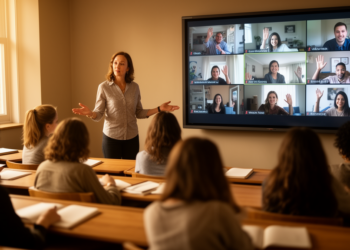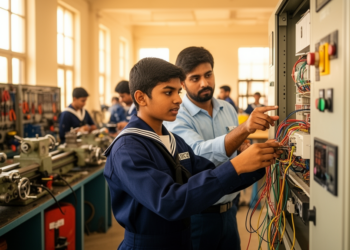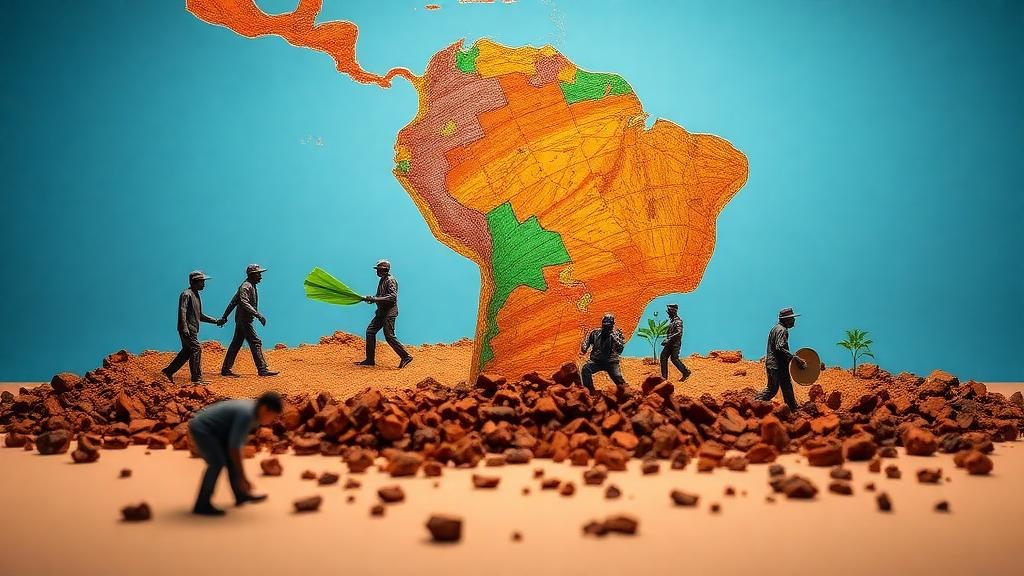
Science classrooms in Latin America often teach models as neutral tools for explaining the world, but a team of science education researchers argues they should also become sites for grappling with the region’s deepest socioecological conflicts. In a conceptual paper published on 15 September 2026 in the open-access journal Disciplinary and Interdisciplinary Science Education Research, Gonzalo Guerrero, Valeria Cabello and colleagues put forward a framework they call critical modelling, which reorients modelling-based instruction towards what the field calls Vision III of scientific literacy: an understanding of science that integrates its epistemic, ethical, sociopolitical and environmental dimensions rather than treating it as a neutral body of knowledge.
The paper is explicitly theoretical. The authors describe it as a research-informed framework for conceptualising modelling-based instruction, not a report of completed classroom studies, and they state that no datasets were generated or analysed during the study. Its pedagogical examples are described as theoretically grounded hypothetical scenarios, designed to show the coherence and flexibility of the framework across educational levels, pending empirical validation. That caveat matters, because the framework’s central claim is ambitious: that modelling, usually valued for building conceptual understanding, can also serve as a civic practice connecting scientific reasoning with deliberation, justice-oriented thinking and sustainability.
The argument builds on the socioscientific issues movement, which emerged in the early 2000s. Socioscientific issues are complex societal dilemmas grounded in science, such as climate change, genetically modified organisms, pandemics, food insecurity and biotechnology in healthcare. They are inherently controversial, open-ended and ill-structured, lacking definitive solutions, and their resolution depends not only on scientific knowledge but also on economic, social, cultural, religious, environmental, political and ethical considerations. Two decades of research, the authors note, have shown that engaging with such issues offers opportunities for students to develop argumentation, decision-making and democratic participation alongside disciplinary knowledge.
Why Latin America? The authors insist the framing is an epistemic choice rather than a geographical limitation. The region’s configuration of extractivism, colonial legacies and socioecological conflict, they argue, makes the non-epistemic dimensions of science unusually visible and analytically tractable. In contexts where curricula often portray science as neutral and apolitical, and where socioenvironmental conflicts are intertwined with disputes over environmental governance, development models and the legitimacy of Indigenous knowledge systems, the ethical and political dimensions of scientific knowledge cannot easily be hidden. The framework, they write, applies wherever SSI education seeks Vision III goals, with Latin America functioning as a locus of epistemic innovation rather than a boundary on its reach.
The framework’s core move is to define critical modelling as an approach in which the construction and evaluation of scientific representations is explicitly oriented towards developing critical scientific literacies. Epistemic aims such as explanatory adequacy, coherence and evidential grounding are pursued in conjunction with examination of the ethical, sociopolitical and environmental dimensions implicated in socioscientific issues. Following Sadler and Zeidler, the authors use ‘epistemic’ to refer to knowledge-oriented dimensions of modelling and ‘non-epistemic’ to refer to the values, ethical commitments, political interests and cultural contexts that shape, but are not reducible to, knowledge claims. Crucially, they argue this relationship is constitutive rather than additive: the values, interests and power relations embedded in socioscientific problems are present from the very first decisions of the modelling process, shaping what counts as a relevant phenomenon, an adequate variable or a legitimate criterion of evaluation.
That position distinguishes critical modelling from the earlier SIMBL framework proposed by Sadler and colleagues, which argued that modelling and SSI are pedagogically compatible and mutually reinforcing. The new framework extends SIMBL in two respects: it orients the integration of scientific and socioscientific models towards the sociopolitical reflexivity of Vision III, and it treats epistemic and non-epistemic dimensions as inseparable from the outset rather than sequencing scientific models first and social dimensions afterwards. The authors also acknowledge a tension in the field: concerns have been raised that insufficient attention to disciplinary foundations may limit learners’ opportunities to develop robust capacities for evaluating evidence, and they position modelling as a way of sustaining disciplinary rigour within a critical literacy agenda.
From this analysis the paper derives three cross-cutting conditions for linking modelling with SSI. The first is the deliberate selection of phenomenological contexts, chosen so that scientific explanation is inseparable from socioecological tensions or contested decision-making, attending to epistemic relevance, curricular alignment, socioscientific significance, accessibility and epistemic plurality. The second concerns the orientation of practices: alongside representing, testing and revising models, tasks should include deliberative and reflective engagement such as evaluating public claims, considering consequences for different social groups, examining responsibility and justice, and exploring collective and civic action. The third is the systematic integration of epistemic and non-epistemic dimensions, examining not only the internal adequacy of models but their external consequences, including how they circulate in public debates and inform policy. The authors stress these conditions are mutually constitutive rather than additive.
To illustrate, the paper sketches four hypothetical pathways across educational levels. For lower primary, children in a drought-affected rural community progressively build and revise a shared model of the local water cycle, then use it to deliberate about conservation, storage and distribution, weighing who would benefit or be disadvantaged by each option. For lower secondary, students examine alarmist social media claims about snack ingredients, negotiate a shared model of food composition and additive functions, contrast it with circulating narratives, and then add price data to raise questions about affordability and who can afford products marketed as ‘natural’. For upper secondary, students in a coastal town near a major subduction zone model plate motion, wave formation and shoreline characteristics, then use the model to discuss evacuation routes, differential vulnerability and the fairness of local preparedness plans.
The most developed case, at university level, concerns lithium extraction in the Lithium Triangle spanning northern Chile, Bolivia and Argentina. Students construct representations of brine composition, evaporation ponds, hydrological flows and geochemical processes, compare and revise them, then place the models in dialogue with testimonies and materials produced by Indigenous communities, comparing how water circulation and ecosystem interdependence are represented in scientific assessments and in Indigenous knowledge systems. Through role-based discussions representing Indigenous communities, state agencies, mining companies and scientific advisors, students use the shared model to examine contested proposals on extraction technologies, water governance and limits on expansion. The authors argue this case shows how the selection of a transnational extractive conflict makes questions of water justice and Indigenous rights visible, which in turn shapes which practices become pedagogically salient.
The paper closes with implications and open questions rather than prescriptions. The authors identify three functions modelling contributes to Vision III: it externalises reasoning, making implicit assumptions visible and contestable; it creates a revisable object of collective deliberation; and it anchors civic deliberation in disciplinary knowledge. They also flag structural constraints, noting that bureaucratic demands, rigid curricula, accountability pressures and limited planning time in many Latin American contexts can restrict opportunities for sustained deliberation. The precise mechanisms through which modelling scaffolds the integration of epistemic and non-epistemic dimensions, they write, remain an open theoretical and empirical question, and the tension between standardised assessment and authentic deliberation about non-epistemic dimensions is described as unresolved in SSI education more broadly. What the framework offers, for now, is a conceptual architecture and a research agenda for testing whether classrooms built around critical modelling can deliver the civic and epistemic gains it envisions.
Subject of Research: A conceptual framework linking scientific modelling with socioscientific issues to foster critical scientific literacy in Latin America
Article Title: Critical modelling of socioscientific issues: fostering critical scientific literacy in Latin America
Article References: Guerrero, G., Soto, M., Ariza, Y., Marzábal, A., Olivares-Donoso, R., Cândido, N., Gomez, F., & Cabello, V. (2026). Critical modelling of socioscientific issues: fostering critical scientific literacy in Latin America. Disciplinary and Interdisciplinary Science Education Research, 8(1), Article 28. https://doi.org/10.1186/s43031-026-00175-x
Image Credits: AI Generated
DOI: 10.1186/s43031-026-00175-x
Keywords: science education, socioscientific issues, scientific literacy, critical modelling, Latin America, Vision III, lithium extraction, modelling-based instruction, environmental education, teacher education, sustainability education, extractivism
Cite Scienmag News
Courtney Benton. (October 28, 2026). Scientists propose ‘critical modelling’ to teach science through Latin America’s socioecological conflicts. Scienmag. https://scienmag.com/scientists-propose-critical-modelling-to-teach-science-through-latin-americas-socioecological-conflicts/
Courtney Benton. "Scientists propose ‘critical modelling’ to teach science through Latin America’s socioecological conflicts." Scienmag, 28 October 2026, https://scienmag.com/scientists-propose-critical-modelling-to-teach-science-through-latin-americas-socioecological-conflicts/. Accessed 28 October 2026.
Courtney Benton. "Scientists propose ‘critical modelling’ to teach science through Latin America’s socioecological conflicts." Scienmag. October 28, 2026. https://scienmag.com/scientists-propose-critical-modelling-to-teach-science-through-latin-americas-socioecological-conflicts/