


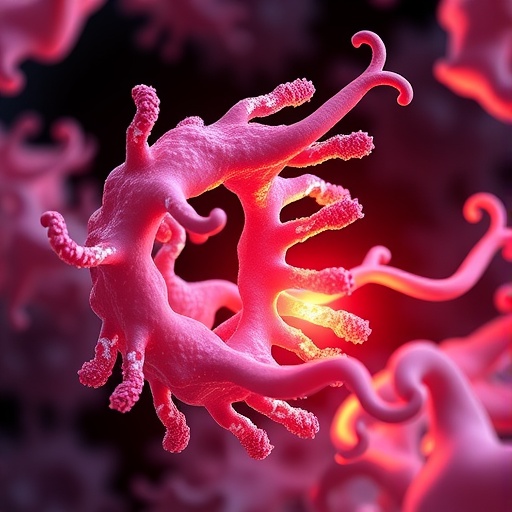
In a groundbreaking advance in molecular biology, scientists have decrypted critical stages in the assembly of the eukaryotic DNA replication machinery, shedding new light on the formation of the CMGE helicase complex. This intricate process is vital for DNA unwinding and replication initiation, and the latest cryo-electron microscopy (cryo-EM) studies provide unprecedented structural insights that unravel the transition from the double hexamer (DH) state to the active CMG helicase complex.
At the heart of this research lies the exploration of how the pre-initiation complex (pre-IC) forms and destabilizes the DH interface, a question that has long puzzled researchers. Earlier studies left it ambiguous whether the binding of Dpb11 disrupts the DH interface or if Dpb11 binds to a pre-existing gap, and if Mcm7–Sld3 engagement triggers this disruption or is a consequence thereof. By employing a refined biochemical staging, the team reconstituted the early Cdc45 assembly reaction, intentionally omitting accessory factors such as Sld2, Dpb11, DNA polymerase epsilon (Pol ε), and GINS, thereby isolating the initial binding events.
The resultant cryo-EM structure, resolved at an impressive 3.1-Å resolution, reveals the double hexamer with Sld3 density occupying the A4 site, a potential early intermediate state in Cdc45 recruitment. Notably, in this complex, the Mcm7 N-terminal insertion remains tightly anchored to Mcm5, maintaining the integrity of the hexamer interface. This finding contradicts previous assumptions that Sld3 or Cdc45 binding alone might cause the dismantling of the DH interface, indicating a more complex sequence prerequisite for ring opening.
Further 3D classification and local refinement techniques unraveled a more elaborate structure at 3.7-Å resolution, comprising DH bound to the Sld3/7 heterodimer and Cdc45 (termed DH-3745). Despite local resolution variances caused by the intrinsic flexibility of Sld3’s Cdc45-binding domain (CBD), this structural snapshot accentuates Cdc45’s positioning at the interstices between the A domains of Mcm2 and Mcm5, consistently aligning with its spatial location in both the pre-IC and fully active CMG complex. Complementing these observations, Sld7’s interaction with Mcm6 at a canonical ATPase site substantiates a conserved mode of heterodimer engagement.
Intriguingly, the study delves deeper into the flexible linkers connecting Sld3 and Sld7, corroborating prior crystallographic data and modern AlphaFold3 predictions. These flexible domains likely contribute to the dynamic nature of the pre-IC and the sequential recruitment steps necessary for helicase activation. Comparative analyses with previously characterized DDK-treated DH structures further support that Sld3/7–Cdc45 binding does not prompt immediate structural rearrangements at the MCM dimerization interface; rather, it suggests that subsequent recruitment of factors such as Sld2, Dpb11, GINS, and Pol ε are critical to induce the necessary conformational transitions.
The researchers also revealed significant steric conflicts when modelled interactions of Mcm7-bound Dpb11 were overlayed onto the DH structure, implying spatial incompatibility with the intact DH state. This supports the hypothesis that the stable DH must ‘crack’ or separate to accommodate Dpb11 binding and subsequent steps towards active helicase formation. Hence, the stepwise assembly triggered by these newly resolved structural stages underscores an elegant, temporally orchestrated cascade rather than a solitary conformational flip.
Moreover, the team’s single-molecule and cryo-EM observations illuminate the independent recruitment of Cdc45 molecules to each hexamer in the DH, marking a key departure from earlier models seen in amphibian systems like Xenopus, where Cdc45 is recruited synchronously. These species-specific mechanistic insights open avenues for understanding divergent regulatory paradigms in eukaryotic DNA replication initiation.
Additional analyses touch upon the subtle DNA engagement transitions triggered during the progression from the DH-3745 state to the pre-IC, revealing foundational modifications in DNA binding dynamics and helicase activation. Although the precise structural rearrangements remain to be further elucidated, these findings offer a framework for understanding how replication origins transition from dormant complexes to active replisomes.
This seminal work not only expands the knowledge of pre-initiation complex assembly but also enhances our grasp of the molecular choreography underlying genome duplication. The high-resolution structures and biochemical staging provide a platform for future therapeutic targeting, potentially influencing cancer research where replication stress and helicase function are of paramount importance.
As we unravel the symphony of molecular interactions that coordinate DNA replication initiation, this study marks a pivotal chapter in the structural biology of the replication machinery, harmonizing biochemical data with atomic-level images to map the pathway from dormant MCM double hexamers to the bustling origins of replication.
Cite Scienmag News
Denise Maddox. (June 17, 2026). Pre-initiation Complex Reveals CMGE Assembly Mechanism. Scienmag. https://scienmag.com/pre-initiation-complex-reveals-cmge-assembly-mechanism/
Denise Maddox. "Pre-initiation Complex Reveals CMGE Assembly Mechanism." Scienmag, 17 June 2026, https://scienmag.com/pre-initiation-complex-reveals-cmge-assembly-mechanism/. Accessed 3 September 2026.
Denise Maddox. "Pre-initiation Complex Reveals CMGE Assembly Mechanism." Scienmag. June 17, 2026. https://scienmag.com/pre-initiation-complex-reveals-cmge-assembly-mechanism/


