


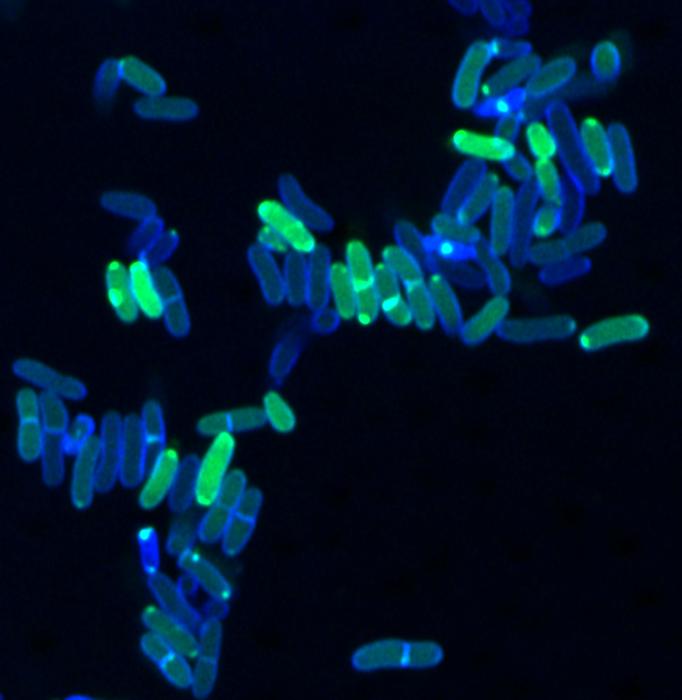
Many bacteria produce substances to gain an advantage over competitors in their highly competitive natural environment. Researchers at the University Hospital Bonn (UKB), the University of Bonn and the German Center for Infection Research (DZIF) have discovered a new so-called lantibiotic, namely epilancin A37. It is produced by staphylococci that colonize the skin and acts specifically against their main competitors there, the corynebacteria. This specificity is presumably mediated by a very special mechanism of action, which the researchers were able to decipher in detail. Their results have now been published in the renowned ISME Journal.

Credit: University Hospital Bonn (UKB) / Jan-Samuel Puls
Many bacteria produce substances to gain an advantage over competitors in their highly competitive natural environment. Researchers at the University Hospital Bonn (UKB), the University of Bonn and the German Center for Infection Research (DZIF) have discovered a new so-called lantibiotic, namely epilancin A37. It is produced by staphylococci that colonize the skin and acts specifically against their main competitors there, the corynebacteria. This specificity is presumably mediated by a very special mechanism of action, which the researchers were able to decipher in detail. Their results have now been published in the renowned ISME Journal.
Due to increasing antibiotic resistance in pathogens causing infections, the development of new antibacterial substances is important. Hopes are pinned on a new group of substances produced by gram-positive bacteria, the lantibiotics. These are antimicrobial peptides that often have a very narrow spectrum of activity. “Such compounds are highly interesting from a medical point of view, as they could specifically attack individual groups of organisms without affecting the entire bacterial flora, as is the case with broad-spectrum antibiotics, for example,” says corresponding author Dr. Fabian Grein, until recently head of the DZIF research group “Bacterial Interference” at the Institute of Pharmaceutical Microbiology at the UKB and member of the Transdisciplinary Research Area (TRA) “Life & Health” at the University of Bonn.
Essential competitive advantage over corynebacteria
The UKB research team led by Fabian Grein and Tanja Schneider, together with the team led by Ulrich Kubitscheck, Professor of Biophysical Chemistry at the University of Bonn, have now discovered a new lantibiotic, namely epilancin A37. It is produced by staphylococci, which are typical colonizers of the skin and mucous membranes. Little is known about these antimicrobial peptides. “We were able to show that epilancins are widespread in staphylococci, which underlines their ecological importance,” says first author Jan-Samuel Puls, a doctoral student from the University of Bonn at the Institute of Pharmaceutical Microbiology at the UKB. This is because staphylococci and corynebacteria are important genera of the human microbiota – i.e. the totality of all microorganisms such as bacteria and viruses – in the nose and skin, which are closely linked to health and disease. The need to produce such a compound indicates a pronounced competition between the species. The researchers were able to show that the newly discovered epilancin A37 acts very specifically against corynebacteria, which are among the main competitors of staphylococci within the skin microbiome.
New mode of action in the “bacterial war” decoded
“This specificity is presumably mediated by a very special mechanism of action that we were able to decipher in detail,” says Grein. Epilancin A37 penetrates the corynebacterial cell, initially without destroying it. The antimicrobial peptides accumulate in the cell and then dissolve the cell membrane from the inside, thus killing the corynebacterium. Co-author Dr. Thomas Fließwasser from the Institute of Pharmaceutical Microbiology at the UKB, postdoctoral researcher at the University of Bonn and acting head of the DZIF research group “Bacterial Interference” adds: “Our study shows how a specific mechanism of action can be used to specifically combat a single bacterial species. It therefore serves us as a ‘proof of concept'”.
Promotion:
This project was funded by the German Center for Infection Research and the Transregio SFB TRR 261 “Antibiotic CellMAP” of the German Research Foundation.
Journal
The ISME Journal
Article Title
Staphylococcus epidermidis bacteriocin A37 kills natural competitors with a unique mechanism of action
Article Publication Date
26-Apr-2024
Cite Scienmag News
Ophelia Keating. (April 29, 2024). Possible alternative to antibiotics produced by bacteria. Scienmag. https://scienmag.com/possible-alternative-to-antibiotics-produced-by-bacteria/
Ophelia Keating. "Possible alternative to antibiotics produced by bacteria." Scienmag, 29 April 2024, https://scienmag.com/possible-alternative-to-antibiotics-produced-by-bacteria/. Accessed 4 September 2026.
Ophelia Keating. "Possible alternative to antibiotics produced by bacteria." Scienmag. April 29, 2024. https://scienmag.com/possible-alternative-to-antibiotics-produced-by-bacteria/

