


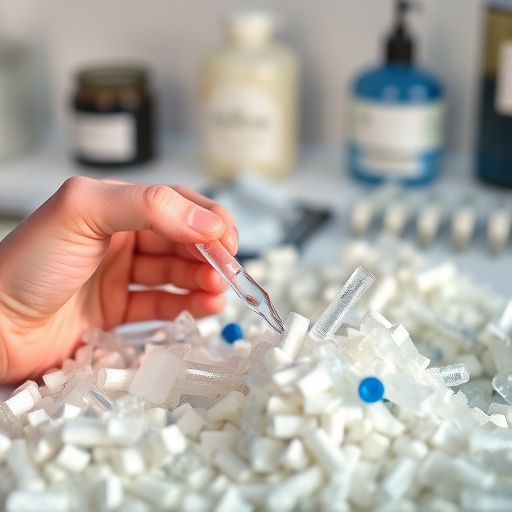
In recent years, microplastics research has emerged as a critical frontier in environmental science, drawing global attention due to the pervasive presence of these minuscule plastic particles in ecosystems worldwide. Despite the surge in investigations and mounting public concern, the field faces formidable challenges that hamper consistent progress and reliable data generation. In groundbreaking work published in Microplastics & Nanoplastics, McIlwraith, Lindeque, Tolhurst, and colleagues argue that the cornerstone for advancing microplastics research lies in the rigorous establishment of positive controls utilizing representative materials. Their findings elucidate why such controls are not merely beneficial but indispensable for scientific accuracy, reproducibility, and policy-relevant outcomes.
Microplastics, defined typically as plastic particles smaller than 5 millimeters, have infiltrated oceans, freshwater sources, soils, and even the atmospheric environment. Their ubiquitous presence results from both primary sources—such as microbeads and industrial abrasives—and the fragmentation of larger plastic debris. Researchers have long grappled with the challenge of reliably detecting and quantifying microplastics amidst complex environmental matrices. The lack of standardized methods and calibration materials often leads to considerable variability and uncertainty in experimental analyses. According to McIlwraith et al., positive controls composed of representative microplastic materials could address these fundamental limitations.
At the heart of their argument lies a technical but critical issue: the heterogeneity of microplastic particles complicates analytical workflows. Microplastics vary widely in polymer composition, size distribution, morphology, and surface characteristics, each parameter influencing behavior and detectability. Without positive controls that closely mimic these real-world attributes, laboratory methods risk producing results that are either inconsistent or incomparable. By introducing well-characterized, representative positive controls, experimentation can shift from relative approximation toward genuine quantification.
The research team emphasizes that positive controls serve as a benchmark to validate analytical protocols across different laboratories and studies. This is particularly vital given the multidisciplinary approaches employed in microplastics research, ranging from spectroscopic methods like Fourier-transform infrared (FTIR) and Raman spectroscopy to visual microscopy and chemical digestion techniques. Each analytical strategy has intrinsic strengths and limitations, and controls enable researchers to assess method recovery efficiency, sensitivity thresholds, and detection limits, fostering methodological transparency.
Moreover, McIlwraith and colleagues highlight how the absence of standard positive controls undermines our understanding of microplastic distribution and impacts. When varying studies report conflicting concentrations or particle types in similar environmental contexts, stakeholders such as policymakers and environmental managers struggle to interpret the data reliably. Robust positive controls can harmonize research outputs and inform risk assessments and mitigation strategies, ultimately guiding regulatory frameworks to curb plastic pollution effectively.
The concept of representativeness in positive controls is central to the authors’ thesis. Creating standardized control materials involves replicating the diversity of microplastic types encountered in environmental samples. This includes parameters like polymer resin type—such as polyethylene, polypropylene, polystyrene—particle shape (fragment, fiber, sphere), and size classes down to the nanoscale sub-micron range. Addressing the diversity requires interdisciplinary collaboration, combining polymer chemistry insights with advanced manufacturing techniques capable of producing synthetic but environmentally relevant particles.
The paper further discusses challenges in storage, stability, and handling of positive controls, which must preserve particle integrity over time to ensure consistent calibrations. Contamination control is another critical factor, as microplastic samples and controls share susceptibility to airborne or laboratory-derived plastic particles that can lead to false positives. The authors advocate for rigorous laboratory cleanliness protocols and chain-of-custody documentation to mitigate contamination risks.
Method development is another domain where the integration of positive controls proves indispensable. As detection techniques scale toward the nanoscale, differentiation between genuine microplastic particles and natural or anthropogenic organic matter becomes increasingly complex. Positive controls enable method developers to fine-tune instrument parameters, spectral libraries, and classification algorithms. This iterative process optimizes identification accuracy, paving the way for more nuanced ecological and toxicological assessments.
In addition, the authors argue for the necessity of positive controls in ecotoxicology experiments aimed at deciphering microplastic impact on living organisms. Dose-response relationships and bioaccumulation studies depend on precise knowledge of the material characteristics used in exposure experiments. Without representative controls, experimental outcomes risk misinterpretation, leading to ambiguous conclusions about microplastic toxicity and environmental hazard potential.
Importantly, McIlwraith et al. suggest that an open-access repository of standardized positive control materials could revolutionize the field by democratizing access and promoting cross-comparison of results worldwide. Such a resource would bolster collaborative efforts and reduce duplication, which currently burdens research efficiency and funding. They envision this repository evolving alongside the field, incorporating novel particle types as the understanding of microplastic diversity expands.
The article also ventures into the realm of policy implications. As microplastics attract increasing media attention and legislative scrutiny, the availability of reliable data is paramount for evidence-based decision-making. Standardized positive controls underpin regulatory testing protocols, facilitating compliance verification, environmental monitoring, and consumer product evaluations concerning plastic contamination. The authors argue that without this foundation, regulatory efforts risk being both overambitious and underinformed.
Technological innovation, as discussed in the publication, complements these efforts. Emerging spectroscopic techniques with enhanced spatial and chemical resolution, coupled with machine learning algorithms capable of spectral pattern recognition, are poised to redefine microplastics analytics. Yet, their deployment at scale demands robust positive controls for training, validation, and normalization—solidifying the paper’s central thesis.
Lastly, the authors acknowledge current limitations and propose future directions—including the development of microplastic reference materials that simulate environmental weathering processes, which alter particle surface chemistry and behavior. Incorporating aged and biofouled particles into controls will render laboratory tests more representative of real-world conditions, enhancing ecological relevance.
In sum, this pioneering study addresses a fundamental bottleneck at a pivotal moment for microplastics science. By advocating the strategic design and use of positive controls with representative materials, McIlwraith, Lindeque, Tolhurst, and their colleagues lay out a compelling path forward. Their call for methodological rigor, standardization, and global collaboration resonates far beyond microplastics, offering lessons applicable across complex environmental contaminant research disciplines. As ecosystems and human health face mounting threats from plastic pollution, the field’s advancement depends on embracing these essential scientific tools—ushering in an era of clarity, confidence, and actionable insight.
Cite Scienmag News
Denise Maddox. (August 6, 2025). Positive Controls Propel Microplastics Research Forward. Scienmag. https://scienmag.com/positive-controls-propel-microplastics-research-forward/
Denise Maddox. "Positive Controls Propel Microplastics Research Forward." Scienmag, 6 August 2025, https://scienmag.com/positive-controls-propel-microplastics-research-forward/. Accessed 4 September 2026.
Denise Maddox. "Positive Controls Propel Microplastics Research Forward." Scienmag. August 6, 2025. https://scienmag.com/positive-controls-propel-microplastics-research-forward/


