


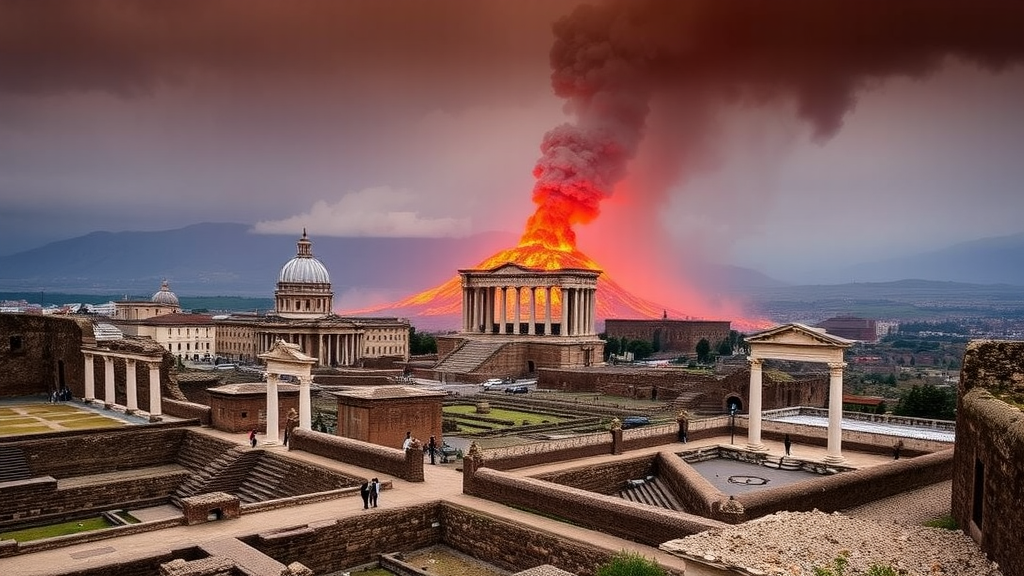
Nearly two thousand years after ash and pumice from Mount Vesuvius buried the Roman town of Pompeii, the catastrophe that killed Pliny the Elder and was witnessed by his nephew is once again making scientific history. A team of researchers from the Berkeley Geochronology Center, the University of California, Berkeley, and the University of Padua in Italy has used the precisely documented date of the eruption, August 24 in the year 79 CE, to recalibrate one of the most powerful tools in the geosciences: argon-argon dating. The study, published this week in the journal Science Advances, demonstrates that a method capable of dating everything from human ancestors to the oldest rocks in the solar system can now be anchored to a known historical event with remarkable accuracy, giving scientists a new benchmark for measuring deep time.
The significance of the work lies in the unusual nature of the calibration target. Most geological dating methods are validated against other laboratory measurements, creating a chain of inference in which small errors can compound. The Vesuvius eruption is different. Because Pliny the Younger recorded his first-hand observations of the disaster in extraordinary detail, scientists know the eruption date from written history rather than from any radiometric measurement. That makes the volcanic minerals erupted in 79 CE a kind of natural standard, a sample whose true age is known independently and against which the laboratory technique can be tested and refined.
Argon-argon dating relies on the slow, steady radioactive decay of potassium-40, a naturally occurring isotope, into argon-40. Because argon is a gas that normally escapes from minerals before they crystallize, any argon-40 trapped inside a volcanic mineral must have accumulated after the rock cooled. Scientists measure the ratio of argon-40 to argon-39, a proxy isotope created in the laboratory by irradiating the sample with neutrons, which converts a stable isotope of potassium, potassium-39, into argon-39. The more argon-40 relative to argon-39, the older the sample. The technique is prized because it spans an enormous range of time, from eruptions within living memory to meteorites that formed at the dawn of the solar system, but its usefulness depends entirely on knowing the decay rate of potassium-40 with precision.
The new study, led by Paul Renne, a Berkeley professor in residence of earth and planetary science and director of the independent Berkeley Geochronology Center, analyzed eight samples of sanidine, a potassium-rich volcanic mineral, from pumice ejected during the 79 CE eruption. When the minerals were analyzed in 2025, the argon-argon method pegged their age at 1,938 years, give or take 13 years. The actual age, derived from the historical record, is 1,946 years. That result corresponds to a precision of 0.7 percent and an accuracy of 0.4 percent, a level of performance that pushes the technique firmly into the historical realm. Accuracy, in this context, refers to whether a measurement reflects the true value, while precision describes how reproducible the measurement is; the Vesuvius benchmark shows the method now excels on both counts.
Getting to that level of performance required solving problems on two fronts: the laboratory and the archive. In the laboratory, the team benefited from better samples, an improved mass spectrometer, and updated neutron irradiation techniques. The samples themselves had an interesting history. In 1998, co-author Andrea Marzoli of the University of Padua collected new, more potassium-rich pumice from Oplontis, another Roman town buried by the same eruption. Crucially, these samples came from the earliest stage of the eruption. Magma chambers beneath stratovolcanoes like Vesuvius tend to stratify, with dense iron- and magnesium-rich magma settling to the bottom while soluble elements such as potassium concentrate near the top. Because the potassium-rich magma erupts first, it ends up at the base of the ash and pumice deposits, and Marzoli’s samples came from exactly those bottom layers. The samples were then shelved and never analyzed for nearly three decades.
Several years ago, graduate students Caroline Hasler, Anthony Fuentes, and Andy Tholt, working under postdoctoral fellow Jack Carter in Renne’s laboratory, proposed retrieving the old samples and attempting to improve on a 1997 analysis of Vesuvius sanidine that had predicted sub-one-percent precision was achievable. The effort dovetailed with a larger project: a Bayesian scheme, published in 2025, to intercalibrate the two most widely used geologic clocks, argon-argon dating and uranium-lead dating, which have historically produced results that do not always agree. The 1997 Vesuvius data had been included in that intercalibration but carried little statistical weight because of its lower precision. The new measurements change that, giving the historical benchmark real authority in reconciling the two methods. Renne also credited co-author Bill Cassata with a major role in developing the analytical strategy and data analysis, describing the success as a combination of better samples, instrumental advantage, and a more concerted effort.
Before any of the laboratory work could be interpreted, however, the team had to settle a long-running dispute among historians. Some scholars have argued that the eruption occurred later in the fall of 79 CE, citing a coin found at Pompeii that they claimed could only have been minted in September of that year. Hasler compared the coin with other contemporary Roman coinage and concluded that it was likely produced before September, supporting the traditional August 24 date derived from Pliny the Younger’s account. Adopting a liberal two-month uncertainty in the eruption timeline turned out to have little effect on calibrating the dating technique itself, but it proved essential for a second major result: a sharper determination of the half-life of potassium-40.
That half-life, the time it takes for half of any given quantity of potassium-40 to decay, is the fundamental constant underlying every argon-argon date ever published. The team now reports a value of 12.044 billion years, with an uncertainty of 0.088 billion years, twice as precise as the previous value derived from nuclear physics experiments. Because the decay constant links the measured argon ratios to elapsed time, improving it tightens every argon-argon age across the entire timescale the method covers, from recent volcanic eruptions to the formation of the planets.
The practical consequences extend well beyond Vesuvius. Renne noted that more accurate and precise argon-argon dating will be invaluable in calibrating radiocarbon dating, the dominant method for attaching dates to organic materials such as wood that are younger than about 55,000 years. It will also help ground-truth uranium-lead dating of billion-year-old rocks from the earliest days of planet Earth. Geologists studying active volcanoes stand to benefit directly as well, since reconstructing the eruptive history of a volcano that still threatens dense urban areas, such as those near Mexico City, Naples, or Yogyakarta in Indonesia, depends on precisely dating its past eruptions. As Renne put it, if you want to assemble the eruptive history of a volcano in relatively recent time, precision and accuracy really count, and the study shows that kind of useful precision can now be achieved into the historical realm.
The improved clock also sharpens scientists’ ability to connect cause and effect in the deep past. Renne pointed out that better precision allows researchers to more confidently infer causal relationships between events in the geologic record, such as a meteor impact structure and a mass extinction. A decade ago, he used argon-argon dating to establish precise dates for a meteor impact, massive volcanic eruptions in India, and the dinosaur extinction, all of which occurred within a few tens of thousands of years around 66 million years ago. Those dates bolstered the idea that the impact triggered intensified volcanism, delivering a one-two punch that wiped out all non-avian dinosaurs. Looking forward, Renne said the team hopes to unify as many geologic dating methods as possible using the same Bayesian mathematics, bringing more raw observations into a single coherent framework. But argon-argon dating, he emphasized, will always remain a standard and an important calibrant. The study also establishes a new benchmark for the method’s ability to date very recent eruptions with decadal accuracy, ensuring that the eruption that destroyed Pompeii will keep contributing to science for centuries to come. The work was funded by the National Science Foundation, the Ann and Gordon Getty Foundation, and the Berkeley Geochronology Center.
Subject of Research: Recalibration of the argon-argon geologic dating method using the historically dated 79 CE Vesuvius eruption
Article Title: The eruption that destroyed Pompeii is helping scientists date Earth's history
Article References: The eruption that destroyed Pompeii is helping scientists date Earth's history. (n.d.). Original publication
Image Credits: AI Generated
DOI: Not provided
Keywords: argon-argon dating, Vesuvius, Pompeii, geochronology, potassium-40 half-life, sanidine, radiometric dating, Pliny the Younger, Science Advances, UC Berkeley, volcanic eruption dating, uranium-lead calibration
Cite Scienmag News
Courtney Benton. (September 25, 2026). Pompeii Eruption Gives Scientists a Precise New Clock for Dating Earth’s History. Scienmag. https://scienmag.com/pompeii-eruption-gives-scientists-a-precise-new-clock-for-dating-earths-history/
Courtney Benton. "Pompeii Eruption Gives Scientists a Precise New Clock for Dating Earth’s History." Scienmag, 25 September 2026, https://scienmag.com/pompeii-eruption-gives-scientists-a-precise-new-clock-for-dating-earths-history/. Accessed 4 October 2026.
Courtney Benton. "Pompeii Eruption Gives Scientists a Precise New Clock for Dating Earth’s History." Scienmag. September 25, 2026. https://scienmag.com/pompeii-eruption-gives-scientists-a-precise-new-clock-for-dating-earths-history/


