


Currently, membrane materials play an important role in tissue repair, especially polysaccharide-based membranes, attracting much attention due to their excellent biological properties. However, poor mechanical properties of polysaccharide-based membranes under wet conditions severely limit their in vivo applications. The fabrication of polysaccharide-based membranes with both robust wet mechanical properties and excellent biological properties remains challenging and is worth exploring.

Credit: Photo credit: Jian-Hong Xiao and Si-Ming Chen.
Currently, membrane materials play an important role in tissue repair, especially polysaccharide-based membranes, attracting much attention due to their excellent biological properties. However, poor mechanical properties of polysaccharide-based membranes under wet conditions severely limit their in vivo applications. The fabrication of polysaccharide-based membranes with both robust wet mechanical properties and excellent biological properties remains challenging and is worth exploring.
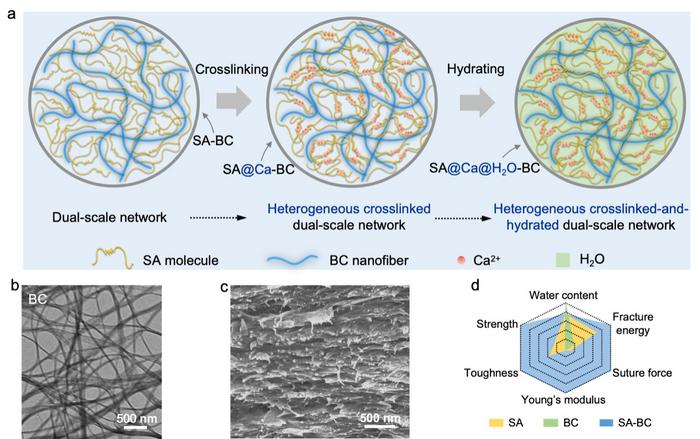
Researchers at the University of Science and Technology of China recently published a research article in the National Science Review, attempting to address this challenge. They proposed a bioinspired mechanical reinforcement strategy based on heterogeneous crosslink-and-hydration (HCH) of molecular/nanoscale dual-network. By the easy chemical principle (Ca2+ crosslinking and water molecule invasion), researchers can regulate the heterogeneity of the structure and composition of targeted nanocomposite materials. Here, the heterogeneity lies in the crosslink-and-hydration process which selectively occurs in the molecular network. The molecular network makes the membrane soft and flexible (containing water) while the undisturbed nanofiber network can bear external stress to provide mechanical support.
As one demonstration, a dual-scale network nanocomposite membrane composed of Ca2+-crosslinked-and-hydrated sodium alginate (SA) molecule-network and bacterial cellulose (BC) nanofiber-network was fabricated. Mechanical experiments showed that the dual-scale network nanocomposite membrane exhibits excellent wet mechanical properties such as strength, toughness, and suture force. At the same time, the biological evaluation and in vivo experiments (such as the dog mandibular defect repair experiment) showed that the functionalized membrane possesses good biological properties (such as cell adhesion capability, cytocompatibility, antibacterial capability, and osteogenic capability), which indicates the large biomedical application potential of the dual-scale network nanocomposite membrane.
The bioinspired mechanical strengthening strategy of HCH of molecular/nanoscale dual-network proposed in this work is universal and would provide important insight into the design and fabrication of advanced polysaccharide-based biomaterials used in the biomedical field.
See the article:
Bioinspired polysaccharide-based nanocomposite membranes with robust wet mechanical properties for guided bone regeneration
Journal
National Science Review
Cite Scienmag News
Denise Maddox. (April 10, 2024). Polysaccharide-based membranes with high wet mechanical properties used for bone repair. Scienmag. https://scienmag.com/polysaccharide-based-membranes-with-high-wet-mechanical-properties-used-for-bone-repair/
Denise Maddox. "Polysaccharide-based membranes with high wet mechanical properties used for bone repair." Scienmag, 10 April 2024, https://scienmag.com/polysaccharide-based-membranes-with-high-wet-mechanical-properties-used-for-bone-repair/. Accessed 3 September 2026.
Denise Maddox. "Polysaccharide-based membranes with high wet mechanical properties used for bone repair." Scienmag. April 10, 2024. https://scienmag.com/polysaccharide-based-membranes-with-high-wet-mechanical-properties-used-for-bone-repair/

