


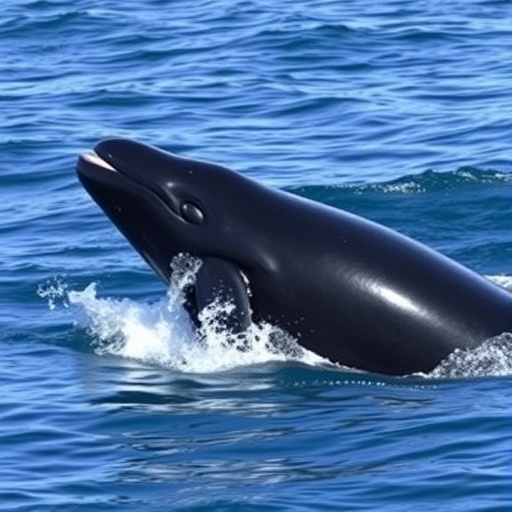
In one of the planet’s busiest maritime corridors, the Strait of Gibraltar, an extraordinary challenge unfolds quietly beneath the waves. This slender waterway, where over 60,000 ships traverse annually, links the vast Atlantic Ocean to the warm Mediterranean Sea, forming a bustling highway not only for human vessels but also for a fragile population of long-finned pilot whales (Globicephala melas). These remarkable cetaceans face an escalating crisis as anthropogenic noise from shipping activity disrupts their vital acoustic communication, potentially imperiling their survival.
The long-finned pilot whales, renowned for their complex social structures and deep-diving foraging behaviors, rely heavily on sound for navigation, foraging coordination, social bonding, and pod cohesion. With the relentless increase in maritime traffic, underwater noise pollution in this region reaches alarming decibel levels, rivaling the intensity of a vacuum cleaner or a bustling restaurant. This acoustic smokescreen challenges the whales’ ability to discern each other’s calls and maintain essential social connections in an already endangered population estimated at merely 250 individuals within this area.
Between 2012 and 2015, an international team of marine biologists, led by Frants Jensen of Aarhus University and collaborators from Spain, Portugal, the United Kingdom, and the United States, undertook a groundbreaking study to unravel how these pilot whales adapt their vocal behavior amidst such acoustic interference. Employing innovative technology, the researchers deployed suction-cup attached devices affixed via a six-meter pole to 23 individual whales. These sophisticated instruments recorded the whales’ underwater movements, dive depths, ambient noise levels, and vocalizations during 24-hour recording sessions.
Back on land, the research team faced the painstaking task of sifting through over 1,400 recorded whale calls, classifying them into four distinct types based on frequency and structure. These classifications included low-frequency calls, short pulsed calls, high-frequency calls, and two-component calls. Of particular significance are the low-frequency and two-component calls, which possess greater propagation capabilities, thus serving as crucial signals for reunion and localization within widely spaced pods when whales resurface after deep foraging dives.
However, the study revealed that the whales’ acoustic environment is far from optimal. Background noise levels fluctuated dramatically, sometimes reaching 144 decibels—a sound intensity intense enough to significantly mask communication signals. Such noise stems predominantly from the relentless hum and roar of commercial shipping engines, generating a persistent auditory challenge that the pilot whales must confront daily. This cacophony compromises the whales’ ability to transmit essential signals over long distances.
Faced with this deleterious acoustic environment, the pilot whales demonstrate a fascinating, albeit limited, adaptive response known as vocal compensation. As ambient noise increases, whales elevate the amplitude of their calls, effectively attempting to “shout louder” to overcome the noise interference. This reactive modulation is more pronounced in certain call types; for example, they raise the volume of high-frequency and short pulsed calls when noise escalates.
Nevertheless, the study highlights significant limitations to this vocal adaptation. Critically, the pilot whales are already emitting their low-frequency and two-component calls at maximal vocal effort, leaving them no room to increase amplitude further. As these calls are indispensable for maintaining pod integrity—especially to find their group after deep dives in environments where visual cues are unavailable—it is alarming that the animals cannot amplify these signals beyond their current levels. This physiological ceiling presents a profound challenge: as noise levels rise, the effective range at which calls can be detected diminishes, reducing communication efficacy substantially.
The implications of compromised acoustic communication in such a small, endangered population are profound. The inability to reliably locate pod members after foraging could disrupt social cohesion, breeding interactions, and collective defense mechanisms. Long-term, this could weaken social structures and reduce reproductive success, accelerating the risk of population decline. The study by Hegeman, Jensen, and colleagues underscores the existential dilemma posed by increasing human marine traffic and the resultant noise pollution for sensitive marine mammals.
Importantly, this research forms a crucial nexus between marine biology and maritime policy. It signals the urgent need to mitigate underwater noise pollution, advocating for quieter shipping technologies and vessel speed reductions as practical measures. Without such interventions, critically endangered pilot whales may face increasing difficulties maintaining social bonds, echolocating prey, and ultimately surviving in their shrinking acoustic habitat.
Moreover, these findings raise broader concerns about the impact of human-generated noise on marine ecosystems globally. As ocean noise intensifies, myriad species within these complex acoustic landscapes may experience similar communication breakdowns, affecting behaviors ranging from mating and foraging to navigation and predator avoidance. This study, therefore, adds an important voice to growing conservation dialogues emphasizing quieter oceans as a critical frontier in marine wildlife protection.
Future research must continue monitoring these vocal compensatory behaviors, exploring potential physiological constraints on call amplitude, and investigating innovative strategies to further reduce the acoustic footprint of maritime human activity. Advanced passive acoustic monitoring combined with biologging technologies can enrich our understanding of how increasingly noisy oceans shape the lives of marine mammals.
In conclusion, the struggles of long-finned pilot whales navigating the noisy straits between two great seas serve as a compelling testament to the subtle but profound consequences of human interference with natural soundscapes. Ensuring a sustainable coexistence demands urgent scientific insight paired with proactive conservation efforts, addressing the invisible yet disruptive pulse of noise that threatens the communication and survival of these captivating marine creatures beneath the surface.
News Publication Date: 7 May 2026
References:
Hegeman, M., Macfarlane, N. B. W., Verborgh, P., Gauffier, P., Esteban, R., de Stephanis, R., Tyack, P. L., and Jensen, F. H. (2026). Vocal compensation to noise in long-finned pilot whales (Globicephala melas). J. Exp. Biol. 229, jeb.251217. doi:10.1242/jeb.251217.
Cite Scienmag News
Violet Maxwell. (May 7, 2026). Pilot Whales Raise Their Voices to Overcome Noise Pollution. Scienmag. https://scienmag.com/pilot-whales-raise-their-voices-to-overcome-noise-pollution/
Violet Maxwell. "Pilot Whales Raise Their Voices to Overcome Noise Pollution." Scienmag, 7 May 2026, https://scienmag.com/pilot-whales-raise-their-voices-to-overcome-noise-pollution/. Accessed 4 September 2026.
Violet Maxwell. "Pilot Whales Raise Their Voices to Overcome Noise Pollution." Scienmag. May 7, 2026. https://scienmag.com/pilot-whales-raise-their-voices-to-overcome-noise-pollution/


