


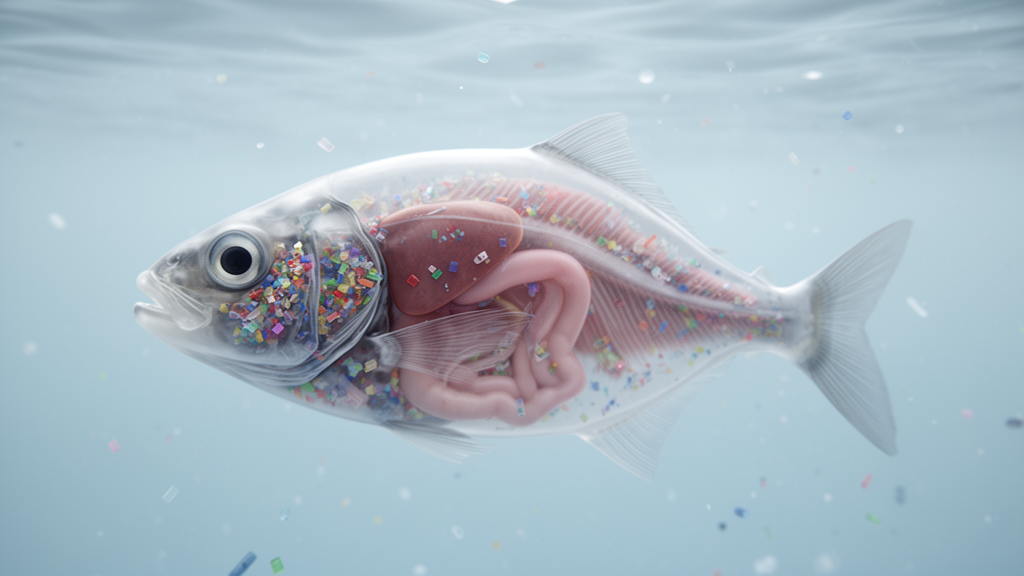
Microplastics were detected in every one of 15 fish examined in a pilot observational study of five fish species caught near Sozopol on the Bulgarian coast of the Black Sea in February 2022. The sample comprised three similarly sized specimens each of garfish, mullet, knout goby, Pontic shad and Mediterranean horse mackerel, with researchers reporting between 10 and 40 microplastic particles per individual.
The study was conducted at the Department of Biology of the University of Shumen and was described by the authors as the first pilot assessment of the composition of microplastic particles in different anatomical structures of key fish species from the Bulgarian Black Sea area. After the fish were transported to the laboratory at 4 °C, they were dissected and samples were collected from the skin, muscle, gills, intestinal tract and caviar.
To reduce the risk of introducing microplastics during laboratory work, the investigators used glass and metal tools, rinsed equipment with bidistilled water, filtered the glassware and tested reagents for particles through a blank-sample procedure. Minced tissue was treated with 5 ml of 1 M sodium hydroxide at 50 °C for 15 minutes. The researchers then added 17.5 ml of 49% nitric acid and 2.5 ml of ultrapure water, heated the mixture at 50 °C for another 15 minutes and then applied further heating for 15 minutes at up to 80 °C.
Following filtration through cellulose nitrate filters with an 8 µm pore size, the filters were dried for 24 hours at 37 °C and examined by stereomicroscopy at 1,000× magnification. Particles were classified by shape as pellets, fibres or irregular fragments and by their largest cross-section into size groups of no larger than 25 µm, 25–100 µm and 100–200 µm. Fourier-transform infrared spectroscopy was used to identify polymer composition, with the analyses performed in triplicate.
Pellets were generally the most abundant morphological type, followed by fibres, although their distribution differed among species and tissues. Garfish contained small pellets in the gills, muscle and skin and small fibres in the gills, while irregular particles occurred in the skin and intestinal tract. No particles in the 100–200 µm group were reported for this species. Mullet contained predominantly small pellets, especially in the intestinal tract, gills and skin, and small fibres in the skin, muscle and intestinal tract. Pellets in the 100–200 µm group were detected in the muscle, gills and intestinal tract, while irregular particles occurred in every sampled structure except the caviar.
Knout goby also contained mostly small pellets across the skin, gills, intestinal tract and muscle. Small fibres were recovered from muscle and skin, and fibres in the 100–200 µm group appeared in the gills. No microplastics were detected in the sampled knout goby or Pontic shad caviar. Pontic shad contained small pellets in the skin and gills, small fibres in the gills and fibres in the 25–100 µm group in both skin and gills; irregular particles were isolated from muscle. Mediterranean horse mackerel contained small pellets in the intestinal tract, gills, muscle and skin. Fibres in the two smallest size groups occurred in the intestinal tract, while 25–100 µm particles also appeared in the gills and skin.
The largest species-specific count in the intestinal tract was 36 microplastic particles in mullet. This total represented the three sampled mullet gastrointestinal-tract samples combined, rather than a count from a single fish. The investigators noted that particle counts lower than those reported in some previous investigations could reflect differences in analytical methods and pollution levels. They also observed higher proportions in the pelagic garfish and Mediterranean horse mackerel, while noting that literature links potentially greater uptake in bottom-dwelling fish to feeding behaviour and sediment deposition.
Fourier-transform infrared analysis identified low-density polyethylene, polyamide, polyethylene terephthalate, polypropylene, polystyrene, expanded polystyrene and plasticised polyvinyl chloride among the isolated particles. Spectral characteristics were also reported for individual fibres, including peaks consistent with polyamide, polyethylene terephthalate and acrylates, as well as a material spectrally similar to siloxanes. The study did not quantify the contribution of every polymer across all samples, so its results establish diversity among detected polymers rather than a precise basin-wide polymer profile.
The authors proposed domestic wastewater, particularly the washing of synthetic fabrics, as a possible principal source of the particles, while emphasizing that detailed studies would be needed to establish that origin. Because the pilot included only 15 fish from one locality and month and examined tissue contamination rather than toxicological outcomes, it cannot establish food-web biomagnification, population-wide exposure, adverse effects in fish or consequences for human health. The authors called for further characterisation of microplastics and research into possible toxicological effects in benthic and pelagic fish communities.
Subject of Research: Pilot assessment of microplastic contamination in five Black Sea fish species
Article Title: The assessment of the bioaccumulation of microplastics in key fish species from the Bulgarian aquatory of the Black Sea
Article References: Toschkova, S., Ibryamova, S., Bachvarova, D. C., Koynova, T., Stanachkova, E., Ivanov, R., Natchev, N., & Ignatova-Ivanova, T. (2024). The assessment of the bioaccumulation of microplastics in key fish species from the Bulgarian aquatory of the Black Sea. BioRisk, 22, 17-31. https://doi.org/10.3897/biorisk.22.117668
Image Credits: AI Generated
DOI: 10.3897/biorisk.22.117668
Keywords: microplastics, Black Sea, fish contamination, Bulgaria, Sozopol, polymer analysis, marine pollution, bioaccumulation, assessment, fish, species, Bulgarian
Cite Scienmag News
Reese Ellison. (October 20, 2026). Pilot study finds microplastics in all 15 fish sampled near Sozopol on Bulgaria’s Black Sea coast. Scienmag. https://scienmag.com/pilot-study-finds-microplastics-in-all-15-fish-sampled-near-sozopol-on-bulgarias-black-sea-coast/
Reese Ellison. "Pilot study finds microplastics in all 15 fish sampled near Sozopol on Bulgaria’s Black Sea coast." Scienmag, 20 October 2026, https://scienmag.com/pilot-study-finds-microplastics-in-all-15-fish-sampled-near-sozopol-on-bulgarias-black-sea-coast/. Accessed 20 October 2026.
Reese Ellison. "Pilot study finds microplastics in all 15 fish sampled near Sozopol on Bulgaria’s Black Sea coast." Scienmag. October 20, 2026. https://scienmag.com/pilot-study-finds-microplastics-in-all-15-fish-sampled-near-sozopol-on-bulgarias-black-sea-coast/


