


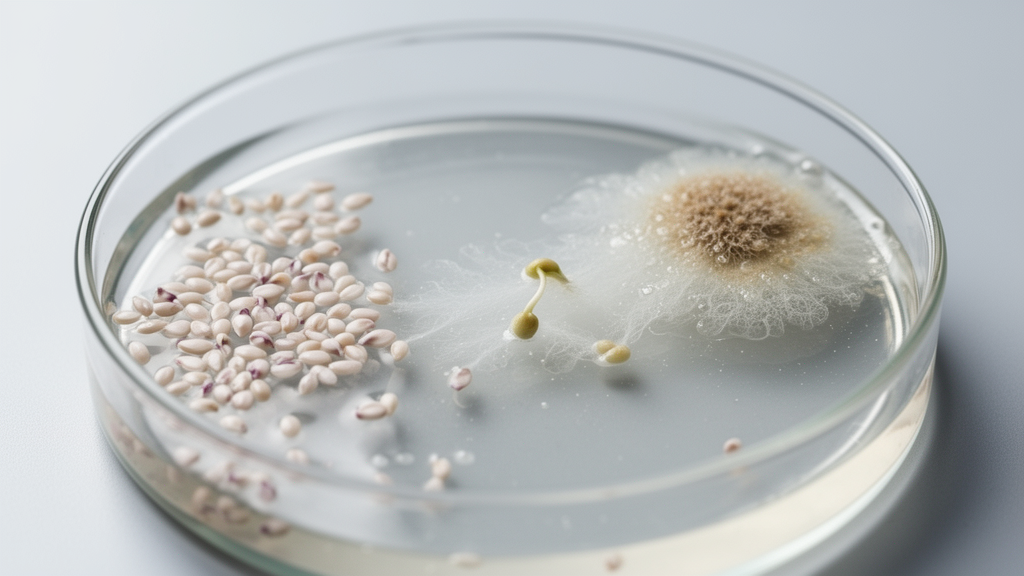
Exudates from the germination-promoting fungus Ceratobasidium sp. GS2 produced measurable transcriptional and physiological responses in seeds of the terrestrial orchid Gymnadenia conopsea without physical contact between the fungus and the seeds. The laboratory study indicates that the exudates alter gene expression, hormone levels and fatty acid content during the pre-symbiotic stage, although it did not establish the complete mechanism or identify the signals responsible.
Orchid seeds generally rely on mycorrhizal fungi for successful germination and development, but communication between fungal exudates and orchid seeds before contact is poorly understood. The researchers used G. conopsea and GS2, a strain originally isolated from the orchid’s roots, to investigate whether fungal products alone could initiate host responses. The fungus was grown in liquid culture, and its filtered exudates were freeze-dried, concentrated 60-fold, sterilized and applied to surface-disinfected seeds for 18 days. Sterile water served as the control.
The study combined RNA sequencing with four biological replicates, untargeted metabolomics of the exudates, hormone measurements with five replicates, fatty acid profiling with five replicates and transmission electron microscopy. RNA sequencing identified 5,172 significantly upregulated and 18,051 significantly downregulated genes in treated seeds relative to controls. Upregulated genes were enriched in starch and sucrose metabolism, fatty acid biosynthesis and elongation, plant hormone signal transduction, brassinosteroid biosynthesis and zeatin biosynthesis. Among the induced genes were fatty acid-associated genes including PKp, KASII, KAR, FatB and RAM2, several brassinosteroid-biosynthesis genes, and the cytokinin-related genes IPT and CYP735A.
Targeted hormone analysis found that brassinolide content in treated seeds reached 14 times the control level. Several bioactive cytokinins also increased, including trans-zeatin-riboside, cis-zeatin-riboside, cis-zeatin and N6-(Δ2-isopentenyl)adenosine, with cis-zeatin-riboside measured at 4.7 times the control value. Three bioactive gibberellins—GA3, GA4 and GA7—were detected, with GA7 accounting for more than 99.9% of total gibberellins and increasing significantly after treatment. Gibberellin regulatory genes were induced and abscisic-acid signaling was repressed, patterns the authors associated with possible release of seed dormancy. These measurements show associations with exudate exposure; they do not prove that every altered pathway was required for fungal colonization.
Separate experiments using GS2 during symbiotic germination provided functional evidence for a role for brassinosteroids and cytokinins. Exogenous 24-epibrassinolide at 5 µmol L-1 increased seed germination by 3.0 percentage points, whereas the brassinosteroid-biosynthesis inhibitor brassinazole reduced it by 4.7 points and significantly reduced the number of colonized cells in protocorms. Exogenous 6-benzylaminopurine at 10 µmol L-1 increased germination by 5.7 points, while zeatin at 1 and 5 µmol L-1 increased it by 4.6 and 6.7 points, respectively. Lovastatin did not significantly alter germination rate but reduced protocorm dimensions in a concentration-dependent manner; at 50 µmol L-1, protocorm length and width fell by 29.5% and 28.8%, respectively.
Exudate exposure was also associated with increased lipid accumulation. Transmission electron microscopy showed a greater area ratio of lipid droplets in treated seeds, and quantitative gas chromatography-mass spectrometry confirmed higher fatty acid content than in controls. The induction of RAM2 and FatB occurred alongside this increase. During symbiotic germination, fatty acid accumulation was observed before GS2 colonization, which began at 12 days post-symbiosis, while key components of the common symbiosis signaling pathway—CASTOR, POLLUX/DMI1, CCaMK/DMI3 and CYCLOPS/IPD3—were induced by day 3 and remained highly expressed after colonization. The authors therefore proposed that the pathway may mediate some exudate-induced changes, describing this as a potential mechanism rather than a demonstrated complete signaling chain.
Evolutionary comparisons showed that the orchid retained RAM2 and other components of the common symbiosis signaling pathway, whereas the fully mycoheterotrophic orchids Neottia fugongensis and Gastrodia elata lacked those genes in the analysis. The gene FatM and the arbuscular-mycorrhiza-specific genes RAM1, STR and STR2 were not detected in orchid-mycorrhizal hosts. GcRAM2 expression was approximately 25 times higher in fungus-colonized adult orchid roots than in non-colonized roots, and in situ hybridization localized its expression to GS2-colonized protocorm cells. In a cross-species functional test, expression of GcRAM2 restored substantial colonization by Rhizophagus irregularis in roots of the Medicago truncatula ram2 mutant, supporting conservation of its fatty acid-related function.
Exudates from GS2, five additional Ceratobasidium strains and a Tulasnella strain induced root-hair branching in M. truncatula. This assay is consistent with the presence of bioactive mycorrhizal factors, potentially lipo-chitooligosaccharides, but the researchers did not identify or structurally characterize those compounds. Untargeted profiling found that GS2 exudates contained 979 lipid or lipid-like metabolites, 673 organoheterocyclic compounds and 591 organic acids and derivatives, with fatty acyls the largest lipid category at 39.63%.
The findings remain limited to one orchid species, selected fungal strains and controlled laboratory seed treatments. Treated seeds entered a pre-germination stage but did not fully germinate, possibly because starch, free sugars or a continuous supply of fungal metabolites was insufficient. The specific fungal molecules that trigger the observed responses, their receptors and their interaction with hormone signaling remain unresolved. The study therefore provides evidence that fungal exudates can alter orchid seed transcription, hormone levels and fatty acid content before physical fungal contact, while presenting hypotheses rather than demonstrated mechanisms for later symbiotic germination and conservation applications.
Subject of Research: Pre-symbiotic responses of Gymnadenia conopsea seeds to Ceratobasidium sp. GS2 exudates
Article Title: Ceratobasidium sp. GS2 exudates elicit downstream transcriptional and physiological responses in seeds of Gymnadenia conopsea ( Orchidaceae )
Article References: Wang, Y., Qian, X., Li, J., Wang, H., Yang, A., Yang, L., Liu, J., & Xing, X. (2026). Ceratobasidium sp. GS2 exudates elicit downstream transcriptional and physiological responses in seeds of Gymnadenia conopsea (Orchidaceae). IMA Fungus, 17, Article e191381. https://doi.org/10.3897/imafungus.17.191381
Image Credits: AI Generated
DOI: 10.3897/imafungus.17.191381
Keywords: Gymnadenia conopsea, Ceratobasidium, orchid seed germination, fungal exudates, mycorrhizal symbiosis, gene expression, phytohormones, fatty acid biosynthesis, common symbiosis signaling pathway, plant–fungus communication, exudates, elicit
Cite Scienmag News
Juliet Wilcox. (October 20, 2026). Fungal exudates alter gene expression, hormones and fatty acids in Gymnadenia conopsea orchid seeds. Scienmag. https://scienmag.com/fungal-exudates-alter-gene-expression-hormones-and-fatty-acids-in-gymnadenia-conopsea-orchid-seeds/
Juliet Wilcox. "Fungal exudates alter gene expression, hormones and fatty acids in Gymnadenia conopsea orchid seeds." Scienmag, 20 October 2026, https://scienmag.com/fungal-exudates-alter-gene-expression-hormones-and-fatty-acids-in-gymnadenia-conopsea-orchid-seeds/. Accessed 20 October 2026.
Juliet Wilcox. "Fungal exudates alter gene expression, hormones and fatty acids in Gymnadenia conopsea orchid seeds." Scienmag. October 20, 2026. https://scienmag.com/fungal-exudates-alter-gene-expression-hormones-and-fatty-acids-in-gymnadenia-conopsea-orchid-seeds/


