

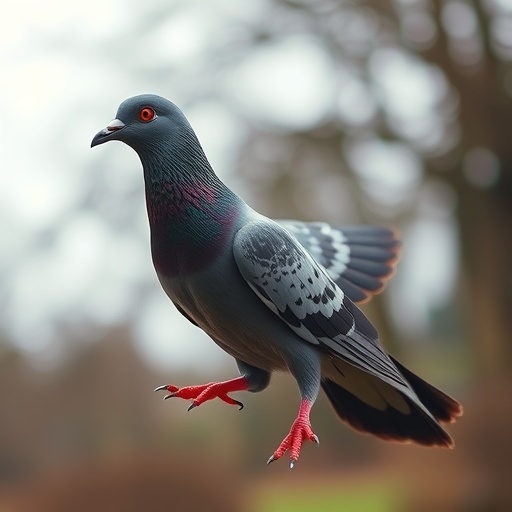
Pigeons have long been viewed as feathered automatons that lock their eyes into a rigid, unblinking stare during flight. A groundbreaking study now demolishes that notion, revealing that homing pigeons perform slow, drifting eye movements while cruising through the air and swing both eyes dramatically inward just before landing. These previously invisible motions suggest the birds are not passive observers but active vision sampling systems, strategically manipulating their gaze to extract navigational detail and judge depth with millisecond precision.
For decades, biologists assumed that birds with laterally placed eyes—like pigeons, which enjoy a nearly panoramic field of view—would freeze their eyes mid-flight to preserve a clean optic flow signal. Optic flow, the pattern of apparent motion of surfaces across the retina, is critical for sensing speed, direction, and the nearness of obstacles. Any eye movement would smear that signal, so it seemed logical that evolution would suppress it. The new work, led by Anthony Lapsansky and Doug Altshuler at the University of British Columbia and published in Current Biology, upends that tidy logic.
To spy on the eyes without disturbing natural flight, Lapsansky drew on his background as a falconer. He sewed custom leather hoods, reminiscent of those used to calm raptors, to anchor a miniature camera on the pigeon’s head. A tiny backpack, weighing just 27 grams in total, carried a single-board computer half the size of a credit card, a modified commercial camera stripped down to its imaging essentials, an inertial measurement unit, and carefully taped cables to suppress electrical noise. Two pigeons at a time were outfitted within a flock of about sixteen; the remainder wore dummy packs to control for any social or aerodynamic side effects.
On a familiar training route, the team released the birds and then Lapsansky raced them home in his truck to collect the footage. For the first time, researchers could see what a pigeon’s retina actually registers as it flies, turns, and descends toward a perch. The video unspooled into a cascade of surprises.
During level, forward flight, the birds produced slow, divergent drifts of both eyes—movements so subtle they would be invisible to the naked eye. Rather than locking their gaze, the pigeons were actively counter-rotating their eyes against the incoming optic flow. When a bird moves through a corridor of trees or beside a building, the visual scene streams across the retina; nearby objects appear to race by faster than distant ones. By moving the eyes with a component opposite to this motion, the pigeons stabilized selected parts of the scene. This stabilisation likely allows the brain to extract finer spatial details or pinpoint familiar landmarks, transforming the head into a biologically tuned gimbal that enhances navigation.
Even more startling was what happened at touchdown. As a pigeon swooped in to land on a perch, both eyes swung inward in a large, perfectly coordinated convergence. This eye alignment is the telltale signature of stereopsis—the ability to perceive depth by comparing the slightly different views from each eye. Until now, stereopsis had been firmly documented only in certain birds of prey, such as owls and hawks, that require acute depth perception to snatch moving targets. Finding robust binocular convergence in a common pigeon indicates that stereoscopic landing may be a widespread avian trick for gauging the precise distance to a branch or ledge in an instant.
The discovery of two distinct eye-movement regimes—slow divergence in transit and fast convergence for landing—rewrites the textbook on avian visual physiology. It highlights that vision is an active sampling process, even in species long assumed to be hardwired for retinal stability. Pigeons do not simply let the world wash over their eyes; they select which parts of the optic array to stabilise, sharpen, or fuse into a three-dimensional percept moment by moment.
These insights are already sending ripples through the world of autonomous drones. Most flying robots bolt a camera rigidly to the airframe and rely on raw optic flow to compute self-motion and avoid collisions. The pigeon study demonstrates that moving the camera itself—through subtle counter-rotations and convergence maneuvers—can yield a far richer description of the environment. Engineering soft, animal-like eye movements into drone control systems could enable more accurate depth perception during landing on cluttered surfaces, better target tracking while weaving through forests, and greater resilience to gusty winds, inching robotic flight closer to genuine autonomy.
The findings also resonate with human vision research. Humans, like pigeons, are intensely visual and constantly shift their eyes as they walk, reach, or drive. By cracking the computational logic behind a bird’s eye movements, the team has exposed fundamental strategies for extracting visual information during locomotion that evolution appears to have conserved across distant branches of the vertebrate tree. In the intricate dance between eye and body, pigeons are revealing steps we are only beginning to learn.
Subject of Research: Eye movements of homing pigeons during flight and landing
Article Title: Pigeons make slow divergent eye movements during flight, and large convergent eye movements when landing
News Publication Date: 6 July 2026
Web References:
https://www.cell.com/current-biology/fulltext/S0960-9822(26)00726-8
http://dx.doi.org/10.1016/j.cub.2026.06.015
References: Current Biology, DOI: 10.1016/j.cub.2026.06.015
Image Credits: Anthony Lapsansky
Keywords
Eye movement, Saccades, Animal physiology, Birds, Optics, Optical properties, Vision, Perception, Pigeon flight, Stereopsis, Depth perception, Autonomous drones


