


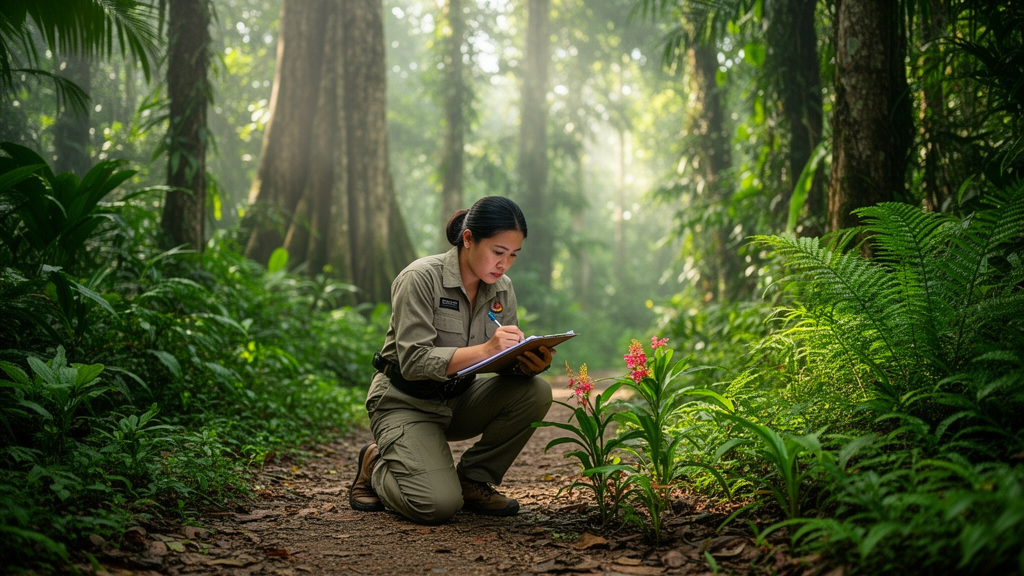
Samar Island Natural Park, the largest terrestrial protected area in the Philippines, has undergone a comprehensive botanical assessment that reveals a flora of exceptional complexity and conservation significance. Published in the Biodiversity Data Journal, the study provides the first definitive floristic baseline for the park, documenting 874 morphospecies of vascular plants across 124 families and 444 genera. This extensive inventory serves as critical empirical evidence supporting the park’s nomination as a UNESCO World Heritage Site, highlighting its outstanding universal value through its unique biological assemblage. The research addresses long-standing taxonomic and distributional gaps that have hindered effective conservation management in one of the country’s most biodiverse regions.
The investigation combined rigorous field surveys with the synthesis of secondary data, including published literature and records from the Global Biodiversity Information Facility. Fieldwork was conducted across eleven strategically selected sites spanning the provinces of Northern Samar, Eastern Samar, and Samar. These locations encompassed a broad spectrum of habitats, from old-growth primary forests and lowland evergreen forests to significant karst formations and forests over limestone. By targeting biologically unexplored karst niches, the researchers were able to document specialized flora that had previously been overlooked or unknown to science, thereby enhancing the representativeness of the checklist for the park’s complex landscape.
The taxonomic composition of the flora is dominated by species-rich families, reflecting both regional floristic patterns and the park’s biogeographical positioning within the Sunda-Sahul Convergence Zone. Rubiaceae emerged as the most species-rich family with 95 species, followed by Orchidaceae with 57, Moraceae with 28, and Polypodiaceae and Euphorbiaceae with 27 each. This dominance aligns with national trends in Philippine flora and underscores the high diversity characteristic of the region. The presence of these major families indicates a robust ecological structure capable of supporting a wide array of plant lineages, many of which are adapted to the specific environmental gradients found in the park’s heterogeneous terrain.
A striking feature of the flora is its high level of endemism, which underscores the park’s role as a critical refuge for unique plant lineages. Of the 874 species documented, 339 are Philippine endemics, meaning they are found nowhere else in the country. Furthermore, 37 species are restricted exclusively to Samar Island, highlighting the island’s status as a center of endemism. The study also recorded 82 new locality records for both the park and the island as a whole, providing valuable range extensions and biogeographical insights. These new records demonstrate that large portions of the park, particularly its interior and remote areas, remain incompletely explored, suggesting that the true botanical diversity may be even higher than currently estimated.
The conservation status of the documented species reveals a concerning pattern of vulnerability and insufficient assessment. Under the IUCN Red List and provisional assessments, 108 species, or 12.78 percent, are classified as threatened, ranging from Vulnerable to Critically Endangered. An additional 277 species are categorized as Near Threatened, Least Concern, or Data Deficient. Most alarmingly, 460 species, representing 54.44 percent of the total, remain Not Evaluated. Under the national listing by the Department of Environment and Natural Resources, 80 species are threatened, while 734 are Not Evaluated. This lack of formal conservation assessment for the majority of the flora means that many unique and vulnerable species may be excluded from policy-making and management priorities, leaving them unprotected against ongoing threats.
The park faces significant anthropogenic pressures, including logging, land conversion, and pollution, which contribute to biodiversity declines and the potential extinction of narrow-endemic species. Samar Island has experienced some of the highest rates of forest loss in the country over recent decades, further constricting the already limited habitats of endemic species. The karst landscapes within the park, while ecologically specialized and rich in endemics, are particularly susceptible to local extinction due to their narrow geographic ranges and high environmental sensitivity. The combination of high endemism and accelerating habitat loss creates an urgent need for sustained conservation efforts and rigorous monitoring of the park’s biological resources.
Access to the park’s central and remote areas has been constrained by various factors, including security risks associated with armed conflict and insurgent activity in the region. These challenges limit the ability of researchers to conduct comprehensive surveys in the most botanically promising areas, perpetuating the Wallacean shortfall, which refers to the lack of knowledge about species distributions. Additionally, the Linnaean shortfall, or the number of undescribed species, remains significant, with several collections from the study potentially representing new taxa. Addressing these knowledge gaps is essential for formulating effective conservation strategies and ensuring the long-term survival of the park’s unique flora.
The study builds upon a century of botanical research in the Philippines, tracing its roots back to Merrill’s Enumeration of the Philippine Flowering Plants in 1926. While significant progress has been made in taxonomic understanding, the findings confirm that the Philippines remains a plant diversity darkspot of global collection priority. The integration of recent field collections with historical records provides a robust framework for future floristic monitoring and ecological studies. This baseline is crucial for identifying centers of endemism, assessing species rarity, and refining conservation priorities in a region where deforestation and climate change are accelerating habitat loss.
Ultimately, the floristic evidence presented in this study provides a strong scientific foundation for the Samar Island Natural Park’s nomination as a UNESCO World Heritage Site. The park functions as an ark for the country’s unique botanical heritage, harboring exceptional levels of endemism and ecological uniqueness. The comprehensive checklist not only updates the understanding of the park’s flora but also highlights the urgent need for continued botanical exploration and conservation action. By establishing a clear baseline, the study enables more informed management decisions and supports the international recognition of areas with outstanding biological importance, ensuring that the park’s invaluable contribution to global natural heritage is preserved for future generations.
Subject of Research: Floristic inventory and conservation assessment of Samar Island Natural Park
Article Title: An enumeration of Philippine vascular plants in Samar Island Natural Park: floristic evidence for outstanding universal value
Article References: Odulio, E. J., Ordas, J. A., Chen, Y. T., Alfeche, N. K., Operio, M. D., Zamudio, S. G., Romeroso, R., Venturina, P. J., Docot, R. V., Lola, A. M., Olivar, J. E., delos Angeles, M., Arbias, A. F., Tandang, D., Alejandro, G. J., & Moran, C. (2026). An enumeration of Philippine vascular plants in Samar Island Natural Park: floristic evidence for outstanding universal value. Biodiversity Data Journal, 14, Article e182643. https://doi.org/10.3897/bdj.14.e182643
Image Credits: AI Generated
Keywords: Samar Island Natural Park, Philippine flora, Vascular plants, Endemism, UNESCO World Heritage, Biodiversity, Karst landscape, Conservation status, Floristic baseline, Sunda-Sahul Convergence Zone, enumeration, Philippine
Cite Scienmag News
Margaret Porter. (October 18, 2026). Philippine Park Plant Survey Reveals High Endemism. Scienmag. https://scienmag.com/philippine-park-plant-survey-reveals-high-endemism/
Margaret Porter. "Philippine Park Plant Survey Reveals High Endemism." Scienmag, 18 October 2026, https://scienmag.com/philippine-park-plant-survey-reveals-high-endemism/. Accessed 18 October 2026.
Margaret Porter. "Philippine Park Plant Survey Reveals High Endemism." Scienmag. October 18, 2026. https://scienmag.com/philippine-park-plant-survey-reveals-high-endemism/


