


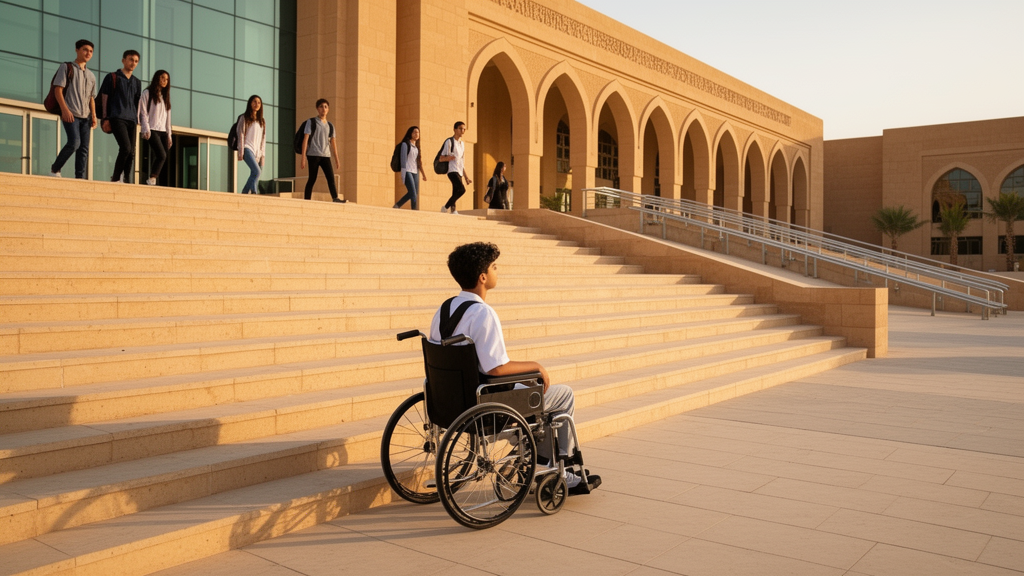
Students with disabilities enrolled at two public universities in the Middle East report only moderate access to the accommodations and support services they are formally entitled to, and the quality of that access appears to shape how well they fare in daily life, according to a new cross-sectional study published in PLOS One. The research, led by Hatem A. Alkhamra with Sana M. N. Abu Dahab and Rana A. Alkhamra, surveyed 79 students with disabilities who were officially registered with disability or student support services at public universities in Qatar and Jordan, offering a rare quantitative window into how disability support functions in higher education systems that remain underrepresented in the international research literature.
The study’s central innovation lies in its design. Rather than examining access to services, barriers to using them, and quality of life as separate research questions, the team measured all three dimensions within the same participant sample using a single cross-sectional survey. This approach allowed the researchers to ask whether students who encounter more obstacles to obtaining accommodations also report lower well-being, and whether these patterns differ between two institutional contexts operating under different national policies, funding structures, and cultural expectations around disability. The participants completed a questionnaire assessing their perceived access to accommodations and the barriers they faced in utilizing services, alongside the World Health Organization Quality of Life instrument, known as the WHOQOL-BREF, a validated 26-item measure that generates scores across four domains: physical health, psychological health, social relationships, and environment.
The headline finding is that students rated their overall access to disability-related accommodations and support services as moderate, with a median score of 1.95 on the study’s rating scale and an interquartile range of 1.81 to 2.17. Perceived barriers to service utilization were similarly rated at a moderate level, with a median of 1.65 and an interquartile range of 1.47 to 2.00. In practical terms, this means that even students who had successfully navigated the formal registration process and were known to their institutions’ support offices still did not experience full, unimpeded access to the accommodations designed for them, and they continued to encounter meaningful obstacles when trying to use those services. The moderate scores on both sides of the equation suggest a system that functions, but not seamlessly, for the students it is meant to serve.
Beneath the aggregate numbers, the statistical analysis revealed striking differences between the two university contexts. The researchers used nonparametric tests, specifically Mann-Whitney U tests, which are appropriate for comparing two independent groups when data are ordinal or not normally distributed, and they calculated the effect size r to express how large each difference was. Four comparisons stood out with large effect sizes. Access to quiet examination rooms differed dramatically between the two settings, with U = 249.00, p < .001, and r = .65, meaning that the location of a student’s university was a powerful predictor of whether they could take tests in a reduced-distraction environment, a common accommodation for students with attention-related, sensory, or anxiety-related disabilities.
Quality of life also diverged sharply between contexts. Physical health quality of life showed a large between-group difference, with U = 245.00, p < .001, and r = .59, and environmental quality of life showed a similarly large gap, with U = 251.00, p < .001, and r = .58. The environmental domain of the WHOQOL-BREF captures perceptions of physical safety, home environment, financial resources, availability of health and social care, opportunities for acquiring new information and skills, participation in recreation and leisure, and the quality of the physical surroundings such as pollution, noise, traffic, and climate. A large difference in this domain between two universities in different countries points to the cumulative weight of surroundings, infrastructure, and resources on how students with disabilities experience their daily lives, independent of the formal support services on offer.
Financial barriers emerged as another major axis of divergence. The difference in perceived financial obstacles to accessing services was statistically significant with a large effect size, U = 326.00, p < .001, and r = .55. This finding is particularly consequential because cost is one of the most modifiable barriers in disability support provision. When the price of assessments, assistive technology, transportation, or personal assistance determines whether a student can obtain an accommodation, the support system effectively converts a civil entitlement into a means-tested privilege. The large effect size indicates that students at one institution perceived financial barriers as far more salient than students at the other, suggesting that national funding models and institutional budgeting for disability services differ in ways that students directly feel.
The effect sizes reported in the study deserve emphasis because they communicate something that p-values alone cannot. In behavioral research, an r of .50 or above is conventionally regarded as a large effect, and the four standout comparisons in this study all fall in that territory, ranging from .55 to .65. This means the differences between the two contexts were not marginal statistical artifacts detectable only in large samples; they were substantial, student-perceivable gaps in examination conditions, physical well-being, environmental quality, and financial accessibility. For university administrators and policymakers, the implication is that the institutional context in which a student with disabilities is enrolled materially changes their support experience and their reported quality of life, even when both institutions operate formal disability registration systems within the same broad region.
The study also carries methodological significance for the field of disability research in higher education. Most existing evidence on disability support comes from North America, Europe, and Australia, where legal frameworks such as the Americans with Disabilities Act or national equality legislation shape institutional obligations. Evidence from Middle Eastern higher education contexts has been sparse, and studies that combine service access, utilization barriers, and quality of life in a single design are rarer still. By foregrounding students’ own perspectives rather than relying on administrative records or staff reports, the researchers captured the lived dimension of support provision, including accommodations that exist on paper but are difficult to obtain in practice, and barriers that never appear in official statistics because students simply stop requesting services after repeated obstacles.
The WHOQOL-BREF results add a well-being dimension that disability support research often omits. Because the instrument spans physical health, psychological health, social relationships, and environment, it treats students with disabilities as whole people whose academic accommodations interact with their health, finances, social connections, and physical surroundings. The finding that physical health and environmental quality of life differed significantly between contexts, while the study reports moderate overall access and barriers, suggests that the relationship between support services and well-being is not one-to-one. A student may receive adequate academic accommodations yet still face environmental and financial conditions that depress their overall quality of life, which is precisely the kind of interaction the single-sample design was built to detect.
The authors position the work as a baseline contribution intended to inform inclusive policy and service development in higher education. The evidence indicates that students’ experiences of disability support vary across institutional contexts in ways that are reflected in both service access and quality-of-life outcomes, and that specific, concrete provisions such as quiet examination rooms can show some of the largest between-context disparities. For universities in the region and beyond, the study offers a template: measure access, barriers, and well-being together, listen to registered students directly, and treat the gaps revealed by large effect sizes, in examination accommodations, physical health, environmental quality, and financial accessibility, as priority targets for intervention. As universities worldwide expand their disability-registered populations, the study’s student-centered evidence from Qatar and Jordan provides a grounded reminder that the measure of inclusive higher education is not the existence of a support office, but the everyday experience of the students it serves.
Subject of Research: Disability support services, access barriers, and quality of life among students at public universities in Qatar and Jordan
Article Title: Access, barriers, and quality of life: Student perspectives on disability support in higher education
Article References: Alkhamra, H. A., Abu Dahab, S. M. N., & Alkhamra, R. A. (2026). Access, barriers, and quality of life: Student perspectives on disability support in higher education. PLOS One, 21(10), e0360516. https://doi.org/10.1371/journal.pone.0360516
Image Credits: AI Generated
DOI: 10.1371/journal.pone.0360516
Keywords: disability support, higher education, quality of life, WHOQOL-BREF, accessibility, Qatar, Jordan, accommodations, students with disabilities, PLOS One, cross-sectional study, inclusive education
Cite Scienmag News
Courtney Benton. (October 18, 2026). Students With Disabilities Face Uneven Support and Barriers Across Middle Eastern Universities. Scienmag. https://scienmag.com/students-with-disabilities-face-uneven-support-and-barriers-across-middle-eastern-universities/
Courtney Benton. "Students With Disabilities Face Uneven Support and Barriers Across Middle Eastern Universities." Scienmag, 18 October 2026, https://scienmag.com/students-with-disabilities-face-uneven-support-and-barriers-across-middle-eastern-universities/. Accessed 18 October 2026.
Courtney Benton. "Students With Disabilities Face Uneven Support and Barriers Across Middle Eastern Universities." Scienmag. October 18, 2026. https://scienmag.com/students-with-disabilities-face-uneven-support-and-barriers-across-middle-eastern-universities/


