


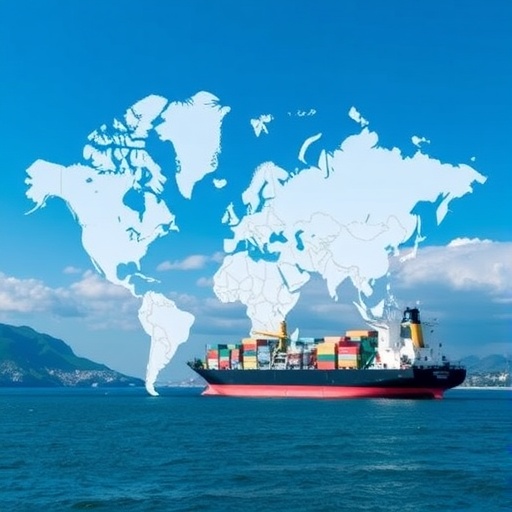
Shipping’s decarbonization problem is entering a more complicated phase. The industry is under pressure to move away from fossil fuels, yet the vessels that carry goods between Asia and Europe cannot simply be replaced overnight, and the ports that serve them cannot instantly provide a completely new energy system. A study by Li, Gu, Qin and colleagues, published in Nature Sustainability, examines how a carefully sequenced transition between marine fuels could help decarbonize the Asia–Europe Green Shipping Corridor. Rather than treating the switch to clean shipping as a single technological leap, the research focuses on a phased strategy designed to connect what is available today with what may become scalable tomorrow.
The Asia–Europe route is one of the world’s most important maritime arteries, linking manufacturing centers, energy markets and consumer economies across thousands of nautical miles. Its scale makes it a powerful opportunity for emissions reduction, but also a difficult test for any proposed solution. Ocean-going ships need fuels with high energy density, reliable storage characteristics and global bunkering networks. Unlike cars, they cannot routinely stop for short refueling sessions, and unlike aircraft, they operate in a sector where vessels may remain in service for decades. These constraints mean that climate policy for shipping must address not only the carbon released from engines, but also the production, transportation and distribution of alternative fuels.
The study’s central idea is that the cleanest long-term fuel may not be the most practical first step. Shipping companies, ports and regulators face a moving target: conventional fuels are widely available but carbon intensive, transitional options may reduce emissions while relying on existing infrastructure, and emerging fuels could offer deeper cuts but require expensive new engines, storage systems and supply chains. A phased transition attempts to manage this sequence. In technical terms, it can be understood as a pathway that coordinates fuel choice, vessel replacement, port investment and policy support over time, rather than optimizing any one component in isolation.
This distinction matters because the climate performance of a fuel depends on its entire life cycle. A ship burning a fuel with no direct carbon dioxide emissions at the exhaust can still contribute substantially to global warming if the energy used to produce it comes from fossil sources or if methane and other greenhouse gases escape during production. Researchers therefore increasingly assess marine fuels through “well-to-wake” accounting, which combines upstream emissions from extraction, cultivation, processing and transport with emissions generated during onboard use. The approach also highlights differences among fuels that may look similar at the engine but perform very differently across the wider energy system.
A phased corridor could begin by reducing dependence on conventional heavy fuel oil and marine diesel through options that are compatible with some existing vessels or can be introduced with comparatively limited changes. Such fuels may serve as bridges, but their climate value depends on how they are produced and how long ships remain dependent on them. Later stages could expand the use of low-carbon and zero-carbon fuels, potentially including hydrogen-derived fuels, advanced biofuels or other alternatives suited to long-distance marine transport. Each option brings engineering challenges. Hydrogen has low volumetric energy density and may require cryogenic storage or chemical conversion; ammonia avoids onboard carbon emissions but is toxic and can produce nitrogen oxides; methanol is easier to handle but may not deliver deep climate benefits unless produced from low-carbon sources.
The corridor concept also shifts attention from individual ships to the infrastructure surrounding them. A vessel cannot adopt a new fuel at scale unless ports along its route can supply that fuel safely, consistently and at predictable prices. Asia–Europe shipping involves multiple jurisdictions, making standards for fuel quality, bunkering procedures, storage tanks, emergency response and emissions accounting essential. Coordinated investment could reduce the risk that shipping companies order alternative-fuel vessels before supplies exist, while energy providers may hesitate to build new facilities before demand is guaranteed. The research highlights why corridor-based planning can help solve this “chicken-and-egg” problem by concentrating efforts along a defined route rather than attempting to transform every port simultaneously.
The timing of the transition is equally important. Replacing ships too rapidly could create stranded assets, raise transport costs and place pressure on global supply chains. Moving too slowly could lock in fossil-fuel infrastructure and consume part of the remaining carbon budget. A carefully designed sequence can align vessel lifetimes with the gradual expansion of cleaner fuels. Existing ships might improve efficiency through operational measures, route optimization, wind-assistance technologies or energy-saving hardware, while new vessels are designed around fuels expected to become more available in the following decades. This approach treats efficiency as a complement to fuel switching, not a substitute for it: using less energy lowers costs and emissions, but it cannot by itself eliminate the carbon intensity of maritime transport.
The study arrives as governments and companies are searching for credible pathways from climate pledges to physical deployment. International shipping is difficult to decarbonize because emissions are distributed across global supply chains, while responsibility is divided among shipowners, charterers, cargo companies, ports, fuel producers and regulators. A corridor-based transition can create a shared planning framework, but it will require transparent monitoring and rules that prevent emissions reductions in one part of the system from being offset elsewhere. Independent verification of fuel origin, lifecycle emissions and onboard performance will be crucial, particularly as markets begin to distinguish between fuels that are merely labeled “alternative” and those that deliver genuine climate benefits.
The broader message is that green shipping will not be won by choosing a single miracle fuel. It will depend on matching fuels to vessel types, voyage distances, port capabilities and the pace at which clean energy can be produced. The Asia–Europe corridor offers a high-profile proving ground for that strategy because its enormous scale could accelerate investment, while its complexity exposes the practical barriers that simpler models often overlook. By framing decarbonization as a phased transition, Li and colleagues place timing, infrastructure and lifecycle emissions at the center of the debate. The result is a roadmap-oriented vision of maritime climate action: not an overnight revolution, but a coordinated transformation in which every new ship, fuel terminal and policy decision moves the global fleet closer to genuinely low-carbon trade.
Cite Scienmag News
Sloane Callahan. (August 25, 2026). Phased Fuel Transitions Could Decarbonize the Asia–Europe Green Shipping Corridor. Scienmag. https://scienmag.com/phased-fuel-transitions-could-decarbonize-the-asia-europe-green-shipping-corridor/
Sloane Callahan. "Phased Fuel Transitions Could Decarbonize the Asia–Europe Green Shipping Corridor." Scienmag, 25 August 2026, https://scienmag.com/phased-fuel-transitions-could-decarbonize-the-asia-europe-green-shipping-corridor/. Accessed 4 September 2026.
Sloane Callahan. "Phased Fuel Transitions Could Decarbonize the Asia–Europe Green Shipping Corridor." Scienmag. August 25, 2026. https://scienmag.com/phased-fuel-transitions-could-decarbonize-the-asia-europe-green-shipping-corridor/


