


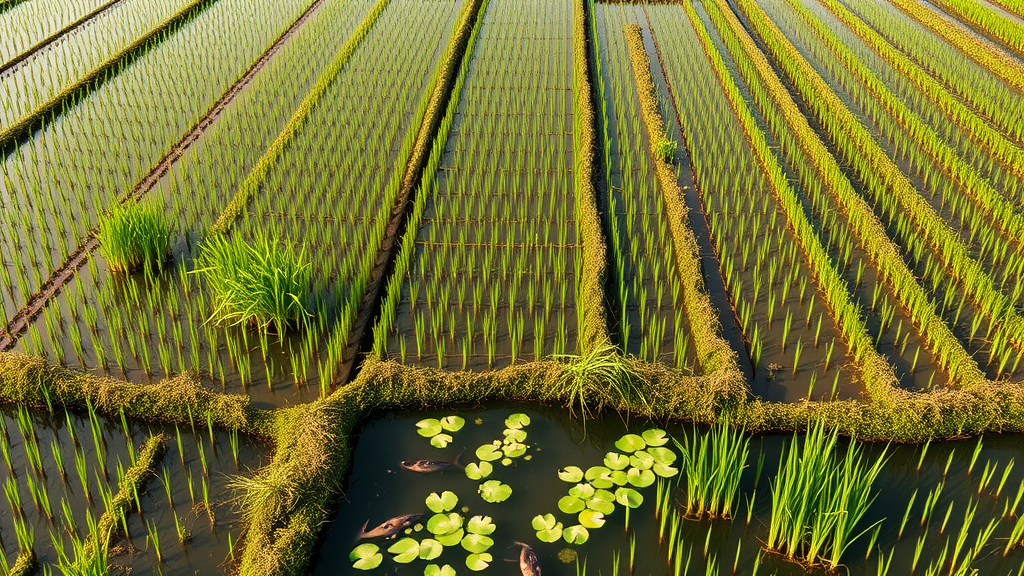
In a landscape where nearly all natural wetlands have vanished, some of the most unexpected refuges for freshwater life are turning out to be flooded rice fields. A new study conducted across the Swiss lowlands has found that pesticide-free rice paddies, a crop only recently introduced to the country, support dense and distinct communities of aquatic invertebrates that differ markedly from those found in nearby natural wetlands. The findings, published in Ecology and Evolution, offer a fresh perspective on how agriculture and biodiversity conservation might coexist in temperate regions where wetland loss has been catastrophic.
Freshwater ecosystems are in trouble worldwide, with biodiversity declining faster in rivers, ponds and marshes than in almost any other biome. In the densely populated Swiss lowlands north of the Alps, only around ten percent of the original wetlands remain, largely because drainage infrastructure built during the twentieth century transformed waterlogged soils into farmland. That same drainage network is now ageing and increasingly expensive to maintain, creating an unexpected opening. Rather than repair the drains, some farmers are letting fields flood again, and rising temperatures have made the Swiss climate newly suitable for rice. Since the first successful trials in 2017, paddy rice cultivation has expanded under a unique regulatory framework: Swiss law restricts pesticide use in open water bodies, meaning these paddies are managed entirely without agrochemicals.
To find out whether these new paddies actually deliver on their biodiversity promise, researchers from Agroscope and partner institutions spent two years surveying every rice paddy then existing in Switzerland. They compared eleven paddies with eleven nearby wetlands, measuring water chemistry, temperature, depth and surface area while exhaustively sampling macroinvertebrates, the insects, snails, crustaceans and clams that live on and in the sediment. Macroinvertebrates are widely used as indicators of aquatic ecosystem health because their community composition responds sensitively to water quality, habitat structure and management. Sampling took place in July and August of both 2022 and 2023, using a framed net with a fine 0.5 millimetre mesh swept repeatedly across representative patches until no further animals were caught.
The environmental comparison revealed clear differences between the two habitat types. Rice paddies were, on average, far larger than the natural wetlands they were paired with, covering roughly 0.87 hectares compared with 0.19 hectares. They also had significantly higher water conductivity, a marker of nutrient enrichment linked to the organic and mineral fertilisers applied before flooding, and slightly cooler water. Water depth, dissolved oxygen and pH were statistically similar between the two habitats. In practical terms, the paddies function as large, open, nutrient-rich temporary wetlands, flooded from mid-May until shortly before the September harvest with water held at around ten centimetres, and then deliberately drained.
When the researchers tallied up the invertebrates, a nuanced picture emerged that depended on the scale of analysis. At the regional level, wetlands came out slightly ahead, supporting 58 observed taxa compared with 55 in the paddies, consistent with the greater variety of conditions across the different wetland sites. But at the local level the paddies were the clear winners: individual rice fields held significantly more taxa per site than individual wetlands, and their invertebrate densities were more than twice as high, averaging around 1,212 individuals per square metre against 448 in wetlands. The trade-off was evenness. Shannon diversity, which balances richness against dominance, was higher in wetlands, indicating that paddies pack in many individuals but are dominated by a relatively small set of well-adapted taxa.
Community composition analysis using distance-based redundancy analysis confirmed that the two habitats host genuinely different assemblages rather than simply different abundances of the same species. Habitat type was the single strongest predictor of community structure, followed by water surface area and conductivity, although the measured environmental variables together explained only 14 percent of the total variation, pointing to the additional influence of vegetation structure, dispersal and biotic interactions. Indicator species analysis singled out the dragonfly Orthetrum cancellatum and the freshwater snail Physa as significantly associated with rice paddies. Both are tolerant of fluctuating water levels and nutrient-rich conditions; the snail can survive drying through aestivation and hitchhike on waterbirds, while the dragonfly tolerates muddy substrates and brief desiccation. In contrast, the backswimmers and lesser water boatmen of the superfamily Notonectoidea, the tiny bug Plea minutissima, the mayfly genus Caenis, the isopod Asellus aquaticus and the fingernail clams Sphaerium were significantly tied to natural wetlands, reflecting their need for stable water and greater structural complexity.
The study also tested a specific management feature: ditches, channel-like depressions running along the edges of some paddies that stay flooded longer than the fields themselves. Six of the eleven paddies had them. The hypothesis was that these longer-hydroperiod microhabitats would harbour additional species, effectively embedding a more permanent wetland inside the temporary one. The results were sobering. Paddies with ditches showed slightly higher regional richness, 52 taxa versus 44, but no significant differences in local richness, Shannon diversity or density between ditched and unditched fields. Within paddies, ditch samples actually held fewer taxa and lower evenness than paddy centres, though they were deeper and slightly lower in oxygen. The researchers suggest that ditches, being small relative to the fields, may still offer suitable conditions for some wetland-affiliated species such as fingernail clams and predatory water bugs, but their contribution at the scale of whole fields remains limited.
What makes the Swiss results particularly interesting is how they compare with traditional rice-growing regions. Studies from Italy, France, Portugal, Japan and South America have consistently found that rice paddies support high local invertebrate richness and density but low evenness, dominated by disturbance-tolerant temporary-water specialists, while permanent wetlands shelter species needing stable conditions. The Swiss paddies, despite their cool-temperate climate, recent introduction and pesticide-free management, fit this same ecological template. This convergence suggests that the fundamental drivers, hydroperiod length, nutrient input and habitat homogeneity, shape paddy communities in much the same way regardless of geography, and that Swiss rice cultivation reproduces the biodiversity profile of far older paddy systems without the pesticide burden that characterises conventional production elsewhere.
The authors are careful to stress what the findings do not mean. Rice paddies cannot replace natural wetlands, which maintain higher regional diversity and support taxa absent from the fields. But they can complement them, adding substantial area, high densities and high local richness to a landscape starved of aquatic habitat. Notably, the paddies resemble the temporary wetlands that have declined most steeply in Switzerland due to river channelisation and land-use change, precisely the habitat type favoured by many amphibians and dragonflies sensitive to fish predation, which cannot establish in the seasonally drained fields. As a form of land sharing, where production and conservation occur on the same land, Swiss paddy rice therefore stands out as a rare working example in temperate Europe, a continent where most biodiversity-friendly farming schemes focus on terrestrial features like flower strips while aquatic habitats are overlooked.
Limitations remain. Sampling captured only the mid-to-late growing season, the number of independent sites was inherently constrained because the study included every paddy in the country, and factors such as fertiliser dosage, vegetation structure and landscape connectivity were not quantified. Long-term monitoring will be needed to track how these young ecosystems mature. Still, the message is striking: a crop introduced to Switzerland less than a decade ago, grown without a single pesticide, is already functioning as a meaningful wetland habitat. As climate change pushes rice cultivation further north and ageing drains make re-wetting farmland economically sensible, flood-tolerant agriculture may become an unexpected ally in one of conservation’s hardest tasks, rebuilding freshwater life in landscapes that drained it away generations ago.
Subject of Research: Aquatic macroinvertebrate biodiversity in pesticide-free cool-temperate rice paddies compared with natural wetlands in Switzerland
Article Title: Pesticide‐Free Rice Paddies Promote Diverse and Distinct Aquatic Invertebrate Communities in Cool‐Temperate Agroecosystems
Article References: Bulas, T., Schmidt, B. R., Vorburger, C., D'Haese, R., & Fabian, Y. (2026). Pesticide‐Free Rice Paddies Promote Diverse and Distinct Aquatic Invertebrate Communities in Cool‐Temperate Agroecosystems. Ecology and Evolution, 16(9), Article e74287. https://doi.org/10.1002/ece3.74287
Image Credits: AI Generated
DOI: 10.1002/ece3.74287
Keywords: rice paddies, aquatic invertebrates, wetland restoration, biodiversity conservation, Switzerland, macroinvertebrates, land sharing, temporary wetlands, pesticide-free agriculture, dragonflies, community ecology, agroecosystems
Cite Scienmag News
Alan Morgan. (September 20, 2026). Pesticide-Free Rice Paddies Become Surprising Sanctuaries for Aquatic Life in Switzerland. Scienmag. https://scienmag.com/pesticide-free-rice-paddies-become-surprising-sanctuaries-for-aquatic-life-in-switzerland/
Alan Morgan. "Pesticide-Free Rice Paddies Become Surprising Sanctuaries for Aquatic Life in Switzerland." Scienmag, 20 September 2026, https://scienmag.com/pesticide-free-rice-paddies-become-surprising-sanctuaries-for-aquatic-life-in-switzerland/. Accessed 5 October 2026.
Alan Morgan. "Pesticide-Free Rice Paddies Become Surprising Sanctuaries for Aquatic Life in Switzerland." Scienmag. September 20, 2026. https://scienmag.com/pesticide-free-rice-paddies-become-surprising-sanctuaries-for-aquatic-life-in-switzerland/


