


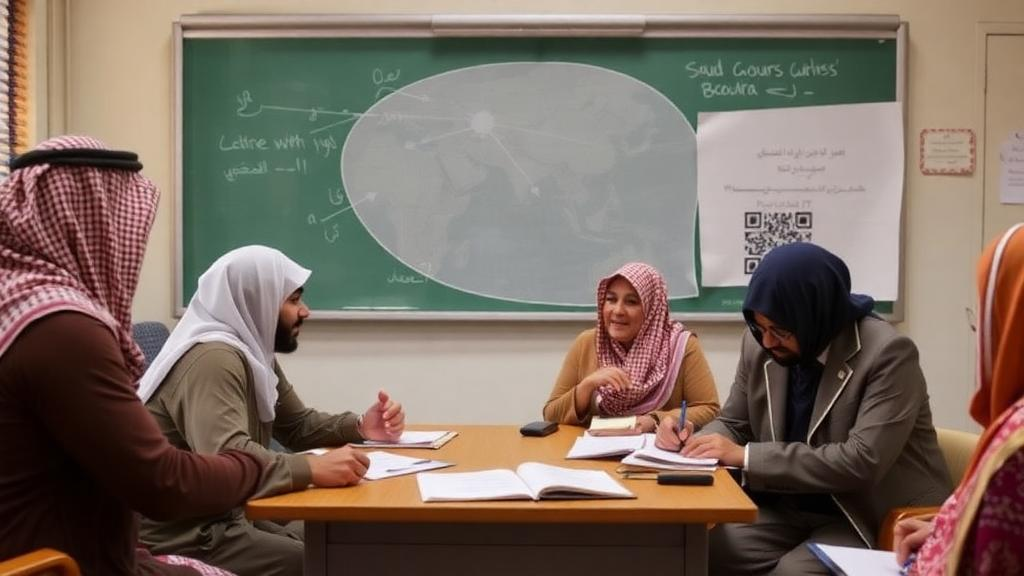
English may be a global language, but a new study from Saudi Arabia argues that it teaches best when it speaks with a local accent. Research published in SN Social Sciences by Mohammad Hamad Al-khresheh of Northern Border University, Shatha F. Alruwaili of Imam Mohammad Ibn Saud Islamic University, and Mayez Almayez of the University of Ha’il examined how Saudi teachers of English as a foreign language (EFL) weave Saudi cultural identity into their lessons. Drawing on the perspectives of 42 teachers, the study offers one of the most detailed pictures to date of how educators in the Kingdom negotiate the tension between an international language and the local knowledge their students carry into the classroom.
The researchers adopted a qualitative descriptive design, a methodology suited to capturing the texture of professional experience rather than measuring it numerically. Participants completed an open-ended questionnaire, and the responses were subjected to thematic analysis, a systematic technique for identifying recurring patterns of meaning across qualitative data. A single frequency item was analysed descriptively to gauge how often teachers reported integrating cultural content. The sample size of 42 sits comfortably within accepted guidance for thematic studies, where the analytical goal is depth of information rather than statistical generalisation.
Three major themes emerged from the analysis. The first concerned how teachers actually integrate and implement cultural identity in their teaching. The second addressed their perceptions of the impact of that integration and how cultural content in EFL teaching has evolved over time. The third focused on the professional development and institutional support teachers believe cultural integration requires. Together, the themes trace a full arc from classroom practice to perceived outcomes to the systemic conditions that make such practice sustainable.
In practical terms, the teachers described a remarkably varied repertoire. They reported incorporating local customs, national events, everyday practices, folklore, and historical narratives into English-language activities. A discussion prompt might centre on a Saudi festival rather than a Western holiday; a reading passage might be adapted to reflect familiar social routines; storytelling exercises might draw on regional folklore. The frequency and form of this integration, however, varied considerably from teacher to teacher, suggesting that culturally responsive EFL teaching in Saudi Arabia remains largely an individual craft rather than a standardised curriculum feature.
The theoretical backdrop for this work is sociocultural theory, which holds that learning is fundamentally a socially situated process mediated by the learner’s cultural tools and prior knowledge. When students encounter new vocabulary and grammar through familiar cultural frames, the theory predicts, comprehension and retention should improve because the new material anchors to existing mental structures. The study also aligns with the broader literature on culturally responsive teaching, which argues that instruction is most effective when it validates and builds upon learners’ identities rather than replacing them with foreign reference points.
The Saudi context gives this question particular weight. English has expanded rapidly in the Kingdom, driven by economic diversification goals and the educational ambitions associated with Saudi Vision 2030, yet educators have long debated how to teach it without eroding national and religious identity. Previous scholarship has analysed the cultural content of Saudi EFL textbooks and critiqued the dominance of native-speaker norms in materials. The new study adds the voices of practising teachers to that conversation, documenting how they perceive the balance between global competence and cultural continuity.
Teachers in the study perceived culturally familiar content as making English instruction more relevant to their students. They associated its use with higher engagement, greater participation, strengthened cultural pride, and heightened cultural awareness. The authors are careful to frame these as teachers’ perceptions rather than directly measured effects: the study did not experimentally test whether cultural integration improves engagement or learning outcomes. That caveat matters, but it does not diminish the finding that experienced practitioners consistently observe a connection between cultural relevance and student responsiveness in their classrooms.
The study also documents significant friction. Teachers reported constraints related to the scarcity of culturally relevant materials, limited curricular flexibility, and gaps in professional preparation. Many described improvising cultural content because textbooks offered little support, and some indicated that their initial teacher training had not equipped them with strategies for culturally situated instruction. These constraints echo findings from other EFL contexts, where teachers often act as cultural mediators without institutional recognition or resources for that role. The authors argue that appropriate materials, curricular support, and professional preparation are essential if cultural integration is to move from individual initiative to systemic practice.
The findings carry implications well beyond Saudi Arabia. Across the world, English is taught to learners whose lived realities differ sharply from the Anglophone settings that dominate many textbooks, and scholars in global Englishes have increasingly questioned the assumption that native-speaker standards should define the target culture of instruction. The Saudi study contributes empirical evidence that local cultural knowledge can function as a pedagogical resource, a bridge rather than a barrier, in the process of acquiring an international language. It suggests that the dichotomy between learning English and preserving identity may be false when teachers are given the tools to contextualise instruction.
For policymakers and teacher educators, the message is concrete. Curriculum designers could embed culturally relevant content in EFL materials rather than leaving it to improvisation; teacher preparation programmes could include explicit training in culturally responsive pedagogy; and schools could grant teachers the flexibility to adapt lessons to local contexts. The study, funded by the Deanship of Scientific Research at Northern Border University and approved by the university’s research ethics committee, involved voluntary participation with informed consent and confidentiality safeguards. Its authors conclude that local cultural knowledge is not a distraction from English learning but a foundation for it, provided the educational system supplies the materials, flexibility, and preparation that culturally situated teaching demands.
Subject of Research: Integrating Saudi cultural identity into English as a foreign language instruction
Article Title: Integrating Saudi cultural identity into EFL instruction: a qualitative study of teachers’ perspectives
Article References: Al-khresheh, M. H., Alruwaili, S. F., & Almayez, M. (2026). Integrating Saudi cultural identity into EFL instruction: a qualitative study of teachers’ perspectives. SN Social Sciences, 6(10), Article 501. https://doi.org/10.1007/s43545-026-01809-7
Image Credits: AI Generated
DOI: 10.1007/s43545-026-01809-7
Keywords: cultural identity, EFL instruction, Saudi Arabia, language teaching, teacher perspectives, qualitative research, thematic analysis, culturally responsive teaching, sociocultural theory, teacher training, curriculum, global Englishes
Cite Scienmag News
Courtney Benton. (October 5, 2026). Saudi Teachers Bring Local Culture Into the English Classroom, Study Finds. Scienmag. https://scienmag.com/saudi-teachers-bring-local-culture-into-the-english-classroom-study-finds/
Courtney Benton. "Saudi Teachers Bring Local Culture Into the English Classroom, Study Finds." Scienmag, 5 October 2026, https://scienmag.com/saudi-teachers-bring-local-culture-into-the-english-classroom-study-finds/. Accessed 5 October 2026.
Courtney Benton. "Saudi Teachers Bring Local Culture Into the English Classroom, Study Finds." Scienmag. October 5, 2026. https://scienmag.com/saudi-teachers-bring-local-culture-into-the-english-classroom-study-finds/


