


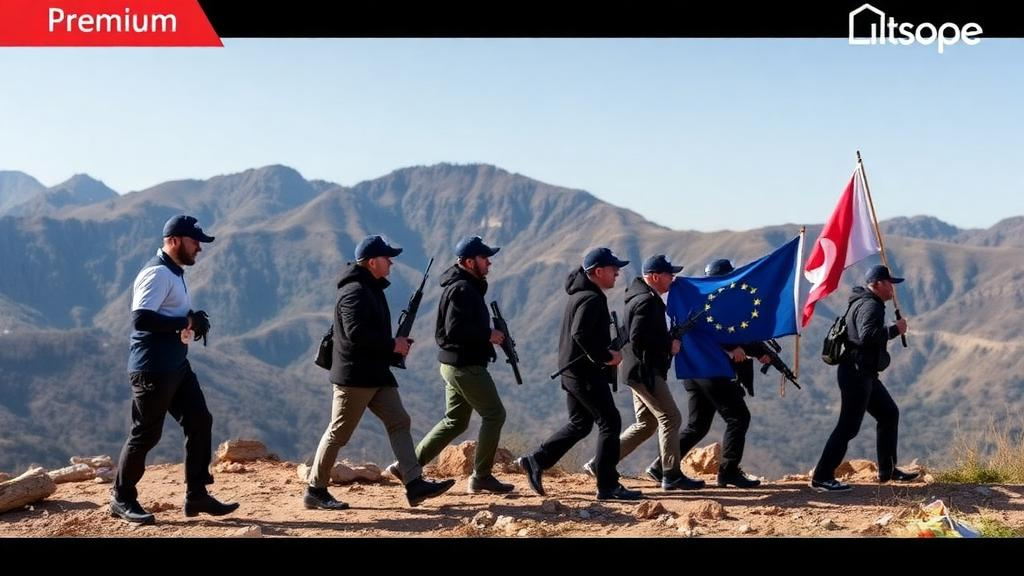
Three decades after the Yugoslav wars, the Western Balkans remain one of the most closely watched laboratories in international politics, and a new open-access study published in Discover Global Society argues that the region’s fragile calm owes far more to institutional engineering than to any single peace treaty. Researchers Shpendim Oxha, Fatos Rushiti and Llokman Mirtezani set out to measure, in a systematic way, how international organizations—above all the European Union and NATO—have shaped security, stability and the everyday wellbeing of citizens across Albania, Bosnia and Herzegovina, Kosovo, Montenegro, North Macedonia and Serbia. Their central claim is deceptively simple: the region’s transformation from a zone of armed conflict into a relatively peaceful neighborhood cannot be understood without accounting for the dense web of external institutions that have monitored, financed, trained and sometimes coerced local governments toward reform.
Methodologically, the study is a qualitative-dominant mixed-methods analysis built on a comparative case study design. The authors combine social constructivism, which treats international organizations as social phenomena that diffuse norms and reshape what states consider legitimate behavior, with institutionalism, which conceptualizes the same organizations as concrete mechanisms for delivering regional security and stability. Their primary evidence consists of official reports and policy documents from the EU and NATO, supplemented by academic literature, think-tank analyses and statistical indicators covering security, investment and democratic performance. Qualitative content analysis and comparative analysis were used to extract themes of stabilization, democratization, military cooperation and economic support, while secondary quantitative indicators tracked trends in citizen safety and wellbeing across the six Western Balkan countries. This dual lens matters, because a purely military reading of Balkan security misses the socio-economic roots of instability, and a purely normative reading misses the hard power that ended the shooting.
The theoretical scaffolding rests on a longer history of international organization. The authors trace the concept back to the Peace of Westphalia in 1648, which established state sovereignty as the organizing principle of international relations, through the structured diplomatic cooperation introduced at the Congress of Vienna in 1815, to the League of Nations, the first universal attempt at collective security after World War I. Although the League failed, it laid the conceptual foundation for the post-1948 explosion of multilateral institutions. The paper notes that international organizations grew from roughly 50 in the interwar period to about 80, and then surged to around 6,000 by 1980 as the Bretton Woods system, built around the US dollar as a reference currency, sought to prevent economic conflicts and maintain monetary stability and free trade. In the authors’ framing, international organization is a process, and international organizations are snapshots of that process at particular stages—a formulation borrowed from the interwar scholar Inis Claude.
Against this backdrop, the Western Balkans present a distinctive threat landscape. The region’s governments classify risks into conventional threats and weapons of mass destruction, transnational and unconventional threats, poor governance, and natural disasters. Nationalist-political, ethnic and religious tensions, together with disputes over indeterminate borders, remain the dangers most capable of destabilizing the region and reigniting armed conflict. Yet the study emphasizes a second, quieter threat: weak institutions, corruption and organized crime, which erode the state’s capacity to protect its own population. When states cannot guarantee basic security, the authors argue, the importance of international security organizations is reaffirmed—the United Nations as the largest multilateral body deploying peacekeeping missions, and NATO as the intergovernmental regional alliance dedicated to peace, security and defense. These dynamics also created urgency for Europe to assume greater responsibility for international peace and to present itself as a global strategic actor.
The empirical core of the paper documents how that responsibility has been exercised on the ground. Following NATO’s 1999 campaign in Kosovo, the UN-mandated security force KFOR was deployed under Security Council Resolution 1244 to provide security and monitor the withdrawal of Serb armed forces, and it continues as a peacekeeping force supporting the Kosovo Security Force. After nearly eight years of UN administration, Kosovo’s unilateral declaration of independence in 2008 created conditions for the EU to launch EULEX in November 2008 through the so-called six-point plan, a mission covering rule of law responsibilities in politics, justice and customs. In Bosnia and Herzegovina, the overall security situation was relatively stable by 2012, but corruption and organized crime persisted as significant challenges; the EU closed its police mission EUPM in June 2012, an operation born of the bloc’s crisis-management ambitions, while continuing to support the rule of law. The European Commission, through its annual country reports, continues to monitor judicial independence, the fight against corruption and organized crime, democratic governance, public administration reform and fundamental rights across the region.
The enlargement framework itself functions as a security instrument, and the study maps each country’s position within it with technical precision. Montenegro began its accession process in December 2011, opened negotiations in 2012, and held its 2016 parliamentary elections under a revised and transparent legal framework characterized by general respect for fundamental freedoms, though progress on media freedom and the economy remains outstanding. Serbia was granted EU candidate status in March 2012 and opened the first negotiating chapters in December 2015, with the pace of talks tied explicitly to rule-of-law progress and the normalization of relations with Kosovo. Albania received candidate status in June 2014 and has advanced on key priorities, including justice reform and the judicial vetting process, but low conviction rates for organized crime offenses such as money laundering and trafficking remain a sticking point. Bosnia and Herzegovina submitted its EU application in February 2016, while Kosovo has taken major steps toward visa liberalization, conditioned on ratifying its border agreement with Montenegro and strengthening the fight against organized crime. Croatia, an EU member since 2013, illustrates the post-accession challenge: the Commission’s reports flag economic performance, public administration, state-owned enterprises and lingering clientelism as areas demanding reform.
On the military dimension, the paper draws on analysis from the Kosovo-based think tank KIPRED to argue that NATO’s arrival fundamentally altered the regional balance. First, the security situation stabilized and armed conflict was discouraged, transforming a region of war-torn societies with hostile neighborly relations into a relatively peaceful one. Second, NATO influenced the transformation of mass territorial-defense armies into smaller professional forces, reducing offensive capabilities against neighbors. Third, NATO enlargement played a crucial role in closing off attempts at violent border change. Fourth, the Partnership for Peace channeled defense cooperation exclusively through Brussels, ending hopes of bilateral or regional counter-balancing alliances. The same analysis, however, flags a genuine concern: Serbia’s defense cooperation with Russia, which includes the Joint Serbo-Russian Center for Response to Emergency Situations—the first such center Russia has opened in Europe since the Cold War—joint military maneuvers, and Serbia’s observer status in the Russian-led Collective Security Treaty Organization’s parliamentary assembly. The study contends that Russia exploits troubled ethnic relations in countries outside the EU and NATO—Bosnia and Herzegovina, Kosovo and North Macedonia—to re-extend its influence, finding fertile ground wherever Brussels shows indecision and US leadership on enlargement wavers.
Threat perceptions within the region itself are strikingly asymmetric, and the authors treat this asymmetry as data. Bosnia and Herzegovina and North Macedonia consider the threat of armed conflict almost non-existent; Albania and Kosovo predict a significant decline; Croatia and Montenegro judge it greatly reduced; Serbia treats it merely as reduced. None of the six completely rules out armed conflict, which could arise mainly from attempts at violent border change, though the possibility of a successful offensive against neighbors is judged small. In military capabilities and defense industry, Serbia and Croatia dominate, while the other states’ forces are marginal: Albania’s military budget stands at roughly 101.75 million euros, Bosnia and Herzegovina’s at around 46 million, and Kosovo’s at 42.03 million with an expected increase. Serbia projects Kosovo as a direct conventional threat and a troubled entity, and the paper suggests Belgrade maintains military planning for unforeseen situations against Pristina. KIPRED’s assessment is sobering: short of a conventional offensive to annex territory north of the Ibar, any Serbian-Kosovar conflict would likely be protracted, with both sides suffering comparable domestic and foreign political injury. The study concludes that the only rational path is normalization of defense relations through confidence-building measures, alongside Kosovo’s membership in the Partnership for Peace, which could eventually allow KFOR’s withdrawal while preserving stability.
The discussion and conclusion sections broaden the lens to non-traditional security. The reduction of large-scale armed conflict confirms the stabilizing impact of NATO’s military presence and broader Euro-Atlantic engagement, supporting the argument that international organizations function as security providers and confidence-building mechanisms in fragile regions. But security has evolved beyond military threats: organized crime, corruption, irregular migration and refugee flows continue to undermine institutional consolidation, and external dangers such as international terrorism and violent extremism—including the threat posed by ISIS—demonstrate the interconnectedness of regional and global security, demanding cooperation in intelligence sharing, border management and social resilience. The authors classify the region’s unfinished transformation into three processes—stabilization and state-building, democratization and institution-building, and Euro-Atlantic integration—and warn that stabilization built from the outside, running in parallel with democratization, risks instability where credible measures overlook conflict leaders. Their verdict is measured: international organizations have been instrumental in stabilizing the Western Balkans, but long-term security depends on addressing internal vulnerabilities alongside external risks through comprehensive, multidimensional engagement—a finding that resonates far beyond the Balkans for every fragile region where peace is being engineered from the outside in.
Subject of Research: The role of international organizations, particularly the EU and NATO, in regional security and stability in the Western Balkans
Article Title: Role of international organizations in the security of the Western Balkans
Article References: Oxha, S., Rushiti, F., & Mirtezani, L. (2026). Role of international organizations in the security of the Western Balkans. Discover Global Society, 4(1), Article 204. https://doi.org/10.1007/s44282-026-00562-9
Image Credits: AI Generated
DOI: 10.1007/s44282-026-00562-9
Keywords: Western Balkans, NATO, European Union, regional security, international organizations, Kosovo, Serbia, EULEX, KFOR, Euro-Atlantic integration, organized crime, Russia
Cite Scienmag News
Courtney Benton. (October 5, 2026). How NATO and the EU Reshaped Security in the Western Balkans. Scienmag. https://scienmag.com/how-nato-and-the-eu-reshaped-security-in-the-western-balkans/
Courtney Benton. "How NATO and the EU Reshaped Security in the Western Balkans." Scienmag, 5 October 2026, https://scienmag.com/how-nato-and-the-eu-reshaped-security-in-the-western-balkans/. Accessed 5 October 2026.
Courtney Benton. "How NATO and the EU Reshaped Security in the Western Balkans." Scienmag. October 5, 2026. https://scienmag.com/how-nato-and-the-eu-reshaped-security-in-the-western-balkans/


