


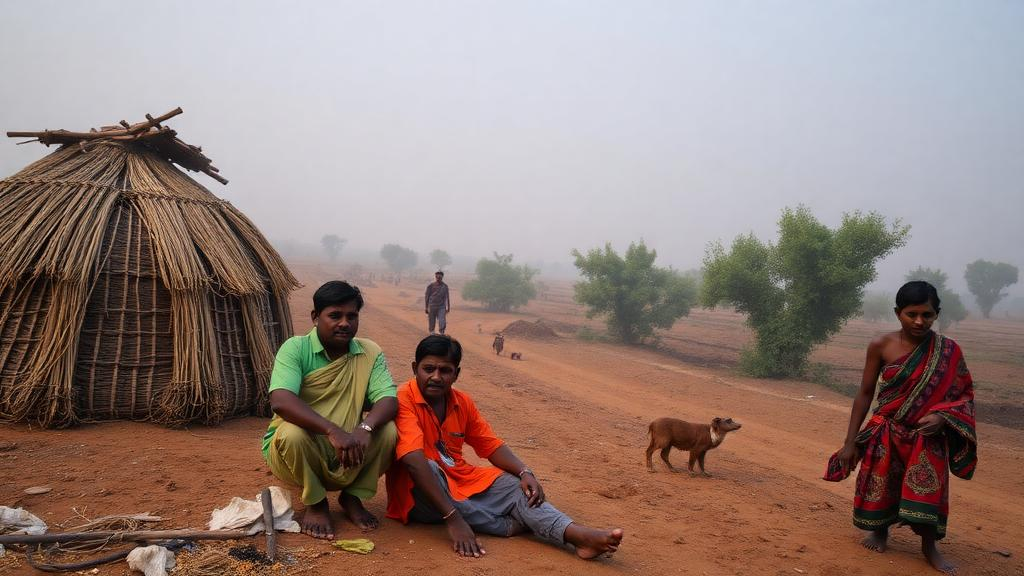
Poverty among India’s tribal communities, known as Adivasis, has long been framed as a problem of geography, culture or simple developmental neglect. A new review published in SN Social Sciences by Koustab Majumdar of the Indira Gandhi National Open University and the Harriet Tubman Institute at York University challenges that framing at its foundations. Drawing on a wide body of historical and social science research, the article argues that tribal poverty is not a natural condition or an accident of isolation. It is, instead, historically produced, politically mediated and institutionally sustained through the interplay of power, policy and governance. The argument reframes one of India’s most persistent social problems as a question of political processes rather than measurement exercises.
The conceptual shift at the heart of the review is deceptively simple but far-reaching. Most research on deprivation, from early town surveys such as Seebohm Rowntree’s 1901 study of poverty to contemporary multidimensional indices developed by Sabina Alkire and Maria Emma Santos, has focused on measuring the extent of poverty: how many people are poor, how deep their deprivation runs, and which dimensions of life it touches. Majumdar argues that for tribal India this approach misses the essential point. The more urgent question is not how much poverty exists but how it is produced and governed. Understanding tribal poverty, the review contends, requires attention to the unequal distribution of resources, risks, institutional authority and political voice.
The historical roots of this argument reach back to colonial rule. The review traces how the British colonial state dispossessed tribal communities of land, forests and customary rights while simultaneously imposing bureaucratic control, administrative classifications and the criminalisation of resistance. Scholars cited in the review, including historians such as Bhangya Bhukya and Ramachandra Guha, have documented how colonial agrarian and forestry policies enclosed land and forests that tribal communities had long used and governed. In central India, colonial agriculture and forest legislation transformed common resources into state property, and in regions such as the jangalmahal of West Bengal, imperial forest management directly undermined tribal livelihoods. Resistance to these enclosures was met with criminalisation, establishing what the review describes as enduring structures of marginalisation.
Crucially, the review argues that these colonial logics did not end with independence. Postcolonial development and welfare regimes, in Majumdar’s analysis, show continuity as well as transformation. Inclusion can co-exist with exclusion, and development with dispossession. The very categories through which the state administers tribal communities, including the Scheduled Tribe designation and the label of Particularly Vulnerable Tribal Groups, carry colonial afterlives. Recent scholarship on the politics of tribalisation in eastern India suggests that state categories created for governance continue to shape identity, entitlement and political struggle long after the contexts that produced them have disappeared. Welfare, in this reading, is never politically neutral: it names its beneficiaries, defines their needs and disciplines their behaviour.
The review then turns to regional experiences to demonstrate that these processes assume differentiated forms across India’s tribal heartlands. In mineral-rich states such as Jharkhand and Odisha, extraction and displacement dominate the picture. Research on development-induced displacement shows that tribal populations have borne a disproportionate share of the costs of mining, dams and industrialisation, losing land and livelihoods while gaining little of the resulting prosperity. Studies of uranium mining at Jadugoda in Jharkhand, co-authored by Majumdar, document the health risks and environmental injustice that accompany such extraction. In Odisha, mining-induced displacement has repeatedly provoked tribal resistance, illustrating how the politics of development is contested on the ground.
Elsewhere, the pathways into marginality run through unequal access to livelihood resources rather than outright displacement. In central India’s tribal belt, scholars have documented the slow erosion of access to land, forests and common resources, a process that converts communities from relatively self-provisioning producers into precarious labourers. In the north-east, questions of land, agriculture and livelihood among Scheduled Tribes intersect with distinctive institutional arrangements, including the Sixth Schedule areas of Meghalaya, where research on the Khasi Hills shows that tribal representation in local land governance shapes outcomes in ways that differ markedly from mainland India. Environmental vulnerability compounds these inequalities: forest-dependent communities face the double burden of restricted access to the resources they once controlled and heightened exposure to ecological degradation.
The review also assembles evidence on the human costs of these political processes, particularly in health and education. Studies of Particularly Vulnerable Tribal Groups in Odisha reveal high rates of malnutrition and anaemia, elevated stillbirth and neonatal mortality compared with the general population, and a heavy burden of diseases such as tuberculosis. Health surveys across tribal India document persistent barriers to healthcare access, while research on mental health literacy shows how stigma and weak service provision interact to suppress help-seeking. In education, systematic reviews of girls from Particularly Vulnerable Tribal Groups identify layered barriers ranging from poverty and distance to language and discrimination. These outcomes, the review insists, should not be read as cultural deficits but as downstream effects of unequal institutional authority and political voice.
What gives the review its analytical coherence is the insistence that these varied pathways are interconnected. Extraction in one region, resource erosion in another, and health and educational exclusion everywhere are not separate problems requiring separate technical fixes. They are, in the article’s framing, distinct expressions of a single underlying dynamic: the reproduction of tribal marginality through political and institutional processes. This dynamic explains a paradox that has long puzzled observers of Indian development, namely how welfare expansion and dispossession can advance simultaneously. When poverty is understood as politically produced, it becomes clear that programmes can deliver benefits to the poor while the structures that generate poverty remain untouched, or are even reinforced by the same administrative apparatus.
The implications for policy are significant. If tribal poverty were primarily a problem of developmental deficit, the solution would be more programmes, better targeting and improved delivery. But if poverty is produced through the unequal distribution of resources, risks, institutional authority and political voice, then effective responses must address those distributions directly. That means strengthening genuine tribal participation in decisions about land, forests and extraction, recognising customary rights rather than merely cataloguing them, and treating tribal communities as political actors rather than passive beneficiaries. It also means scrutinising how welfare itself governs, asking whose categories define vulnerability and whose voices shape the design of interventions. Comparative work by Majumdar on indigenous welfare policies in Taiwan and India suggests that such questions travel across borders, wherever states administer indigenous populations.
The review ultimately offers a broader lesson about the study of poverty everywhere, not only in India. Global scholarship on the politics of poverty governance has increasingly recognised that naming the poor, measuring them and designing programmes for them are themselves exercises of power. Majumdar’s contribution is to apply this insight systematically to India’s tribal communities, connecting colonial history to contemporary welfare and showing how the archive of dispossession continues to structure the present. For a country that has made remarkable progress in reducing measured poverty, the persistence of acute deprivation among its indigenous populations is a standing challenge to triumphalist narratives. The answer, this research suggests, lies not in better statistics but in a more honest account of power: who holds it, how it is exercised, and why the institutions that claim to uplift the marginalised so often reproduce their marginality.
Subject of Research: The political and institutional production of tribal poverty and marginality in India
Article Title: Power, politics and tribal poverty in India
Article References: Majumdar, K. (2026). Power, politics and tribal poverty in India. SN Social Sciences, 6(10), Article 499. https://doi.org/10.1007/s43545-026-01790-1
Image Credits: AI Generated
DOI: 10.1007/s43545-026-01790-1
Keywords: tribal poverty, Adivasis, India, colonialism, dispossession, governance, welfare policy, land rights, displacement, Particularly Vulnerable Tribal Groups, social inequality, indigenous justice
Cite Scienmag News
Courtney Benton. (October 5, 2026). How Power and Politics Keep India’s Tribal Communities in Poverty. Scienmag. https://scienmag.com/how-power-and-politics-keep-indias-tribal-communities-in-poverty/
Courtney Benton. "How Power and Politics Keep India’s Tribal Communities in Poverty." Scienmag, 5 October 2026, https://scienmag.com/how-power-and-politics-keep-indias-tribal-communities-in-poverty/. Accessed 5 October 2026.
Courtney Benton. "How Power and Politics Keep India’s Tribal Communities in Poverty." Scienmag. October 5, 2026. https://scienmag.com/how-power-and-politics-keep-indias-tribal-communities-in-poverty/


