


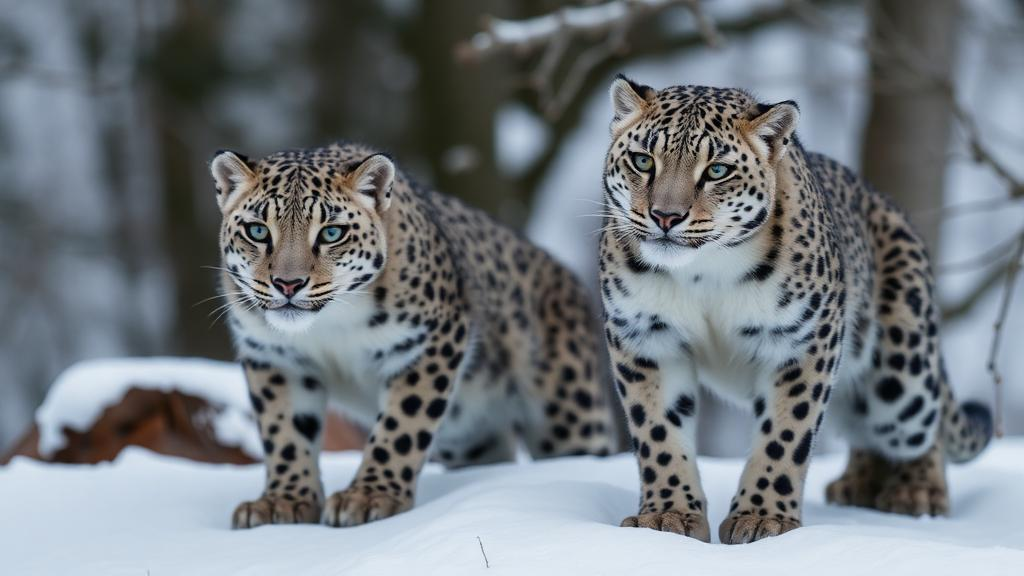
In the high passes of the Himalayas, a snow leopard crouches among snow-dusted rocks, its smoky coat dissolving into the mountainside. A hundred meters away, a blue sheep lifts its head from grazing and scans the horizon, unable to resolve the predator from the terrain. This silent standoff is more than a moment of natural drama. It is the visible edge of a contest that has run for hundreds of millions of years: the struggle between seeing and staying unseen. A new review published in National Science Review by a team led by Professor Yongxiang Liu of the National University of Defense Technology argues that this contest, which the authors call anti-visual perception, is not a loose collection of tricks scattered across biology, physics, and computer science, but a single evolving narrative that now spans everything from polar bear fur to adversarial attacks on self-driving cars.
The review’s central claim is unifying. Biomimetic camouflage, multispectral signature management, and adversarial attacks on machine vision have traditionally been studied in separate communities, each with its own vocabulary, journals, and assumptions. By placing them in one framework, the authors reveal a shared evolutionary logic: every advance in perception drives a corresponding advance in concealment, and every new concealment strategy in turn pressures perception to improve. This reciprocal escalation, an arms race in the strict sense, has shaped life on Earth since the first eyes opened, and it now shapes the security of the artificial systems that increasingly see on humanity’s behalf. Understanding the logic, the authors contend, is the key to building the next generation of camouflage, stealth technology, robust sensors, and trustworthy artificial intelligence.
Nature wrote the first chapter. According to the review, roughly seven hundred million years ago cnidarians deployed opsins, light-sensitive proteins that marked the origin of biological vision. The Cambrian ocean then escalated the stakes dramatically. Anomalocaris, one of the era’s dominant predators, hunted with compound eyes containing approximately sixteen thousand lenses, an arrangement that gave it exceptional resolving power for its time. Color vision emerged more than three hundred million years ago, adding an entirely new dimension to both detection and deception. As sensory systems grew sharper, concealment strategies grew more sophisticated in parallel, producing the countermeasures that still define survival in ecosystems today: the disruptive patterns that break up an animal’s outline, the textures that match a background, the behaviors that exploit the blind spots of a predator’s visual system.
What makes the review distinctive is how it traces these biological strategies into human engineering. The lineage is surprisingly direct. Polar bear hollow hairs, which manage light and heat with remarkable efficiency, have inspired low-observable fabrics. The spot patterns of leopards and the stripes of tigers informed the design of digital camouflage. Leaf-mimicking butterflies, ink-squirting octopuses, and death-feigning frogs each map onto human equivalents such as decoys and smoke screens. The historical record of warfare follows the same playbook. In World War I, the British Navy applied dazzle camouflage, not to hide ships but to confuse enemy rangefinders and gunners about a vessel’s heading and speed. In World War II, the Allies assembled an entire phantom army of inflatable tanks and fabricated radio traffic to misdirect German intelligence about invasion plans. Deception, in other words, need not mean invisibility; it can mean corrupting the observer’s interpretation of what is seen.
The technical core of the review addresses what happens when sensing leaves the visible band. Modern imaging spans the electromagnetic spectrum from ultraviolet to microwave, and each band imposes its own physics on the problem of concealment. In the ultraviolet, materials such as avobenzone and zinc oxide nanoparticles absorb or scatter radiation that would otherwise betray a target. Against lidar, which measures reflected laser pulses, micro- and nanostructured surfaces convert mirror-like specular reflection into diffuse reflection, weakening the coherent echoes that make precise detection possible. These are not incremental tweaks; they represent deliberate control over how matter interacts with waves, band by band, using structure and chemistry rather than paint alone.
The thermal infrared band presents its own distinct challenges, and the review identifies three dominant strategies for managing it. The first is replicating the thermal texture of the background, so that a warm object presents the same infrared mosaic as its surroundings. The second is modulating emissivity, the intrinsic tendency of a surface to emit thermal radiation, which can be tuned with engineered coatings. The third is suppressing heat conduction, so that heat generated by an engine or a body does not propagate to the surface where sensors would detect it. Microfluidics, phase-change materials, and aerogels each play roles in these approaches. Aerogel fibers inspired by polar bear hair exemplify the biomimetic thread running through the work, while electro-responsive photonic crystals inspired by chameleons can reversibly shift color from blue to red, offering dynamic rather than static concealment.
In the microwave band, the domain of radar, the toolkit shifts again. Composite absorbing materials soak up incident radar energy rather than reflecting it back to the transmitter. Smoothly curved stealth airframes, of the kind pioneered on modern aircraft, redirect reflections away from the source instead of eliminating them. Reconfigurable metasurfaces, engineered surfaces whose electromagnetic properties can be adjusted on demand, point toward adaptive stealth that can respond to changing threat conditions. Yet the review is candid about the field’s hardest problem: multispectral compatibility. Requirements that help in one band often hurt in another. A surface optimized to absorb radar may glow in the thermal infrared; a coating that suppresses visible reflections may do nothing for ultraviolet sensors. Multifunctional stacking and hybrid integration are the current paths toward full-spectrum signature management, and the authors describe them as bringing genuine cross-band invisibility closer to practical reality.
Then the observer changes entirely. When the beholder is no longer a human eye or even a physical sensor but a neural network, the rules of the contest transform. Machine vision systems built on sensors and deep learning architectures, from convolutional neural networks to models such as DINO and YOLO, now exceed human performance in certain recognition tasks. But capability and vulnerability rise together, because these systems make decisions based on learned decision boundaries in high-dimensional feature space rather than on the physical properties of light. Anti-perception has consequently shifted from manipulating physical signatures to attacking those decision boundaries directly. In the digital domain, the Fast Gradient Sign Method applies perturbations computed from a model’s own gradients, while the one-pixel attack demonstrates that changing a single pixel can flip a model’s classification entirely.
The physical world makes the threat concrete. Adversarial patches, printed patterns that can be held up to a camera, have been shown to reduce pedestrian detection accuracy by more than seventy percent. A famous 3D-printed adversarial turtle is misclassified as a rifle from essentially any viewing angle, demonstrating that such attacks survive real-world geometry and lighting rather than existing only in simulation. The attacks are also spreading across the spectrum. Thermal camouflage patches can cut infrared detection accuracy from 95.7 percent to 45.4 percent, and cross-modal adversarial patches can deceive visible-light and infrared sensors simultaneously, meaning a single physical object can defeat multiple sensing modalities at once. For autonomous vehicles, military platforms, and security systems that rely on machine perception, these results define a new class of vulnerability that no amount of traditional camouflage addresses.
Looking forward, the authors argue that anti-visual perception is moving from isolated exploration toward deep interdisciplinary integration, and they lay out a roadmap along each of their three threads. Biomimetics must progress from mimicking form to mimicking function, which demands cross-scale knowledge graphs that connect biological mechanisms to engineering implementations, together with scalable manufacturing of multiscale structures. Spectral physics must move from passive trade-offs among bands to active design, combining emerging materials such as graphene and phase-change materials with AI for Science inverse-design platforms that can search vast material and structural spaces faster than human intuition allows. Research on artificial intelligence, meanwhile, must bridge the persistent gap between simulated and real-world conditions, forging stronger shields even as sharper spears are built. The review’s deepest message is that the hide-and-seek begun by cnidarians and Anomalocaris has not ended; it has merely changed substrates. Every gain in seeing, whether by a compound eye, a radar array, or a neural network, will be answered by a new way of hiding, and the disciplines that treat this as one continuous story will be the ones that shape what comes next.
Subject of Research: The evolution of anti-visual perception across biomimetics, multispectral signature management, and adversarial attacks on machine vision
Article Title: The eternal hide-and-seek: How anti-visual perception evolved from snow leopards to AI attacks
Article References: The eternal hide-and-seek: How anti-visual perception evolved from snow leopards to AI attacks. (n.d.). Original publication
Image Credits: AI Generated
DOI: Not provided
Keywords: anti-visual perception, camouflage, biomimetics, stealth technology, adversarial attacks, machine vision, multispectral sensing, thermal infrared, metasurfaces, snow leopard, National Science Review, trustworthy AI
Cite Scienmag News
Gavin Prescott. (October 5, 2026). From Snow Leopards to Stop Signs: The Evolutionary Arms Race of Staying Unseen. Scienmag. https://scienmag.com/from-snow-leopards-to-stop-signs-the-evolutionary-arms-race-of-staying-unseen/
Gavin Prescott. "From Snow Leopards to Stop Signs: The Evolutionary Arms Race of Staying Unseen." Scienmag, 5 October 2026, https://scienmag.com/from-snow-leopards-to-stop-signs-the-evolutionary-arms-race-of-staying-unseen/. Accessed 5 October 2026.
Gavin Prescott. "From Snow Leopards to Stop Signs: The Evolutionary Arms Race of Staying Unseen." Scienmag. October 5, 2026. https://scienmag.com/from-snow-leopards-to-stop-signs-the-evolutionary-arms-race-of-staying-unseen/


