


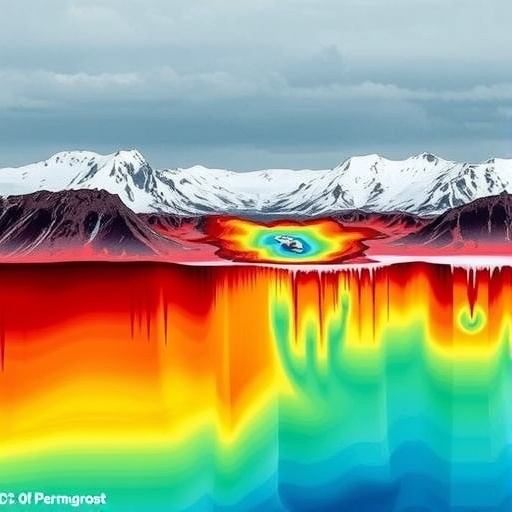
A new study published in Nature Communications warns that Arctic permafrost could become an accelerating source of greenhouse gases, and that the danger may scale in a simple, almost linear way with additional warming beyond climate targets. The research links carbon release not only to how hot the planet becomes, but also to a specific large-scale ocean process whose stability is threatened as warming increases: the Atlantic Meridional Overturning Circulation (AMOC).
Permafrost soils—frozen for millennia—store enormous quantities of organic carbon. When they thaw, microbes convert that material into carbon dioxide and methane, turning a long-term carbon sink into an active emissions source. While previous work has estimated that thawing could intensify under warmer conditions, this new analysis focuses on the relationship between abrupt “overshoot” warming and how fast carbon release might respond.
The authors propose a mechanistic pathway: excess warming can destabilize the AMOC, shifting ocean heat transport patterns that change regional climate conditions over the Arctic. Those changes, in turn, influence permafrost temperature and thaw depth. Rather than treating carbon release as a complex, threshold-driven process, the study finds that the magnitude of carbon emissions can increase in a roughly linear fashion with the size of the overshoot.
Crucially, the scaling depends on the overshoot’s mediation by AMOC tipping. In other words, the ocean circulation acts like a bridge between global temperature excursions and local Arctic warming. When the AMOC transitions toward a weaker state, it amplifies the climatic conditions that drive permafrost degradation.
The results imply that even short-lived periods of extra heat—when temperatures temporarily exceed a stabilization level—could have outsized consequences for carbon release. That matters for scenarios where emissions reductions slow near-term warming but still allow brief overshoots.
Although models cannot reproduce every detail of Arctic soils and microbial ecosystems, the paper’s framework helps translate climate dynamics into a directly comparable carbon-response metric. The takeaway for policy and risk planning is stark: mitigation targets must consider not just peak warming, but also the size and duration of overshoot that can trigger ocean-driven amplification.
By tying permafrost emissions to a linearly scaling overshoot, the study suggests a more predictable—yet still alarming—relationship between climate disruption and long-term greenhouse feedbacks. With AMOC stability in question, the Arctic may not wait for a steady warming future to begin releasing stored carbon.
This work, therefore, elevates permafrost carbon release from a background concern to an active tipping-related feedback that could grow steadily with additional warming episodes.
Cite Scienmag News
Violet Maxwell. (July 16, 2026). Permafrost Carbon Release Grows Linearly With Overshoot Warming via AMOC Tipping. Scienmag. https://scienmag.com/permafrost-carbon-release-grows-linearly-with-overshoot-warming-via-amoc-tipping/
Violet Maxwell. "Permafrost Carbon Release Grows Linearly With Overshoot Warming via AMOC Tipping." Scienmag, 16 July 2026, https://scienmag.com/permafrost-carbon-release-grows-linearly-with-overshoot-warming-via-amoc-tipping/. Accessed 4 September 2026.
Violet Maxwell. "Permafrost Carbon Release Grows Linearly With Overshoot Warming via AMOC Tipping." Scienmag. July 16, 2026. https://scienmag.com/permafrost-carbon-release-grows-linearly-with-overshoot-warming-via-amoc-tipping/


