

Tuesday, October 27, 2026
Science
No Result
View All Result
  • Login
  • HOME
  • SCIENCE NEWS
  • CONTACT US
  • HOME
  • SCIENCE NEWS
  • CONTACT US
No Result
View All Result
Scienmag
No Result
View All Result
Home Science News Agriculture

Pepper kinase CaSNF1 phosphorylates CaHD-ZIP to boost cold tolerance

October 27, 2026
in Agriculture
Alan Morgan
By Alan Morgan Scienmag Editorial Profile - Precision Agriculture
Reading Time: 2 mins read
0
Pepper kinase CaSNF1 phosphorylates CaHD-ZIP to boost cold tolerance

Pepper kinase CaSNF1 phosphorylates CaHD-ZIP to boost cold tolerance

65
SHARES
587
VIEWS
Share on FacebookShare on Twitter
ADVERTISEMENT

Cold stress severely restricts the growth and productivity of pepper (Capsicum annuum L.) by disrupting cellular homeostasis and inducing oxidative damage. Although HD-ZIP transcription factors are known to play important roles in plant responses to abiotic stress, the molecular mechanisms that regulate their function during cold stress have remained largely unknown. A new study published in Theoretical and Applied Genetics characterizes a pepper HD-ZIP transcription factor, CaHD-ZIP, and reports that it is a nuclear-localized, cold-responsive protein that positively contributes to cold stress tolerance.

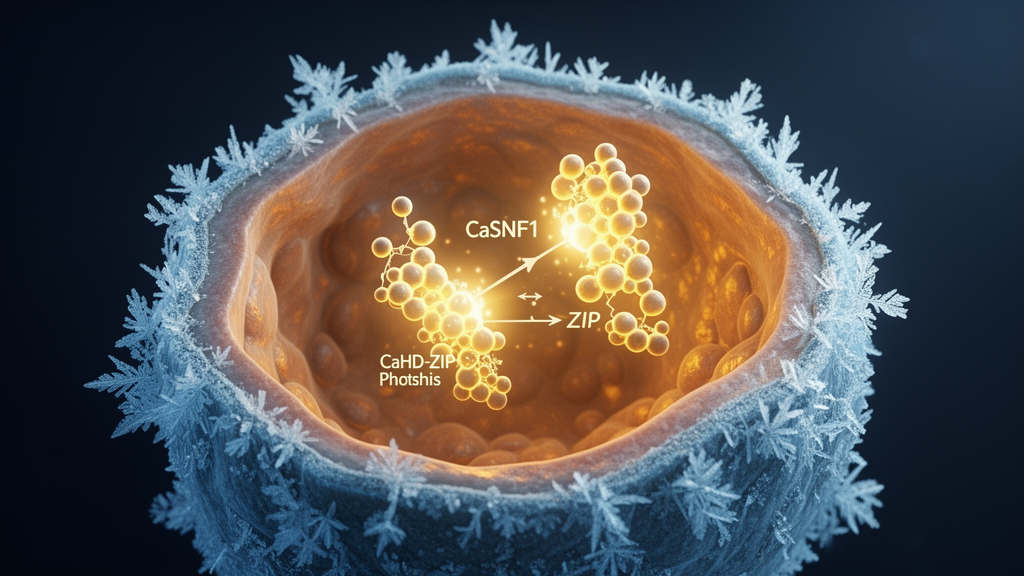
To probe how CaHD-ZIP itself is regulated, the researchers carried out a yeast two-hybrid screen, which identified the sucrose non-fermenting 1-related protein kinase CaSNF1 as a previously unrecognized interacting partner of CaHD-ZIP. The interaction was confirmed by three independent approaches: yeast two-hybrid assays, luciferase complementation imaging, and bimolecular fluorescence complementation. The BiFC experiments indicated that the interaction occurs predominantly in the nucleus, consistent with CaHD-ZIP’s nuclear localization.

The team then sought biochemical evidence for a functional regulatory relationship. In vitro phosphorylation analysis demonstrated that CaSNF1 directly phosphorylates CaHD-ZIP, showing that the physical interaction between the two proteins is accompanied by a direct enzymatic modification. This establishes CaSNF1 as a CaHD-ZIP-interacting kinase and points to a potential CaSNF1–CaHD-ZIP regulatory module involved in pepper cold stress adaptation.

Complementary loss- and gain-of-function analyses supported a positive role for CaSNF1 in cold tolerance. Virus-induced gene silencing and transient overexpression in pepper, together with stable overexpression in Arabidopsis, showed that silencing CaSNF1 increased oxidative damage, impaired antioxidant enzyme activities, and suppressed the expression of antioxidant and cold-responsive genes. Overexpression produced the opposite effects and significantly enhanced cold tolerance in the experimental systems used.

According to the authors, these findings advance understanding of the molecular mechanisms underlying pepper cold tolerance and suggest potential genetic targets for improving cold resilience in pepper and other Solanaceae crops. The work was published online on 23 October 2026 as article number 311 in volume 139 of the journal, with Ikram Ullah, Yingping Pei, Menghan Wang, Altaf Hussain, Jiangbai Guo, Huafeng Zhang and Rugang Chen listed among the authors.

Subject of Research: A CaSNF1–CaHD-ZIP regulatory module involved in cold stress tolerance in pepper

Article Title: CaSNF1 interacts with and phosphorylates CaHD-ZIP to enhance cold tolerance in pepper

Article References: Ullah, I., Pei, Y., Wang, M., Hussain, A., Guo, J., Zhang, H., & Chen, R. (2026). CaSNF1 interacts with and phosphorylates CaHD-ZIP to enhance cold tolerance in pepper. Theoretical and Applied Genetics, 139(11), Article 311. https://doi.org/10.1007/s00122-026-05413-4

Image Credits: AI Generated

DOI: 10.1007/s00122-026-05413-4

Keywords: pepper, cold stress, CaSNF1, CaHD-ZIP, phosphorylation, transcription factor, abiotic stress, antioxidant, Arabidopsis, Capsicum annuum, plant molecular biology, gene silencing

Cite Scienmag News

Alan Morgan. (October 27, 2026). Pepper kinase CaSNF1 phosphorylates CaHD-ZIP to boost cold tolerance. Scienmag. https://scienmag.com/pepper-kinase-casnf1-phosphorylates-cahd-zip-to-boost-cold-tolerance/

Alan Morgan. "Pepper kinase CaSNF1 phosphorylates CaHD-ZIP to boost cold tolerance." Scienmag, 27 October 2026, https://scienmag.com/pepper-kinase-casnf1-phosphorylates-cahd-zip-to-boost-cold-tolerance/. Accessed 27 October 2026.

Alan Morgan. "Pepper kinase CaSNF1 phosphorylates CaHD-ZIP to boost cold tolerance." Scienmag. October 27, 2026. https://scienmag.com/pepper-kinase-casnf1-phosphorylates-cahd-zip-to-boost-cold-tolerance/


Tags: abiotic stressantioxidantArabidopsisbimolecular fluorescence complementation in protein interaction studiesbiochemical analysis of kinase-substrate relationshipsCaHD-ZIPCapsicum annuumCaSNF1CaSNF1 kinase regulation of cold tolerancecold stressgene silencingHD-ZIP transcription factors in plant stress responsemolecular mechanisms of cold stress in Capsicum annuumnuclear localization of stress-responsive proteinspepperPepper cold stress tolerancephosphorylationphosphorylation of transcription factors during abiotic stressplant molecular biologyprotein-protein interactions in plant stress signalingregulatory modules controlling cold stress adaptationrole of phosphorylationtranscription factoryeast two-hybrid screening in plant molecular biology
Share26Tweet16
Previous Post

SWOT satellite reveals fine-scale ocean eddies boost global surface chlorophyll

Next Post

Human-inspired AI model sharpens sound localization while keeping the network compact

Related Posts

Droughts and Floods Are Dismantling the Soil Microbiome That Sustains Ecosystems
Agriculture

Droughts and Floods Are Dismantling the Soil Microbiome That Sustains Ecosystems

October 27, 2026
India’s threatened plants: 700 Red List species assessed for cultural and medicinal uses
Agriculture

India’s threatened plants: 700 Red List species assessed for cultural and medicinal uses

October 27, 2026
Superior haplotypes offer a new framework for climate-resilient crop breeding
Agriculture

Superior haplotypes offer a new framework for climate-resilient crop breeding

October 27, 2026
North American spring wheat shows weak seedling defense against Ug99 stem rust
Agriculture

North American spring wheat shows weak seedling defense against Ug99 stem rust

October 27, 2026
LoRaWAN Collars Track Grazing Cattle Across Colombian Savannah in Field Trial
Agriculture

LoRaWAN Collars Track Grazing Cattle Across Colombian Savannah in Field Trial

October 27, 2026
Slaughterhouse By-Products Could Feed the Cells Behind Cultivated Meat
Agriculture

Slaughterhouse By-Products Could Feed the Cells Behind Cultivated Meat

October 27, 2026
Next Post
Human-inspired AI model sharpens sound localization while keeping the network compact

Human-inspired AI model sharpens sound localization while keeping the network compact

  • Mothers who receive childcare support from maternal grandparents show more optimized

    Mothers who receive childcare support from maternal grandparents show more parental warmth, finds NTU Singapore study

    27656 shares
    Share 11059 Tweet 6912
  • University of Seville Breaks 120-Year-Old Mystery, Revises a Key Einstein Concept

    1061 shares
    Share 424 Tweet 265
  • Bee body mass, pathogens and local climate influence heat tolerance

    682 shares
    Share 273 Tweet 171
  • Researchers record first-ever images and data of a shark experiencing a boat strike

    546 shares
    Share 218 Tweet 137
  • Groundbreaking Clinical Trial Reveals Lubiprostone Enhances Kidney Function

    531 shares
    Share 212 Tweet 133
Science

Embark on a thrilling journey of discovery with Scienmag.com—your ultimate source for cutting-edge breakthroughs. Immerse yourself in a world where curiosity knows no limits and tomorrow’s possibilities become today’s reality!

RECENT NEWS

  • Human-inspired AI model sharpens sound localization while keeping the network compact
  • Pepper kinase CaSNF1 phosphorylates CaHD-ZIP to boost cold tolerance
  • SWOT satellite reveals fine-scale ocean eddies boost global surface chlorophyll
  • WEE1 kinase guards quiescent cells’ path back into the cell cycle

Categories

  • Agriculture
  • Anthropology
  • Archaeology
  • Athmospheric
  • Biology
  • Biotechnology
  • Blog
  • Bussines
  • Cancer
  • Chemistry
  • Climate
  • Earth Science
  • Editorial Policy
  • Marine
  • Mathematics
  • Medicine
  • Pediatry
  • Policy
  • Psychology & Psychiatry
  • Science Education
  • Science News
  • Social Science
  • Space
  • Technology and Engineering

Subscribe to Blog via Email

Enter your email address to subscribe to this blog and receive notifications of new posts by email.

Join 5,151 other subscribers

© 2025 Scienmag - Science Magazine

Welcome Back!

Login to your account below

Forgotten Password?

Retrieve your password

Please enter your username or email address to reset your password.

Log In
No Result
View All Result
  • HOME
  • SCIENCE NEWS
  • CONTACT US

© 2025 Scienmag - Science Magazine

Discover more from Science

Subscribe now to keep reading and get access to the full archive.

Continue reading