


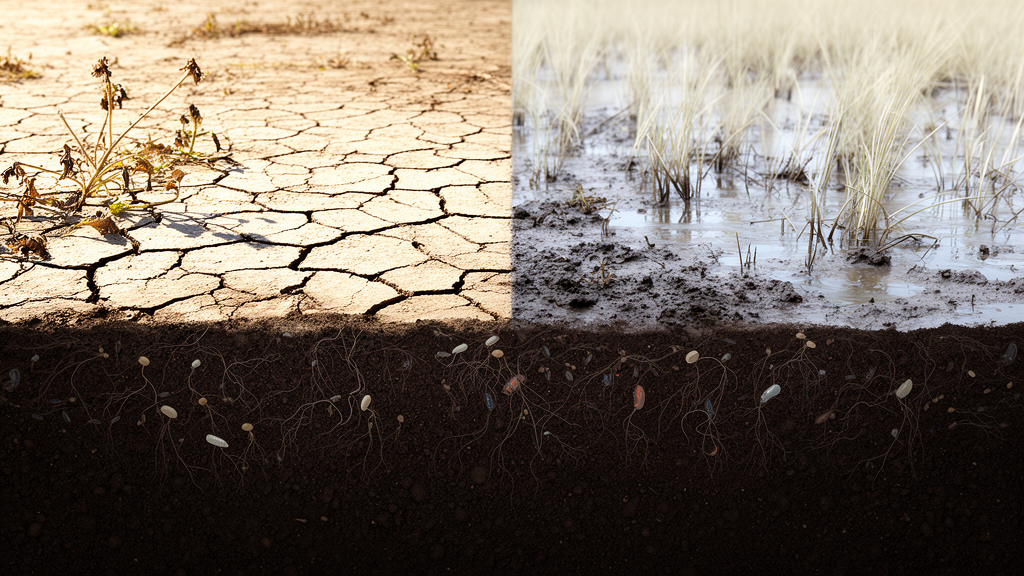
Extreme hydrological events are no longer rare shocks to the world’s soils. According to a systematic review published in Discover Soil, drought currently affects roughly 64 percent of the global land area and flooding another 13 percent, and these footprints are expanding under rising atmospheric temperatures. The review, conducted under the PRISMA framework using Web of Science and Scopus, screened 1,452 non-duplicate records and ultimately synthesized 77 core studies to build a mechanistic picture of what prolonged desiccation, sudden inundation, and violent swings between the two do to the microbial communities that underpin terrestrial life.
The authors frame extreme hydrological events as “pulse” disturbances: acute shocks that compound the chronic “press” pressure of gradual warming and rising carbon dioxide. At the center of the vulnerability sits the soil microbiome, the hyper-diverse assemblage of bacteria, archaea, fungi and viruses that drives carbon sequestration, nitrogen and phosphorus mineralization, and the turnover of soil organic matter. Through extracellular enzymes, these organisms depolymerize complex organic macromolecules into assimilable monomers, controlling the rate-limiting steps of terrestrial nutrient cycling. Their exudates, including glomalin from arbuscular mycorrhizal fungi and bacterial extracellular polymeric substances, act as biological glues that hold soil aggregates together and maintain porosity.
Severe drought dismantles this engine from several directions at once. As matric potential drops, water retreats into increasingly tortuous micropores, breaking the continuous water films that carry nutrients and enzymes to microbial cells and severing the physical link between microbes and their energy sources. Large-scale global meta-analyses cited in the review indicate that extreme drought reduces soil microbial biomass carbon by an average of 22.7 percent, microbial biomass nitrogen by 21.2 percent and microbial biomass phosphorus by 21.6 percent. The decline is driven largely by the mass mortality of desiccation-sensitive, thin-walled bacterial taxa unable to withstand extreme osmotic gradients, which lyse and release their contents into the dehydrated matrix.
Survival favors a different cast of characters. Fungi, with robust chitinous cell walls and filamentous hyphal networks that can bridge air-filled pores to scavenge water from distant wetter microhabitats, generally tolerate drought far better than bacteria, so the fungal-to-bacterial ratio typically rises under prolonged drying. The community also shifts from copiotrophic, fast-growing taxa such as Bacteroidota toward oligotrophic groups like Acidobacteriota, Chloroflexi and Firmicutes, which form resilient spores and sustain basal growth under severe resource limitation. To avoid cellular dehydration, surviving microbes must synthesize osmolytes such as proline, trehalose and glycine betaine, an energetically costly strategy that diverts resources away from growth and enzyme production; when osmoregulation costs exceed available energy, cells either enter dormancy, form endospores or die.
Enzyme activity collapses alongside biomass. Meta-analytical syntheses reported in the review show that drought reduces the potential activity of beta-1,4-glucosidase, a key carbon-acquisition enzyme, by an average of 26.8 percent globally, while acid phosphatase declines by 16.1 percent. Beyond simply producing fewer enzymes, dehydrated soils physically compromise the enzymes themselves: stripped of their stabilizing hydration shells, extracellular proteins denature and their active sites become catalytically inert. Thermodynamic analyses add a subtler layer, showing that maximum reaction velocity falls with shrinking biomass while the apparent half-saturation constant rises, chiefly because substrate diffusion across discontinuous water films becomes limiting. The resulting drop in catalytic efficiency brings nutrient mineralization nearly to a standstill and depresses microbial carbon use efficiency, although communities with a history of arid conditions can maintain higher efficiency through a protective “ecological memory” of stress-response transcription.
Flooding inflicts the opposite stress but an equally severe toll. Because oxygen diffuses roughly 10,000 times more slowly in water than in air, inundated soils plunge into hypoxia and then anoxia, killing obligate aerobes and triggering a predictable thermodynamic cascade of alternative electron acceptors: denitrifiers strip nitrate to nitrogen gas, followed by manganese- and iron-reducing bacteria, sulfate reducers such as Sulfuricurvum species, and finally methanogenic archaea. Fungal abundance, biomass and diversity fall sharply, lowering the fungal-to-bacterial ratio. Anaerobic metabolism also accumulates toxic byproducts, including hydrogen sulfide, acetic and butyric acids, and phytotoxic concentrations of reduced ferrous iron and manganese, while the lower energy yield per mole of carbon oxidized drives a system-wide plunge in carbon use efficiency. Microbiomes with a legacy of frequent inundation transition to alternative electron acceptors more rapidly, softening the crash.
Carbon preservation under flooded conditions hinges on two competing mechanisms. In peatlands, wetlands and highly organic soils, the “Enzyme Latch” hypothesis holds that oxygen depletion disables phenol oxidase and peroxidase, allowing phenolic compounds to accumulate and inhibit hydrolytic enzymes, effectively halting decomposition and preserving the carbon store. But recent work in tropical mineral soils and minerotrophic fens suggests this latch is not universal. In mineral-rich systems, the “Iron Gate” dominates: organic carbon sorbed onto reactive ferric iron oxyhydroxides is released when flooding reduces ferric iron to soluble ferrous iron, exposing previously bound carbon to enzymatic attack. When drained soils re-aerate, rapid oxidation of ferrous iron can generate reactive oxygen species through Fenton-type reactions, which depolymerize organic matter and denature the extracellular enzyme pool.
The most violent biogeochemical response, however, comes from the transition between extremes. When a deeply desiccated soil is suddenly rewetted, the “Birch Effect” produces an immediate, massive pulse of respiration and carbon mineralization, with microbial carbon dioxide efflux spiking by several orders of magnitude within minutes to hours and sometimes dominating the annual carbon budget of semi-arid and Mediterranean ecosystems. Surviving microbes flush their accumulated osmolytes into the soil to avoid rupturing under hypo-osmotic shock, providing an instantaneous pool of labile carbon, while necromass from drought-killed cells fuels opportunistic copiotrophs. Simultaneously, rewetting slakes and shatters desiccated aggregates, exposing previously protected older soil organic carbon to enzymatic attack. Stable isotope partitioning analyses indicate the emitted carbon dioxide derives from a mixture of recent plant inputs and ancient recalcitrant carbon pools, meaning these fluctuations actively accelerate the depletion of long-term carbon sinks. Repeated drying-rewetting cycles depress community-level carbon use efficiency as microbes divert resources to membrane repair and enzyme resynthesis rather than growth, decoupling respiration from biomass production, and under novel extremes even ingrained ecological memory can be overwhelmed, eroding functional redundancy and network complexity.
These microscopic disruptions cascade upward. Drought can cut soil nitrification potential by up to 80 percent in sandy soils within a single month, effectively halting the nitrogen cycle, while flooded soils emit methane at fluxes of 50 to 150 milligrams per square meter per day and transient post-disturbance “hot moments” of incomplete denitrification can account for 50 to 70 percent of a soil’s annual nitrous oxide emissions within days. Severe repeated dry-wet cycles can accelerate the mineralization of decadal-old soil organic carbon pools by 15 to 30 percent compared with stable moisture regimes, and low carbon use efficiency prevents new necromass from stabilizing onto mineral surfaces, shifting soils from net carbon sinks toward net sources.
Against this backdrop, the review evaluates Climate-Smart Agriculture interventions, emphasizing that these strategies buffer mild-to-moderate moisture extremes rather than fully mitigating extreme physical forces. Meta-analyses indicate biochar can increase soil porosity by up to 64 percent, reduce bulk density by 3 to 31 percent and raise water-holding capacity by 10 to 30 percent, and in drought-stressed soils biochar increased microbial biomass carbon by 21.7 percent relative to unamended controls while maintaining urease and alkaline phosphatase activities, with fertilizer requirements potentially reduced by 20 to 40 percent. Continuous cover cropping complements this by supplying year-round root exudates that form rhizosphere hydrogels, maintaining contiguous water films and suppressing the severity of the Birch effect, with legumes specifically supporting post-flood nitrogen recovery. The authors also recommend that soil testing move beyond static total organic carbon tracking toward dynamic microbial indicators, including enzyme kinetics, biomass stability and network complexity indices, as early-warning signals of ecosystem distress, and they call for expanded long-term ecological research networks and standardized extreme-weather simulation protocols to capture how microbial ecological memory evolves under unprecedented climatic extremes.
Subject of Research: Impacts of extreme hydrological events on soil microbial communities and ecosystem resilience
Article Title: Impact of extreme hydrological events on soil microbiome dynamics and ecosystem resilience
Article References: Vikas, & Ranjan, R. (2026). Impact of extreme hydrological events on soil microbiome dynamics and ecosystem resilience. Discover Soil, 3(1), Article 195. https://doi.org/10.1007/s44378-026-00346-2
Image Credits: AI Generated
DOI: 10.1007/s44378-026-00346-2
Keywords: soil microbiome, drought, flooding, Birch effect, carbon use efficiency, extracellular enzymes, biochar, cover cropping, Enzyme Latch, Iron Gate, Climate-Smart Agriculture, ecosystem resilience
Cite Scienmag News
Morgan Morrow. (October 27, 2026). Droughts and Floods Are Dismantling the Soil Microbiome That Sustains Ecosystems. Scienmag. https://scienmag.com/droughts-and-floods-are-dismantling-the-soil-microbiome-that-sustains-ecosystems/
Morgan Morrow. "Droughts and Floods Are Dismantling the Soil Microbiome That Sustains Ecosystems." Scienmag, 27 October 2026, https://scienmag.com/droughts-and-floods-are-dismantling-the-soil-microbiome-that-sustains-ecosystems/. Accessed 27 October 2026.
Morgan Morrow. "Droughts and Floods Are Dismantling the Soil Microbiome That Sustains Ecosystems." Scienmag. October 27, 2026. https://scienmag.com/droughts-and-floods-are-dismantling-the-soil-microbiome-that-sustains-ecosystems/


