


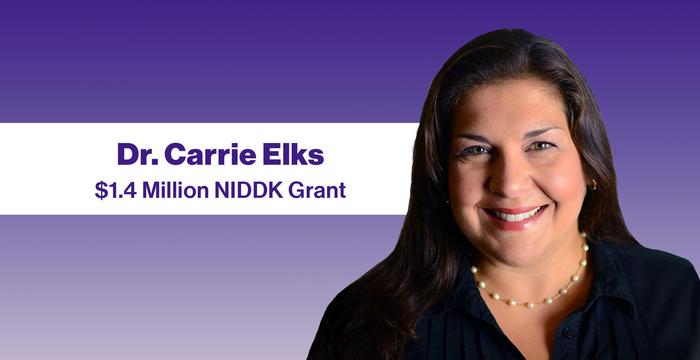
The National Institutes of Health’s National Institute of Diabetes and Digestive and Kidney Diseases, or NIDDK, awarded Pennington Biomedical researcher Dr. Carrie Elks a grant of $1.4 million to explore insulin resistance and inflammation in fat cells. Dr. Elks will apply the grant toward her Matrix Biology Laboratory’s project “Adipocyte cytokine signaling as a coordinator of adipose tissue function.”

Credit: Pennington Biomedical Research Center
The National Institutes of Health’s National Institute of Diabetes and Digestive and Kidney Diseases, or NIDDK, awarded Pennington Biomedical researcher Dr. Carrie Elks a grant of $1.4 million to explore insulin resistance and inflammation in fat cells. Dr. Elks will apply the grant toward her Matrix Biology Laboratory’s project “Adipocyte cytokine signaling as a coordinator of adipose tissue function.”
The proposed project is based on a communication loop that was recently discovered by Dr. Elks and her team. The bidirectional communication loop is between fat cells and immune cells. Interruptions to this loop promote obesity and reduces function of fat tissues. The loop is governed by a small protein called Oncostatin M, or OSM, and the project will further explore how the protein and its communication loop operate in maintaining body weight.
“I’m grateful that the NIDDK has evaluated this discovery and our planned research to be worthy of this generous grant,” said Dr. Elks, assistant professor-research at Pennington Biomedical Research Center and LSU alumna. “The communication between fat cells and immune cells is crucial for fat tissues to work properly, and the ways in which fat cells respond to immune cells can change, resulting in inflammation. The results of this study will ideally reveal new patterns in cell communication that can be further evaluated to treat obesity and other metabolic diseases.”
The OSM protein is produced by immune cells in fatty tissue, but the lab’s research shows that when fat cells lack the receptor for OSM, this leads to fat tissue inflammation and insulin resistance. The lab’s findings suggest that signals from the OSM protein are needed for fat tissues to function properly, but how such an interruption can trigger inflammation and insulin resistance remains to be seen.
Dr. Elks and her team will test if fat cells regulate the amount of free cytokine proteins to maintain homeostasis in fat tissue. They will test to see if continuous exposure of fat cells to OSM makes them less responsive to OSMR, thus causing them to become resistant to insulin.
“I congratulate Dr. Elks on her lab’s recent discovery and the subsequent award to continue exploring it,” said Dr. John Kirwan, executive director of Pennington Biomedical. “This research is a perfect example of our ‘cells to society’ mantra, as we seek to explore the roots of obesity and open new avenues for how to best prevent and treat it.”
Dr. Elks’ Matrix Biology lab studies communication networks on the cellular level that have been linked to insulin resistance, type 2 diabetes and a worsening of Crohn’s Disease in humans. The lab works to uncover methods to regulate adipose tissue function with the ultimate goal of developing better treatments for patients with metabolic diseases.
About the Pennington Biomedical Research Center
The Pennington Biomedical Research Center is at the forefront of medical discovery as it relates to understanding the triggers of obesity, diabetes, cardiovascular disease, cancer and dementia. The Center conducts basic, clinical, and population research, and is a campus of the LSU System.
The research enterprise at Pennington Biomedical includes over 530 employees within a network of 44 clinics and research laboratories, and 13 highly specialized core service facilities. Its scientists and physician/scientists are supported by research trainees, lab technicians, nurses, dietitians, and other support personnel. Pennington Biomedical is a state-of-the-art research facility on a 222-acre campus in Baton Rouge.
For more information, see www.pbrc.edu.
Cite Scienmag News
Drew Townsend. (August 6, 2024). Pennington Biomedical researcher Dr. Carrie Elks awarded $1.4 million to study fat cell communication cycle. Scienmag. https://scienmag.com/pennington-biomedical-researcher-dr-carrie-elks-awarded-1-4-million-to-study-fat-cell-communication-cycle/
Drew Townsend. "Pennington Biomedical researcher Dr. Carrie Elks awarded $1.4 million to study fat cell communication cycle." Scienmag, 6 August 2024, https://scienmag.com/pennington-biomedical-researcher-dr-carrie-elks-awarded-1-4-million-to-study-fat-cell-communication-cycle/. Accessed 3 September 2026.
Drew Townsend. "Pennington Biomedical researcher Dr. Carrie Elks awarded $1.4 million to study fat cell communication cycle." Scienmag. August 6, 2024. https://scienmag.com/pennington-biomedical-researcher-dr-carrie-elks-awarded-1-4-million-to-study-fat-cell-communication-cycle/

