


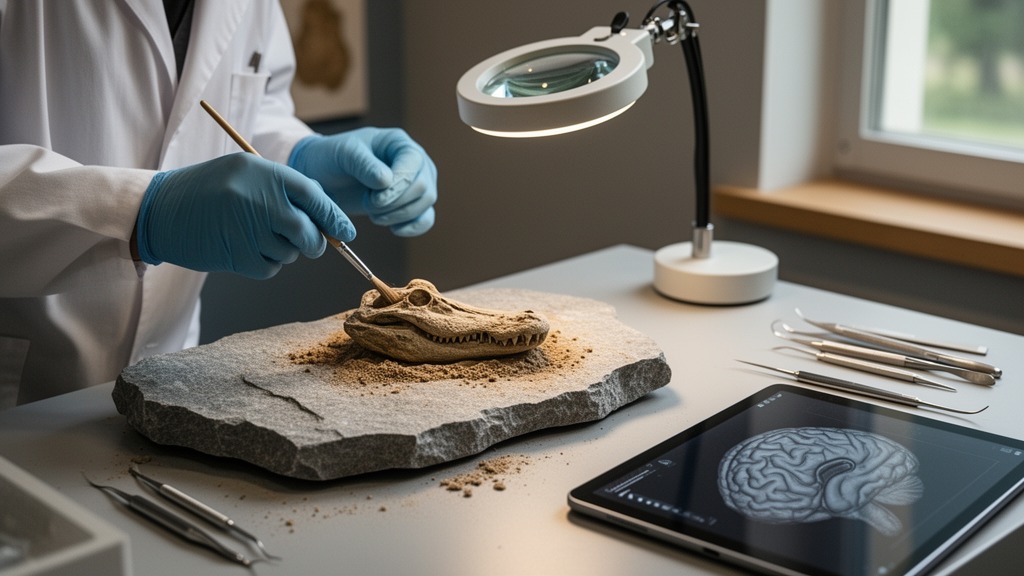
A partial crocodylomorph skull from Portugal’s Upper Jurassic Lourinhã Formation provided the first reconstructed neuroanatomy for the clade Atoposauridae. The specimen, ML2631, is an indeterminate atoposaurid rather than a formally named new species, and its incomplete preservation limits firm conclusions about its taxonomy and ecology.
Researchers recovered ML2631 from the Zimbral vertebrate microfossil assemblage near Lourinhã, where fossils occur in grey marls and silty mudstones interpreted as low-energy floodplain or lagoonal deposits. The specimen comprises a partial skull table and braincase preserved in a calcareous nodule. Its age is constrained to the upper Kimmeridgian–lower Tithonian, at the transition between those stages of the Late Jurassic.
This palaeontological study combined mechanical preparation, high-resolution micro-computed tomography, anatomical comparison, neurosensory estimation and parsimony-based phylogenetic analysis. Because matrix and dense mineral veins obscured parts of the skull, the researchers used micro-CT to segment the preserved anatomy. The scan produced 736 images with a voxel size of 0.049038 mm, although mineralisation created artefacts that complicated reconstruction.
Despite those artefacts, the team digitally reconstructed most of the skull, a nearly complete brain endocast, parts of both inner ears, several cranial nerves, part of the left internal carotid artery and most of the left paratympanic sinus system. The reconstructed brain has the sigmoidal profile reported in mesoeucrocodylians, with estimated cephalic and pontine flexure angles of approximately 150 and 145 degrees, respectively. The rhombencephalon accounts for about 55–60% of total brain length, a proportion the authors associated with neurocranial maturity.
The preserved inner ear was incomplete, although the left side was nearly complete and was combined with the anterior half of the right side in a tentative reconstruction. Its elevated anterior semicircular canal and tall, slender crus commune resembled conditions described in fully terrestrial crocodylomorphs. However, moderate canal thickness and the absence of a dorsoventrally compressed labyrinth were also compatible with eusuchians and living crocodylians. The authors therefore described the vestibular anatomy as intermediate between terrestrial and semi-aquatic forms, rather than treating it as direct proof of terrestrial locomotion.
Auditory capacity was estimated from an approximately 4.01 mm endosseous cochlear duct and an approximately 40.13 mm basicranial length, producing a logarithmic ratio of −1. This approximate result falls within the reported ranges for allodaposuchids and crocodylians and suggests adaptation for detecting low-frequency sounds. The authors noted that the cochlear region and pterygoid–palatine suture are poorly preserved, making both measurements uncertain. Olfactory capacity and the Reptile Encephalisation Quotient could not be calculated because the olfactory bulbs and body-mass proxies were unavailable.
Visual acuity was assessed by comparing reconstructed brain regions. The estimated total brain volume was 1,716.02 mm³, while the mesencephalon measured 154.2 mm³, or 8.98% of the total. This ratio is closer to the lower end of the range reported for large living crocodylians than to the higher ratios typical of smaller individuals. The authors suggested that ML2631 may therefore have been a fully grown, dwarf individual, although its ontogenetic stage could not be established securely. Comparisons with more complete atoposaurid skeletons produced a rough total-length estimate of 0.5–1 metre, probably near 0.8 metres.
The phylogenetic matrix contained 81 taxa and 321 characters. All searches recovered 30 most parsimonious trees of 1,489 steps and a strict consensus in which ML2631 was placed within Atoposauridae, between Knoetschkesuchus and Sabresuchus. Including the specimen resolved polytomies in the earlier analysis, but most internal nodes had Bremer values of 1 and bootstrap support below 50%. The Varanosuchus–Aprosuchus pairing was the exception, with a Bremer value of 6 and 83% bootstrap support.
ML2631 preserves a dorsolaterally open cranioquadrate passage, large supratemporal fenestrae with posterior fossae, a posteriorly placed septate choana and a discontinuous groove on the squamosal lobe. This combination was not matched by any known atoposaurid species and supports the possibility that the specimen represents a distinct taxon. Nevertheless, the authors retained the open designation Atoposauridae indet. because the missing teeth, much of the snout, palate and postcranial skeleton prevent adequate diagnosis and leave the species-level status and ecological interpretation uncertain.
Subject of Research: Micro-CT reconstruction and phylogenetic analysis of an indeterminate Upper Jurassic atoposaurid from Portugal
Article Title: New dwarf crocodylomorph from the Upper Jurassic of Portugal and the first neuroanatomical data for Atoposauridae
Article References: Puértolas-Pascual, E. (2025). New dwarf crocodylomorph from the Upper Jurassic of Portugal and the first neuroanatomical data for Atoposauridae. Fossil Record, 28(2), 321-346. https://doi.org/10.3897/fr.28.167846
Image Credits: AI Generated
DOI: 10.3897/fr.28.167846
Keywords: Atoposauridae, crocodylomorph, palaeoneurology, micro-CT, Lourinhã Formation, Upper Jurassic, Portugal, neurosensory reconstruction, phylogenetics, palaeontology, dwarf, Upper
Cite Scienmag News
Cassandra Pierce. (October 20, 2026). Partial Upper Jurassic crocodylomorph skull yields first neuroanatomy for Atoposauridae. Scienmag. https://scienmag.com/partial-upper-jurassic-crocodylomorph-skull-yields-first-neuroanatomy-for-atoposauridae/
Cassandra Pierce. "Partial Upper Jurassic crocodylomorph skull yields first neuroanatomy for Atoposauridae." Scienmag, 20 October 2026, https://scienmag.com/partial-upper-jurassic-crocodylomorph-skull-yields-first-neuroanatomy-for-atoposauridae/. Accessed 20 October 2026.
Cassandra Pierce. "Partial Upper Jurassic crocodylomorph skull yields first neuroanatomy for Atoposauridae." Scienmag. October 20, 2026. https://scienmag.com/partial-upper-jurassic-crocodylomorph-skull-yields-first-neuroanatomy-for-atoposauridae/


