


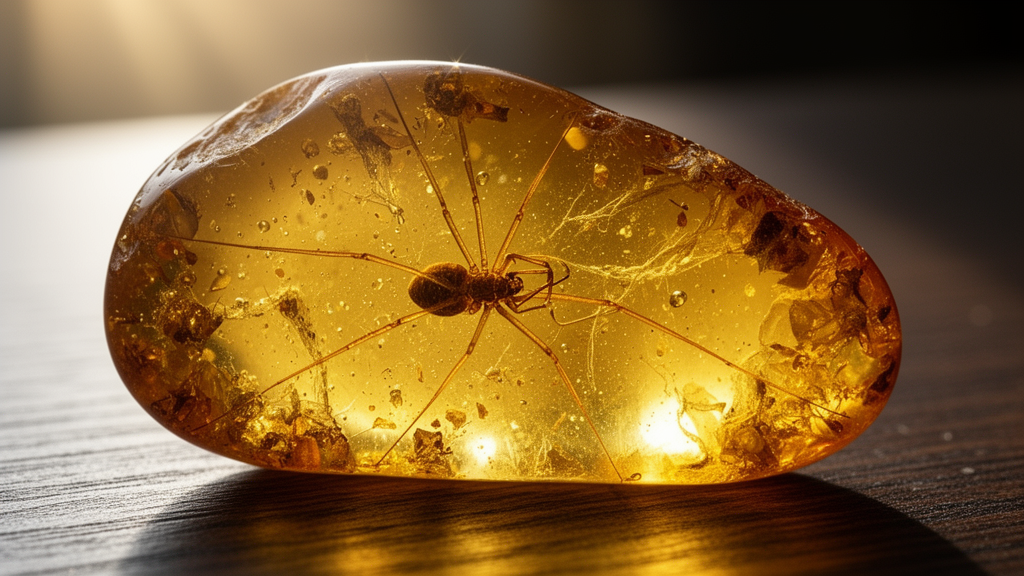
A single fossil harvestman preserved in Baltic amber has seven elements in each pedipalp, including a short additional element within the six-element endopod. The specimen, repository number PED 1313, was described in a descriptive and interpretive study of its anatomy, taxonomy and possible ecology rather than a population-level analysis of harvestman diversity.
Researchers interpreted the arrangement as most consistent with subdivision of the pedipalpal tarsus into two tarsomeres. This is the central anatomical finding, because all previously known representatives of Opiliones had been described as possessing seven pedipalpal elements overall, while the fossil displays an additional element within the endopod.
The fossil is held in the Palaeo-Evo-Devo Research Group Collection of Arthropods at Ludwig-Maximilians-Universität München in Germany. It was purchased from Artur Michalski in Wrocław, Poland, but the exact provenance of the amber was not documented. The amber piece measures 18 mm in length and 14 mm in width. Baltic amber is generally assigned a Late Eocene age of approximately 37.7–33.9 million years, although the age of the deposit remains uncertain.
Researchers examined the inclusion with light microscopy using a Keyence VHX-6000. Images were acquired at 200×, 300× and 500× magnifications under different illumination conditions, and measurements were made with ImageJ. Each measurement was repeated five times and the mean values calculated. Bubbles and fractures restricted access to some parts of the specimen, while the body measured 1.95 mm in length and 1.38 mm in width.
The pedipalps were robust, setose and seven-segmented. The first element, corresponding to the coxa or basipod, was barely discernible. The endopod comprised the trochanter, femur, patella, tibia, an additional short element and the tarsus. The patella measured 0.51 mm, the tibia 0.49 mm, the additional element 0.35 mm and the tarsus 0.58 mm. The claws lacked teeth, and a conical apophysis was present on the anterodistal end of the patella.
The authors considered a malformation unlikely because the left and right pedipalps were strongly similar and both showed the additional element. They instead favoured subdivision of the tarsus into two tarsomeres, noting that tarsal subdivision is common in harvestman walking legs. Under this interpretation, the patella, tibia and tarsal claw retain readily identifiable positions. The study also notes that increased numbers of appendage elements can result from tarsal subdivision, as seen in the pedipalps of micro-whip scorpions and the walking legs of harvestmen.
Several features support a tentative assignment to Eupnoi, a large harvestman group with about 1,800 living species. The fossil had long legs, massive setose pedipalps, a patellar apophysis and an elongated pedipalpal tarsus with a claw. The long legs, massive pedipalps and apparent absence of ozophores, the external openings of defensive glands, were used to exclude Cyphophthalmi. The elongated tarsus and tarsal claw argued against Dyspnoi. A close relationship with Laniatores could not be completely excluded because the tarsi of the third and fourth leg pairs were not preserved.
The body’s overall appearance resembled some Phalangiidae and Sclerosomatidae, but the smooth pedipalpal claw and apparent absence of a well-defined plate on the opisthosoma argued against Sclerosomatidae. Pedipalpal apophyses are common in Phalangiidae. However, important information, including the ocularium, was not accessible, preventing a more precise determination of the fossil’s relationships. The ecological interpretation was also limited. Long legs and numerous tarsomeres were considered consistent with an arboreal lifestyle, but the single specimen could not establish that habit because some long-legged Eupnoi are ground-dwelling and some short-legged harvestmen occur on trees.
The robust, densely bristled pedipalps were interpreted as potentially suitable for predatory feeding, since harvestmen use pedipalps to catch and retain prey. The study did not determine the animal’s diet or establish that the extra joint improved prey capture. Similarly, the robust pedipalps might reflect sexual dimorphism, possibly indicating a male, but another specimen would be required to support that conclusion. As a single fossil example, the specimen cannot establish whether the divided pedipalpal tarsus was common, rare, variable or restricted to a particular sex or life stage.
Amber harvestmen are known from several deposits, including Baltic, Bitterfeld, Rovno and Kachin amber. Their preservation can reveal fine anatomical details, but amber also samples organisms disproportionately from settings close to trees and may not represent the wider ecosystem. The new specimen therefore expands the documented morphological diversity of fossil harvestmen, while its taxonomic placement, lifestyle, diet and the evolutionary significance of the additional pedipalpal element remain constrained by the incomplete preservation of a single individual.
Subject of Research: Fossil harvestman pedipalp morphology and taxonomy
Article Title: An unusual harvestman from Eocene Baltic amber presenting a previously unknown morphology of the pedipalps
Article References: Gerbe, A., Bartel, C., Haug, C., Arce, S. I., Dunlop, J., & Haug, J. T. (2026). An unusual harvestman from Eocene Baltic amber presenting a previously unknown morphology of the pedipalps. Fossil Record, 29(1), 1-9. https://doi.org/10.3897/fr.29.174226
Image Credits: AI Generated
DOI: 10.3897/fr.29.174226
Keywords: Eocene Baltic amber, harvestmen, Opiliones, pedipalp morphology, tarsomere subdivision, Eupnoi, amber fossils, arachnid evolution, paleoecology, unusual, harvestman, Eocene
Cite Scienmag News
Gavin Prescott. (October 20, 2026). Eocene Baltic amber harvestman shows a seven-element pedipalp with a possible subdivided tarsus. Scienmag. https://scienmag.com/eocene-baltic-amber-harvestman-shows-a-seven-element-pedipalp-with-a-possible-subdivided-tarsus/
Gavin Prescott. "Eocene Baltic amber harvestman shows a seven-element pedipalp with a possible subdivided tarsus." Scienmag, 20 October 2026, https://scienmag.com/eocene-baltic-amber-harvestman-shows-a-seven-element-pedipalp-with-a-possible-subdivided-tarsus/. Accessed 20 October 2026.
Gavin Prescott. "Eocene Baltic amber harvestman shows a seven-element pedipalp with a possible subdivided tarsus." Scienmag. October 20, 2026. https://scienmag.com/eocene-baltic-amber-harvestman-shows-a-seven-element-pedipalp-with-a-possible-subdivided-tarsus/


