


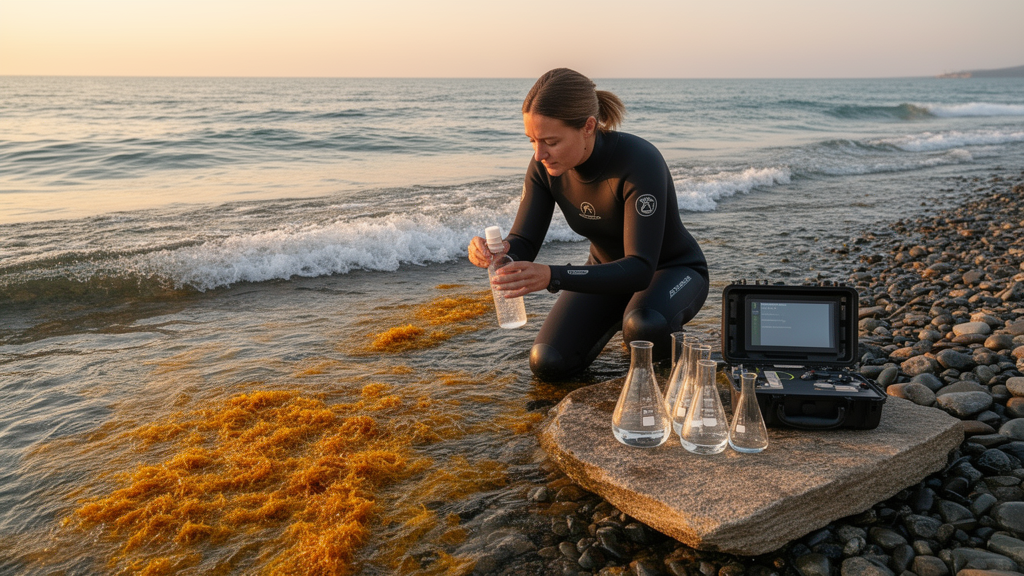
A coastal monitoring study detected domoic acid in three of 21 plankton samples and pectenotoxin-2 in two samples collected along Bulgaria’s Black Sea coast in 2021. These were the only targeted marine biotoxins detected in the sample set. The findings describe toxin occurrence in plankton net hauls rather than concentrations in mussels or other harvested seafood.
The investigators sampled sites associated with mussel farming, wild-mussel harvesting, intensive fishing, protected areas and anthropogenic activities. Sampling took place from March through December 2021 and included locations in northern and southern Bulgaria and the Varna area. The study was an observational assessment of plankton samples, not a clinical investigation or a direct evaluation of toxin levels in food products.
The 21 samples were collected with a conical plankton net with a 40-centimetre outer diameter and 20-micrometre mesh size. Each net haul was taken vertically from one to five metres below the surface. Immediately after collection, net-haul concentrates were adjusted to a volume of 500–1,000 millilitres with 20-micrometre-filtered seawater. After centrifugation at 4,000 times gravitational acceleration for 10 minutes at 10°C, the cell pellets were stored at minus 20°C.
For extraction, the pellets were suspended in 1,000 microlitres of 100% methanol. The suspensions were sonicated for 15 minutes at 40 hertz, centrifuged again for 10 minutes at 4,000 times gravitational acceleration, and filtered through 0.45-micrometre syringe filters. The resulting filtrates were transferred to chromatographic vials and kept at minus 20°C pending analysis. Measurements were performed with a liquid chromatograph coupled to a triple-quadrupole mass spectrometer.
The analytical programme targeted domoic acid and 12 lipophilic toxins: goniodomin A, okadaic acid, dinophysistoxins 1 and 2, pectenotoxin-2, pectenotoxin-2-sulfenic acid, its epimer, yessotoxin, hydroxy-yessotoxin, azaspiracid-1, spirolide-1 and gymnodimine A. Procedural blanks and certified reference material were included in quality control, while detection limits were established using a 3-to-1 signal-to-noise ratio. Results were expressed as nanograms per net tow.
Domoic acid was detected in three samples, representing 14% of the 21-sample collection. The measured values were 170.94 ng/NT in sample ME6, 138.48 ng/NT in ME15 and 13.38 ng/NT in ME58. These positive samples were collected in spring and autumn from areas designated as intensive-fishing sites or as having anthropogenic activities.
Pectenotoxin-2 was detected in sample ME9 at 9.23 ng/NT and sample ME76 at 6.51 ng/NT. The paper described these two positive samples as 10% of the total, while two of 21 samples correspond to approximately 9%. The samples came from an area associated with anthropogenic activities and a protected area, respectively, in spring and autumn. No targeted toxins were detected in the samples collected at mussel farms or in the one sample collected from a protected area.
Among the other compounds examined, the study reported no detections in 2021. This included yessotoxins, which had been registered in a small number of samples during 2016–2018, and spirolide-1, which had previously been recorded in summer and autumn 2018. The authors suggested that the rapid release of yessotoxins into the environment may make them difficult to determine in plankton samples, while the absence of spirolide-1 might be associated with low abundance or absence of its linked producer, Alexandrium ostenfeldii. These were possible explanations rather than measured causal results in the 2021 samples.
At least one measured toxin was detected in 33% of samples from areas with anthropogenic activities and in 50% of samples from intensive-fishing areas. Comparisons with earlier investigations in the same general region were made despite different sample numbers between years. Domoic acid had been detected in 57% of samples in 2016, 41% in 2017 and 17% in 2018, but in none in 2019. Pectenotoxin-2 was detected in 86% of samples in 2016, 48% in 2017, 47% in 2018 and 67% in 2019.
The dataset is limited by its small size, the selected sampling locations and the coverage of only one year. The number of samples also differed from earlier investigation periods, so the comparisons cannot establish a sustained trend or show whether the 2021 patterns extended to unsampled places and times. The authors interpreted the results, including values below detection limits, as indicating that the abundance of marine biotoxins was not alarming and that good-quality mussel meat might be expected. They recommended continued monitoring of harmful phytoplankton and biotoxins to support timely responses to harmful algal blooms and their potential consequences.
Subject of Research: Occurrence of selected marine biotoxins in Bulgarian Black Sea coastal plankton samples collected in 2021
Article Title: Occurrence of marine biotoxins on Bulgarian Black Sea coastal waters in 2021
Article References: Peteva, Z. V., Georgieva, S. K., Knock, B., Max, T., Stancheva, M. D., & Valkova, S. (2023). Occurrence of marine biotoxins on Bulgarian Black Sea coastal waters in 2021. BioRisk, 20, 71-81. https://doi.org/10.3897/biorisk.20.97557
Image Credits: AI Generated
Keywords: marine biotoxins, Bulgarian Black Sea, domoic acid, pectenotoxin-2, plankton monitoring, coastal waters, liquid chromatography, mass spectrometry, harmful algal blooms, shellfish poisoning, Occurrence, marine
Cite Scienmag News
Gavin Prescott. (October 20, 2026). 2021 Bulgarian Black Sea plankton survey detects domoic acid and pectenotoxin-2 in minority of samples. Scienmag. https://scienmag.com/2021-bulgarian-black-sea-plankton-survey-detects-domoic-acid-and-pectenotoxin-2-in-minority-of-samples/
Gavin Prescott. "2021 Bulgarian Black Sea plankton survey detects domoic acid and pectenotoxin-2 in minority of samples." Scienmag, 20 October 2026, https://scienmag.com/2021-bulgarian-black-sea-plankton-survey-detects-domoic-acid-and-pectenotoxin-2-in-minority-of-samples/. Accessed 20 October 2026.
Gavin Prescott. "2021 Bulgarian Black Sea plankton survey detects domoic acid and pectenotoxin-2 in minority of samples." Scienmag. October 20, 2026. https://scienmag.com/2021-bulgarian-black-sea-plankton-survey-detects-domoic-acid-and-pectenotoxin-2-in-minority-of-samples/


