


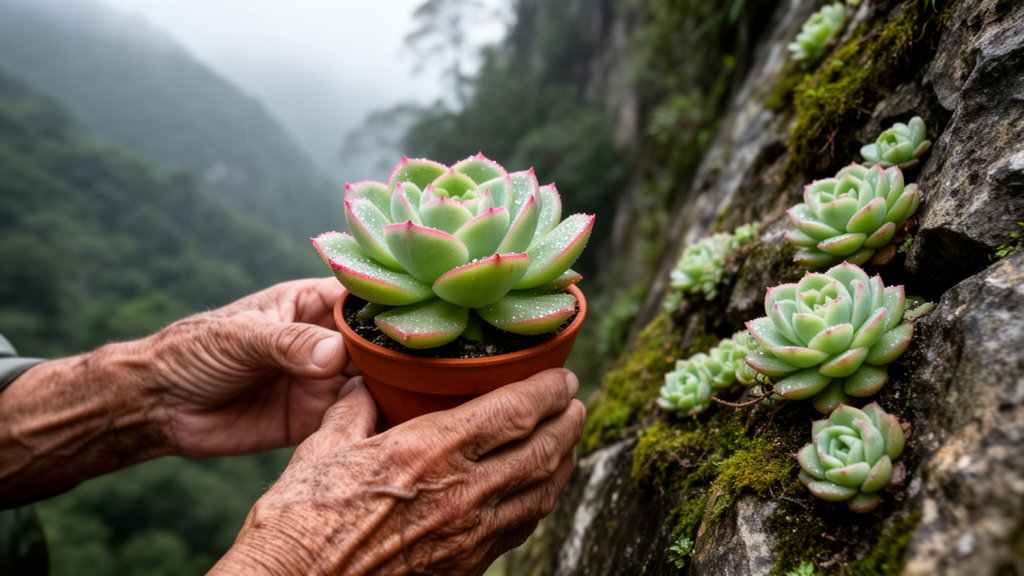
A taxonomic study combining field observations, detailed morphological comparisons and molecular phylogenetic analyses has identified two new species of the succulent genus Sinocrassula in Kunming, Yunnan Province, China. The researchers named them Sinocrassula kunmingensis and Sinocrassula chenggongensis after the city and district where their type populations were found.
The species were recognized through surveys conducted in June 2023 around Qiongzhu Temple in Wuhua District and in October 2025 around Santai Mountain in Chenggong District. These surveys uncovered three natural populations. After reviewing relevant literature, observing cultivated plants and comparing their morphology with known Sinocrassula species, the authors concluded that the populations represented two distinct species rather than variants of previously described taxa.
The study examined leaves, inflorescences, flowers and pollen. Voucher specimens were deposited in the Herbarium of Yunnan University, while living plants were maintained in the university greenhouse for morphological observation. Leaves, inflorescences and flowers were examined with a Nikon SMZ1270 stereo microscope. Mature pollen was mounted, coated with gold and studied with a QUANTA 200 scanning electron microscope. Searches of the Chinese Virtual Herbarium, National Specimen Information Infrastructure, JSTOR Global Plants and the online collections of the Kunming Institute of Botany found no additional specimens beyond those reported in the study.
For the phylogenetic analysis, the researchers sampled 54 specimens representing 23 Sinocrassula species and used species of the related genus Kungia as outgroups. Total genomic DNA was extracted from silica-dried material. The team amplified and sequenced four chloroplast markers—psbA-trnH, trnL-F, rbcL and matK—and the nuclear marker ITS. The resulting dataset contained 267 sequences, including 14 generated for the study.
Sequences were aligned with MAFFT, manually adjusted in BioEdit and concatenated in PhyloSuite. Maximum-likelihood analysis was performed with RAxML-HPC2 on the CIPRES Science Gateway using 5,000 rapid bootstrap replicates. Bayesian inference was conducted in MrBayes with GTR+F+I+G4, two independent runs of four chains each, sampling every 1,000 generations over 20 million generations. The maximum-likelihood and Bayesian analyses produced generally concordant tree topologies.
Each new species formed a highly supported monophyletic clade, with maximum-likelihood bootstrap support of 100 and Bayesian posterior probability of 1.00. The two species were also recovered as sister taxa, supported by a bootstrap value of 99 and posterior probability of 1.00. Together, they were placed as sisters to Sinocrassula adpressa, with support of 96 and posterior probability of 1.00. The combined molecular and morphological evidence therefore supported the recognition of two new species.
Sinocrassula kunmingensis is described as a glabrous perennial 25.0–33.0 centimetres tall. It has greenish-yellow or red stem leaves without spots, ovate-lanceolate bracts and reddish-purple flowers. Its petals have a slight central protrusion, and its subligulate nectar scales measure 0.5–0.8 by 0.4–0.8 millimetres. The species is currently known from two populations in central Yunnan, where it grows in granite crevices and on dry stony or gravelly slopes at elevations of 1,933–2,186 metres.
Sinocrassula chenggongensis is a glabrous perennial 16.0–24.0 centimetres tall. It differs from S. kunmingensis in several visible characters, including green stem leaves with purplish-red spots, oblong-elliptic bracts with an oblique apex, pinkish-purple flowers and petals without a protrusion. Its subligulate nectar scales measure 0.5–0.8 by 0.4–0.6 millimetres. The species is currently known from one central Yunnan population, found on tiles and walls of old village houses as well as on shaded rock faces and boulders at approximately 1,900 metres. Both species flower from September to January.
The two new species occur within a radius of about 200 metres around Santai Mountain but remain morphologically distinct. Their proximity suggests that geographic separation alone does not fully account for their differentiation. The authors note that microhabitat differentiation, ecological specialization and reproductive isolation may be involved, but these possibilities were not directly tested. They also report phylogenetic discordance in earlier Sinocrassula studies and note that hybridization and incomplete lineage sorting may contribute to it. Population-level genomic data, ecological observations and reproductive-biology studies are therefore needed to evaluate local differentiation, gene flow and the processes maintaining species boundaries.
Because only three populations were recorded during these surveys and the database searches found no further specimens, the presently known distributions of both new species are limited to central Yunnan. The study provides material for further systematics and evolutionary research, but it did not test the medicinal or ornamental properties of either species. The authors suggest metabolomic and functional-validation studies to assess potential bioactive compounds, while the findings establish the new taxa on the basis of morphology, phylogenetic placement, herbarium documentation and observed distribution.
Subject of Research: Taxonomic identification and phylogenetic analysis of two new Sinocrassula species from Yunnan, China
Article Title: Two new species of the genus Sinocrassula ( Crassulaceae ) from Yunnan Province, China
Article References: Gong, S.-R., Zhao, J., Zhang, J.-R., Liang, S.-F., Wei, L.-N., Zhou, X.-M., & Wang, J.-G. (2026). Two new species of the genus Sinocrassula (Crassulaceae) from Yunnan Province, China. PhytoKeys, 278, 39-54. https://doi.org/10.3897/phytokeys.278.190330
Image Credits: AI Generated
DOI: 10.3897/phytokeys.278.190330
Keywords: Sinocrassula, plant taxonomy, new species, Yunnan, China, morphology, molecular phylogeny, Crassulaceae, Kunming, species delimitation, species, genus
Cite Scienmag News
Margaret Porter. (October 20, 2026). Morphology and DNA phylogeny identify two new Sinocrassula species in Yunnan, China. Scienmag. https://scienmag.com/morphology-and-dna-phylogeny-identify-two-new-sinocrassula-species-in-yunnan-china/
Margaret Porter. "Morphology and DNA phylogeny identify two new Sinocrassula species in Yunnan, China." Scienmag, 20 October 2026, https://scienmag.com/morphology-and-dna-phylogeny-identify-two-new-sinocrassula-species-in-yunnan-china/. Accessed 20 October 2026.
Margaret Porter. "Morphology and DNA phylogeny identify two new Sinocrassula species in Yunnan, China." Scienmag. October 20, 2026. https://scienmag.com/morphology-and-dna-phylogeny-identify-two-new-sinocrassula-species-in-yunnan-china/


