

Friday, May 1, 2026
Science
No Result
View All Result
  • Login
  • HOME
  • SCIENCE NEWS
  • CONTACT US
  • HOME
  • SCIENCE NEWS
  • CONTACT US
No Result
View All Result
Scienmag
No Result
View All Result
Home Science News Biology

Palaeontology: Discovery of new ancient giant snake in India

April 18, 2024
in Biology
Reading Time: 2 mins read
0
Palaeontology: Discovery of new ancient giant snake in India
66
SHARES
599
VIEWS
Share on FacebookShare on Twitter
ADVERTISEMENT

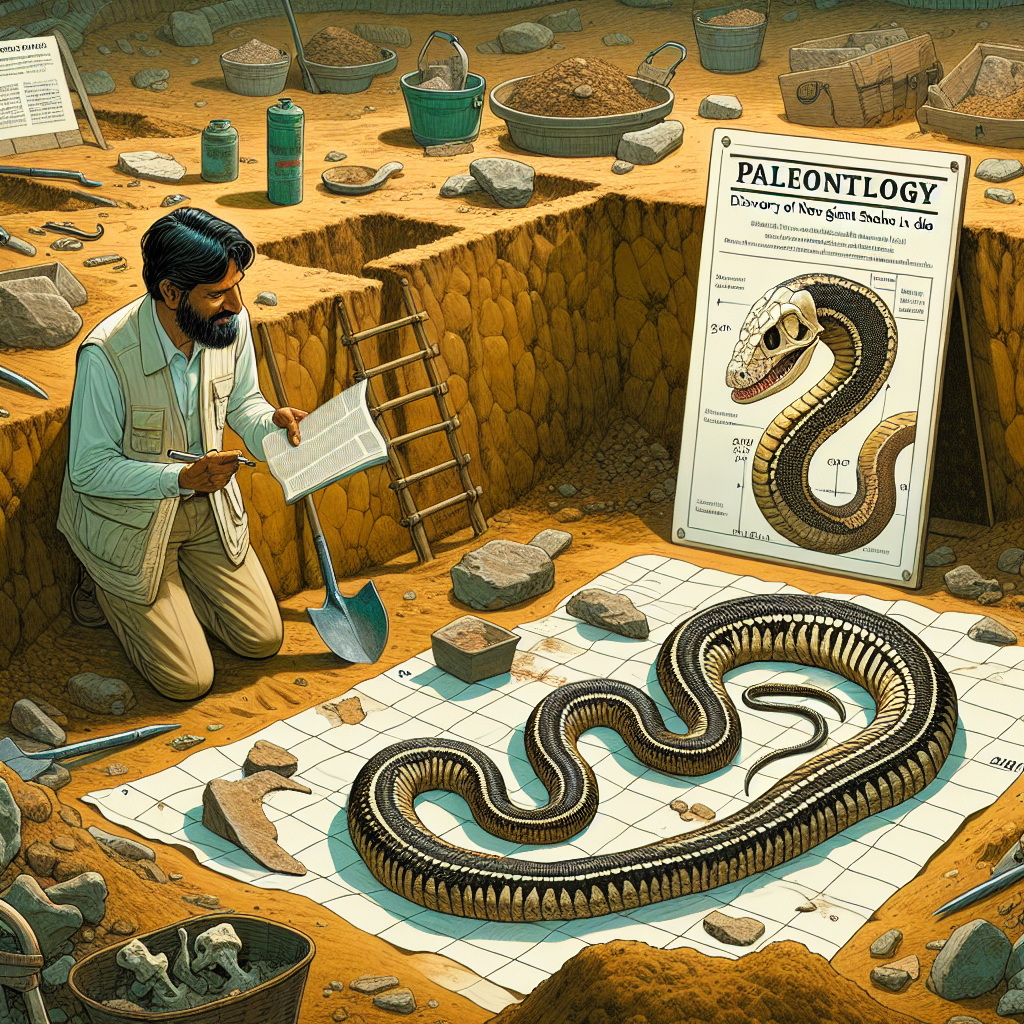
A new ancient species of snake dubbed Vasuki Indicus, which lived around 47 million years ago in the state of Gujarat in India, may have been one of the largest snakes to have ever lived, suggests new research published in Scientific Reports. The new species, which reached an estimated length of between 11 and 15 metres, was part of the now extinct madtsoiidae snake family, but represented a distinct lineage that originated in India.

A new ancient species of snake dubbed Vasuki Indicus, which lived around 47 million years ago in the state of Gujarat in India, may have been one of the largest snakes to have ever lived, suggests new research published in Scientific Reports. The new species, which reached an estimated length of between 11 and 15 metres, was part of the now extinct madtsoiidae snake family, but represented a distinct lineage that originated in India.

Debajit Datta and Sunil Bajpai describe a new specimen recovered from the Panandhro Lignite Mine, Kutch, Gujarat State, India, which dates to the Middle Eocene period, approximately 47 million years ago. The new species is named Vasuki Indicus after the mythical snake round the neck of the Hindu deity Shiva and in reference to its country of discovery, India. The authors describe 27 mostly well-preserved vertebra, some of which are articulated, which appear to be from a fully-grown animal.

The vertebrae measure between 37.5 and 62.7 millimetres in length and 62.4 and 111.4 millimetres in width, suggesting a broad, cylindrical body. Extrapolating from this, the authors estimate that V. Indicus may have reached between 10.9 and 15.2 metres in length. This is comparable in size to the longest known snake to have ever lived, the extinct Titanoboa, although the authors highlight the uncertainty around these estimates. They further speculate that V. Indicus’s large size made it a slow-moving, ambush predator akin to an anaconda.

The authors identify V. Indicus as belonging to the madtsoiidae family, which existed for around 100 million years from the Late Cretaceous to the Late Pleistocene and lived in a broad geographical range including Africa, Europe, and India. They suggest that V. Indicus represents a lineage of large madtsoiids that originated in the Indian subcontinent and spread via southern Europe to Africa during the Eocene, approximately 56 to 34 million years ago.


Journal

Scientific Reports

DOI

10.1038/s41598-024-58377-0

Article Title

Largest known madtsoiid snake from warm Eocene period of India suggests intercontinental Gondwana dispersal

Article Publication Date

18-Apr-2024

COI Statement

The authors declare no competing interests.

Share26Tweet17
Previous Post

Researchers reduce bias in pathology AI algorithms using foundation models

Next Post

Racial discrimination and metabolic syndrome in young Black adults

Related Posts

Successful Birth Following Uterus Transplant Marks Medical Breakthrough — Biology
Biology

Successful Birth Following Uterus Transplant Marks Medical Breakthrough

May 1, 2026
Cockatoos Mimic Peers to Sharpen Adaptation Skills, Study Finds — Biology
Biology

Cockatoos Mimic Peers to Sharpen Adaptation Skills, Study Finds

May 1, 2026
Gut Microbe’s Sulfated Bile Acid Eases Pediatric Sepsis — Biology
Biology

Gut Microbe’s Sulfated Bile Acid Eases Pediatric Sepsis

May 1, 2026
AI Breakthrough Solves One of Science’s Most Challenging Math Problems — Biology
Biology

AI Breakthrough Solves One of Science’s Most Challenging Math Problems

May 1, 2026
Controllable Phage System Bridges Evolutionary Gaps — Biology
Biology

Controllable Phage System Bridges Evolutionary Gaps

May 1, 2026
Viruses Develop Virulence in Mice Based on Genetics and Sex — Biology
Biology

Viruses Develop Virulence in Mice Based on Genetics and Sex

April 30, 2026
Next Post
Racial discrimination and metabolic syndrome in young Black adults

Racial discrimination and metabolic syndrome in young Black adults

  • Mothers who receive childcare support from maternal grandparents show more parental warmth, finds NTU Singapore study

    Mothers who receive childcare support from maternal grandparents show more parental warmth, finds NTU Singapore study

    27639 shares
    Share 11052 Tweet 6908
  • University of Seville Breaks 120-Year-Old Mystery, Revises a Key Einstein Concept

    1042 shares
    Share 417 Tweet 261
  • Bee body mass, pathogens and local climate influence heat tolerance

    677 shares
    Share 271 Tweet 169
  • Researchers record first-ever images and data of a shark experiencing a boat strike

    540 shares
    Share 216 Tweet 135
  • Groundbreaking Clinical Trial Reveals Lubiprostone Enhances Kidney Function

    527 shares
    Share 211 Tweet 132
Science

Embark on a thrilling journey of discovery with Scienmag.com—your ultimate source for cutting-edge breakthroughs. Immerse yourself in a world where curiosity knows no limits and tomorrow’s possibilities become today’s reality!

RECENT NEWS

  • New Study Reveals Dangers of Driving After Consuming Cannabis Edibles and Alcohol
  • Chilly Extremities, Steamy Hearts: How Body Temperature Influences Disease from TRPM4 Mutations
  • Using Epigenetics to Monitor Environmental Arsenic Exposure
  • Unseen Benefits of Inactivating Resistance Genes

Categories

  • Agriculture
  • Anthropology
  • Archaeology
  • Athmospheric
  • Biology
  • Biotechnology
  • Blog
  • Bussines
  • Cancer
  • Chemistry
  • Climate
  • Earth Science
  • Editorial Policy
  • Marine
  • Mathematics
  • Medicine
  • Pediatry
  • Policy
  • Psychology & Psychiatry
  • Science Education
  • Social Science
  • Space
  • Technology and Engineering

Subscribe to Blog via Email

Enter your email address to subscribe to this blog and receive notifications of new posts by email.

Join 5,145 other subscribers

© 2025 Scienmag - Science Magazine

Welcome Back!

Login to your account below

Forgotten Password?

Retrieve your password

Please enter your username or email address to reset your password.

Log In
No Result
View All Result
  • HOME
  • SCIENCE NEWS
  • CONTACT US

© 2025 Scienmag - Science Magazine

Discover more from Science

Subscribe now to keep reading and get access to the full archive.

Continue reading
