


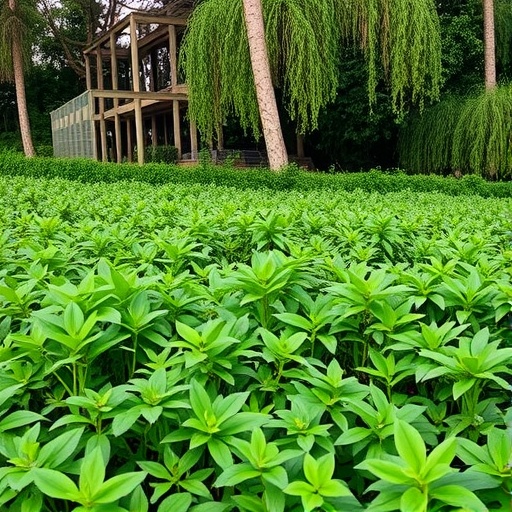
In a groundbreaking study published in Nature Communications, researchers have uncovered the surprising role of ozone in counteracting the extended growing seasons and increased vegetation greenness observed worldwide due to climate change. This revelation challenges some of the prevailing assumptions about how plant life will respond to ongoing environmental shifts and introduces a nuanced understanding of atmospheric chemistry’s influence on terrestrial ecosystems.
Over the past few decades, satellite imagery and ground observations have consistently documented a lengthening of the growing season across many biomes, especially in northern latitudes. This extension, typically driven by warmer temperatures and elevated carbon dioxide concentrations, has resulted in increased photosynthetic activity and “greener” landscapes during times of the year previously marked by dormancy or reduced growth. These phenomena contribute to what scientists term “ecosystem carbon uptake enhancement,” which has implications for the global carbon cycle and climate regulation.
However, the new research spearheaded by Yin, Meng, and Richardson et al. reveals that the presence of tropospheric ozone—a secondary pollutant formed from precursor emissions such as nitrogen oxides and volatile organic compounds—modulates these greening trends in unexpected ways. While ozone is known to be phytotoxic, causing damage to plant tissues and reducing photosynthetic efficiency, its overarching impact on ecosystem phenology under the combined forces of ambient environmental change had remained poorly quantified until now.
To unravel this complexity, the authors undertook a multi-decadal, multi-scale analysis integrating remote sensing data, ground-based atmospheric measurements, and sophisticated ecosystem modeling paradigms. Their approach contextualized vegetation dynamics within the interrelated frameworks of climate warming, atmospheric composition changes, and biogeochemical cycles, offering unprecedented insights into how growing season length and vegetation greenness evolve under interactive pressures.
Intriguingly, the study highlights that elevated ozone concentrations, particularly in polluted regions, act to suppress the phenological shifts otherwise anticipated from warming climates. Vegetation exposed to harmful levels of ozone exhibited truncated growing seasons, evidenced by earlier senescence dates and delayed green-up timings. This mitigation effect significantly offsets the greening potential associated with elevated CO2 and temperature—a counterbalance that has profound implications for forecasting vegetation productivity and carbon sequestration.
Mechanistically, ozone interferes with plants’ physiological processes through oxidative stress, impairing stomatal conductance and thus limiting CO2 uptake. Concurrently, it accelerates nutrient recycling by enhancing leaf litter decomposition rates, reshaping ecosystem nutrient availability and feedbacks. These combined physiological and ecological effects culminate in an overall dampening of vegetation vigour, directly influencing seasonal growth patterns.
The researchers further demonstrate spatial heterogeneity in ozone’s mitigating impact; temperate and subtropical zones experiencing high anthropogenic ozone pollution show the most pronounced reductions in greenness and growing season extension. Conversely, less polluted regions, particularly in boreal and arctic biomes, continue to display robust seasonal elongation and increased chlorophyll concentration, driven largely by warming and CO2 enrichment without significant ozone constraints.
This spatially differentiated response underscores the intricate interplay between air quality policies, climate dynamics, and ecosystem functionality. It also suggests that improvements in air pollution controls could inadvertently amplify vegetation responses to climate change, potentially altering carbon budgets and ecosystem services. Therefore, multi-sectoral approaches integrating climate mitigation and air quality management are critical for maintaining ecological balance.
The implications of these findings extend beyond academic interest, bearing direct relevance for agricultural productivity, forest health, and biodiversity conservation. Croplands and natural forests sensitive to ozone damage may underperform future yield expectations based solely on temperature and CO2 scenarios. This underscores the necessity for regionalized assessments of environmental stressors and adaptive strategies that consider atmospheric composition alongside climatic variables.
From a methodological perspective, the study’s success hinges on coupling high-resolution spectroradiometric indices such as the Normalized Difference Vegetation Index (NDVI) with mechanistic ecosystem models that incorporate oxidative damage pathways. This integrated modeling framework allows for disentangling the overlapping influences of climate and air pollution drivers on phenology, overcoming the limitations of singular observational or experimental datasets.
Moreover, the research calls for enhanced monitoring networks that can capture fine-scale variations in ozone pollution, especially in developing regions where emissions controls are evolving rapidly. Bridging data gaps here will refine future projections, enabling policymakers and stakeholders to devise more effective environmental and agricultural policies grounded in mechanistic understanding.
This revelation of ozone’s mitigating role also opens new frontiers for exploring feedback loops within the Earth system. For instance, reduced growing season length and vegetation greenness may alter surface albedo, evapotranspiration rates, and local microclimate conditions, subsequently influencing atmospheric chemistry and weather patterns. Recognizing these bidirectional interactions is essential for developing holistic Earth system models that faithfully simulate future climates and ecosystem trajectories.
Importantly, the study challenges the simplistic assumption that “greening” invariably equates to healthier or more productive ecosystems. Instead, it presents a nuanced narrative wherein pollution-induced stress can diminish the adaptive potential of vegetation despite favorable climatic trends. This recognition advocates for more integrated approaches to environmental stewardship that address pollutant mitigation alongside climate adaptation.
Looking ahead, the authors call for expanding research efforts that investigate other pollutants, such as particulate matter and nitrogen deposition, which may further modulate vegetation responses to climate forcing. They also highlight the value of experimental manipulations in controlled environments to dissect interaction mechanisms at physiological and community levels, complementing observational and modeling insights.
The discovery that ozone limits extended growing seasons shines a spotlight on the complex web of factors shaping vegetative life on Earth amid rapid environmental change. It warns that improving air quality and climate conditions in isolation may provoke counterintuitive ecosystem outcomes if their interactions are overlooked. This intricate dance between pollutants and plant vitality demands interdisciplinary collaborations that weave together atmospheric science, ecology, and policy.
As climate change accelerates, understanding how vegetation will respond to its diverse stressors remains a critical scientific challenge with far-reaching social and ecological ramifications. The findings by Yin, Meng, Richardson and colleagues provide a vital piece of this puzzle, underscoring that addressing air pollution is not just a matter of human health but fundamental to the resilience of Earth’s terrestrial biosphere.
In sum, this research reshapes our expectations of the biosphere’s trajectory in a warming world. By identifying ozone as a key modulator of phenological and greening trends driven by environmental change, it invites a broader reevaluation of ecosystem models that aspire to predict the future of global vegetation under intertwined atmospheric pressures. This advance charts a compelling path forward for science and policy aimed at stewarding the planet’s living systems through turbulent ecological transformations.
Cite Scienmag News
Russell Cooper. (April 20, 2026). Ozone Limits Extended Growing Seasons, Vegetation Greenness. Scienmag. https://scienmag.com/ozone-limits-extended-growing-seasons-vegetation-greenness/
Russell Cooper. "Ozone Limits Extended Growing Seasons, Vegetation Greenness." Scienmag, 20 April 2026, https://scienmag.com/ozone-limits-extended-growing-seasons-vegetation-greenness/. Accessed 3 September 2026.
Russell Cooper. "Ozone Limits Extended Growing Seasons, Vegetation Greenness." Scienmag. April 20, 2026. https://scienmag.com/ozone-limits-extended-growing-seasons-vegetation-greenness/


