


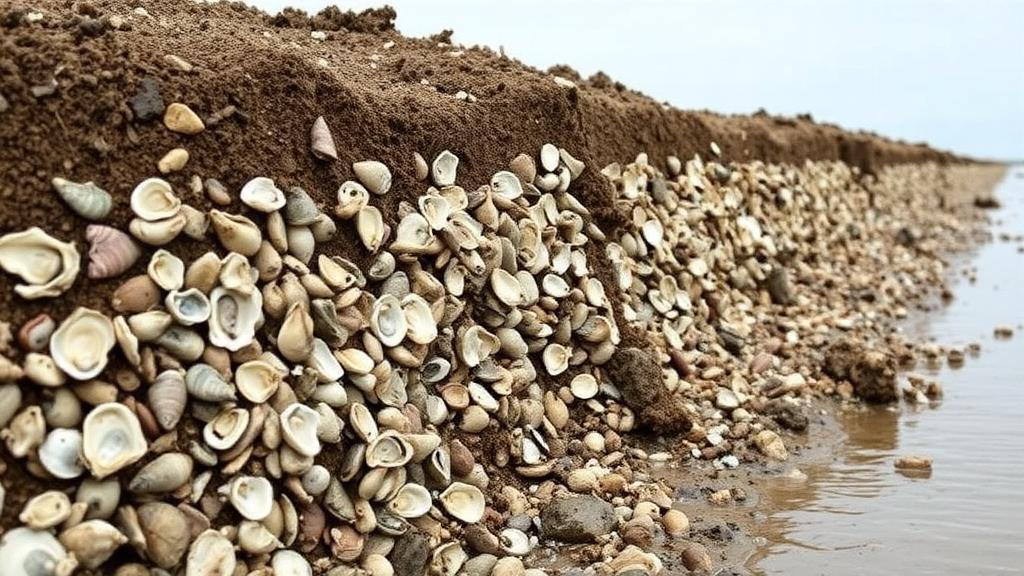
On the subtropical coast of Qinzhou, in China’s Guangxi Zhuang Autonomous Region, two unwanted piles of material keep growing: mountains of discarded oyster shells left behind by a booming aquaculture industry, and fields of expansive clay soil that swells and cracks with every change in moisture. A new study published in Environmental Earth Sciences shows that these two local liabilities, when combined with a small dose of a waxy organic molecule, can be transformed into a durable, water-repelling filling material that keeps rainwater out of cracked rock slopes. The work, led by Song Yang and colleagues at Beibu Gulf University, offers a low-carbon alternative to conventional cement grouting and could reshape how engineers approach shallow landslide prevention.
The problem the researchers set out to solve is one of the most common triggers of geological disaster worldwide. When sandstone slopes develop vertical fissures, rainwater penetrates deep into the cracks and dramatically reduces the shear strength of the rock mass, setting the stage for catastrophic sliding. The standard remedy, filling cracks with cement grout or chemical slurries, works only temporarily and comes with heavy costs: high energy consumption, substantial carbon emissions, and the risk of secondary pollution. Cement-based fillers are also poorly suited to shallow, low-stress surface layers, where their expense and rigidity offer little ecological or economic advantage.
The team’s insight was to look at what the region already had in abundance. Oyster shells, composed mainly of calcium carbonate, are piled along the shores of the Beibu Gulf, where open stacking and landfilling consume land and threaten coastal environments. Expansive soil, meanwhile, blankets much of Guangxi and is notorious in geotechnical circles for its swelling-shrinkage behavior under alternating wet and dry conditions, which causes foundation deformation and shallow slope collapse. All three sampling sites, the cracked sandstone slope, the expansive soil deposit, and the shell-strewn coastline, lie within 30.7 kilometers of one another, meaning the raw materials for crack repair can be sourced locally, cutting transport costs and improving sustainability.
The recipe is deceptively simple. Crushed oyster shell powder and sieved expansive soil were mixed with octadecylamine, or ODA, an alkylamine compound with a long hydrophobic carbon chain, and heated to 70 degrees Celsius for an hour, just above ODA’s melting point. In its liquid state, the molecule spreads easily over soil particles. The researchers tested ODA dosages of 0.8, 1.6, 2.4, and 3.2 percent by mass of dry soil, and oyster shell powder contents of 10, 20, and 30 percent, screening each combination through standardized water-repellency and swelling tests.
Water repellency was assessed with two complementary measures. The water droplet penetration time, or WDPT, records how long a standard droplet sits on the soil surface before soaking in, while the contact angle measures the angle between the droplet and the solid surface. At the lowest ODA dosage of 0.8 percent, performance was erratic: contact angles swung from 86.7 degrees down to 24.4 degrees over twelve drying-wetting cycles, and penetration times fluctuated between 91 and 409 seconds. At 2.4 percent ODA, however, the material achieved durable superhydrophobicity, maintaining contact angles above 90 degrees and WDPT values exceeding 3600 seconds, the threshold for extremely water-repellent soil, throughout all twelve accelerated wet-dry cycles. Because 3.2 percent ODA performed no better, 2.4 percent was selected as the optimal, most economical dosage.
The oyster shell powder plays a different but equally important role. As an inert, coarser-grained filler, it dilutes the swelling montmorillonite clay minerals and occupies pore space within the soil. The free swelling rate of the expansive soil dropped from 92 percent in its raw state to 48 percent with 30 percent shell powder added. Shell powder alone also reduced the surface crack ratio after drying, from 25.4 percent for untreated soil to 19.3 percent. But the real breakthrough came from the synergy between the two additives: when 2.4 percent ODA was combined with 30 percent shell powder, the desiccation crack ratio plummeted to 5.47 percent, a 78.5 percent reduction compared with untreated expansive soil, far outperforming either additive on its own.
To understand why the composite works so well, the team turned to a battery of microscopic techniques. Scanning electron microscopy revealed that the sharp-edged, porous lamellar structure of raw expansive soil became coated with a continuous amorphous film after ODA treatment, with particle edges softened and micropores blocked. X-ray diffraction showed the montmorillonite basal diffraction peak shifting to a lower angle, indicating that ODA’s long alkyl chains had intercalated into the clay’s interlayer spaces, expanding the basal spacing by about 9.5 percent, from roughly 1.47 to 1.61 nanometers. This nanoscale intercalation, confirmed by infrared spectroscopy through new CH2 absorption peaks and weakened interlayer water bands, fundamentally converts the hydrophilic clay mineral into a water-repellent one. Thermogravimetric analysis added further evidence, showing reduced water loss in modified samples and a characteristic decomposition peak of ODA’s organic chains near 320 degrees Celsius.
Mechanical testing reinforced the practical value of the modification. In unconsolidated undrained triaxial tests after twelve drying-wetting cycles, raw expansive soil lost cohesion steadily, falling from 20.4 kilopascals to 14.3 kilopascals, while the composite material retained far higher strength values, with differences between the two reaching as much as 220.5 kilopascals at the eighth cycle. Because water barely infiltrates the hydrophobic composite, the wetting and drying that normally degrades clay strength simply cannot reach the material’s interior, preserving its shear parameters over time. Soil-water characteristic curves also showed that at low water contents, below 20 percent, the modified soil sustains significantly higher matric suction, since only its large pores participate in water migration while the small hydrophobic pores resist saturation.
The decisive test came from a 134-day field-scale model experiment. The team built two artificial model cracks, each 150 centimeters long, 20 centimeters wide, and 100 centimeters deep, filled one with untreated expansive soil and the other with the composite material, and instrumented both with moisture sensors at depths of 5, 25, 45, 65, and 85 centimeters, recording data every two hours through both rainy and dry seasons totaling 1055 millimeters of rainfall. The contrast was stark. In the untreated crack, a 210-millimeter-per-day storm raised saturation at 25 centimeters depth from 25.4 to 77.2 percent within 13 hours, and within roughly 60 hours water had percolated the full 85-centimeter depth, eventually saturating the bottom layer completely. Saturation fluctuations across depths ranged from 34.2 to 75.1 percentage points. In the composite-filled crack, by comparison, fluctuations never exceeded 7.2 percentage points at any depth, and only 2.2 points at 85 centimeters, demonstrating that rainfall had essentially no influence on the material’s interior.
The researchers describe the approach as treating hazards with waste: a surface barrier of hydrophobic composite material placed at the top of a crack intercepts rainfall recharge before it can penetrate, converting two problematic local waste streams into a value-added geotechnical product. Beyond the engineering performance, the environmental accounting is compelling, since the method avoids the carbon emissions of cement grout production while reducing the methane emissions and land occupation associated with shell dumping. With raw materials that are abundant, cheap, and locally available, and with the 134-day field observation validating the laboratory’s accelerated wet-dry cycling as a realistic proxy for natural conditions, the technique offers a genuinely green route to shallow landslide prevention, one that could be replicated wherever coastal shell waste and expansive soils coexist.
Subject of Research: Development of a hydrophobic crack-filling material from waste oyster shells and expansive soil for slope stabilization
Article Title: From waste to a watershed-scale solution: Transforming oyster shell and expansive soil into a hydrophobic barrier for intercepting rainfall recharge and stabilizing slopes
Article References: Yang, S., Wu, Y., Wang, W., Yang, Z., Zhang, K., & Jiang, Q. (2026). From waste to a watershed-scale solution: Transforming oyster shell and expansive soil into a hydrophobic barrier for intercepting rainfall recharge and stabilizing slopes. Environmental Earth Sciences, 85(16), Article 412. https://doi.org/10.1007/s12665-026-13149-z
Image Credits: AI Generated
DOI: 10.1007/s12665-026-13149-z
Keywords: oyster shell waste, expansive soil, octadecylamine, superhydrophobic soil, slope stability, landslide prevention, rainfall infiltration, montmorillonite, geotechnical engineering, solid waste recycling, water repellency, crack grouting
Cite Scienmag News
Violet Maxwell. (September 30, 2026). Oyster Shell Waste and Problem Soil Turned Into Superhydrophobic Slope Barrier. Scienmag. https://scienmag.com/oyster-shell-waste-and-problem-soil-turned-into-superhydrophobic-slope-barrier/
Violet Maxwell. "Oyster Shell Waste and Problem Soil Turned Into Superhydrophobic Slope Barrier." Scienmag, 30 September 2026, https://scienmag.com/oyster-shell-waste-and-problem-soil-turned-into-superhydrophobic-slope-barrier/. Accessed 17 October 2026.
Violet Maxwell. "Oyster Shell Waste and Problem Soil Turned Into Superhydrophobic Slope Barrier." Scienmag. September 30, 2026. https://scienmag.com/oyster-shell-waste-and-problem-soil-turned-into-superhydrophobic-slope-barrier/


