

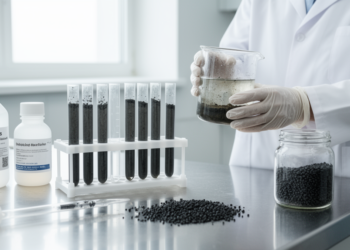
Clay–Carbon Hybrids Trap Antibiotics in Water, but Real-World Additives Undermine Them
Argentine researchers found that clay–carbon hybrid adsorbents can remove up to 0.6 mmol/g of the veterinary antibiotic oxytetracycline from water ...
Argentine researchers found that clay–carbon hybrid adsorbents can remove up to 0.6 mmol/g of the veterinary antibiotic oxytetracycline from water ...

Researchers in Thailand combined a cross-linked gelatin and alginate thin film embedded with surfactant-modified montmorillonite with gradient boosting algorithms to ...
Researchers in India have created a pH-responsive hydrogel from pullulan, carboxymethyl cellulose, and montmorillonite clay that removes over 96 percent ...
A systematic study of polypropylene composites filled with both glass fiber and organoclay finds that the fibers dominate reinforcement, consume ...
Researchers in Guangxi have converted waste oyster shells and problematic expansive soil into a durable superhydrophobic filling material that blocks ...
New research shows that negatively charged clay minerals can keep lead-bearing chloropyromorphite colloids mobile in soil water, while positively charged ...
New pot experiments show that clay mineral surface area controls mineral-associated soil carbon while pore size governs physically protected particulate ...

Embark on a thrilling journey of discovery with Scienmag.com—your ultimate source for cutting-edge breakthroughs. Immerse yourself in a world where curiosity knows no limits and tomorrow’s possibilities become today’s reality!