


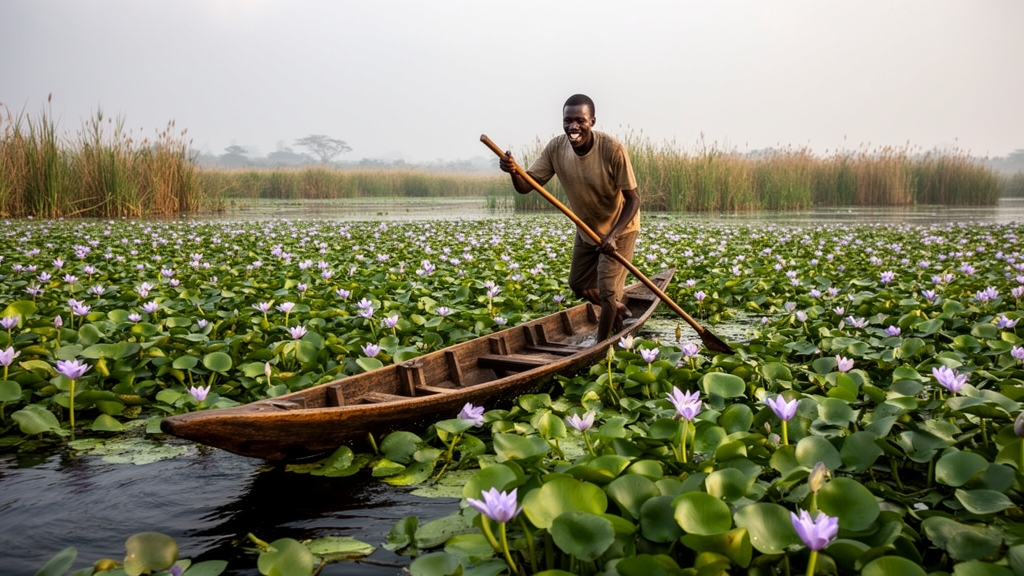
A single floating plant is quietly dismantling the economies of communities living around one of Rwanda’s most important wetland systems. Water hyacinth (Eichhornia crassipes), a South American native widely regarded as the world’s worst aquatic weed, has spread so aggressively across the Rweru-Mugesera wetland complex in Eastern Rwanda that annual fish harvests in the most heavily invaded district have collapsed from 2,147 kilograms to just 39 kilograms per year. That figure, reported in a new study published in the journal Nature Conservation, is one of the starkest illustrations yet of how an ornamental plant introduced for its pretty lavender flowers can become an ecological and economic wrecking ball when it escapes its natural enemies.
The research, conducted across the districts of Bugesera, Ngoma, and Rwamagana, surveyed 399 households living within two kilometers of the wetland complex and interviewed 22 key informants, including ecologists, village leaders, district environmental officers, fishers, and farmers’ cooperative leaders. The wetland complex itself is vast, comprising 11 lakes and associated wetlands covering 13,845 hectares within the Akagera catchment, part of the Nile and Lake Victoria basins. Roughly 225,073 people live in the surrounding sectors and depend on the wetland for farming, livestock, fishing, forestry, and trade, with a mean poverty rate of about 48 percent across the three districts, well above the national average of 39 percent. It is precisely this dependence that makes the invasion so consequential.
The researchers deliberately selected districts representing a gradient of invasion severity: Bugesera as highly invaded, Ngoma as moderately invaded, and Rwamagana as a non-invaded control. This comparative design allowed the team to test how invasion intensity shapes both what people know about the weed and how it affects their livelihoods. The results were striking. In Bugesera, 92.5 percent of respondents reported knowing about water hyacinth, and in Ngoma the figure was 81.2 percent. In uninvaded Rwamagana, by contrast, 96.25 percent of respondents had never heard of the plant. Knowledge, the study found, was largely a product of lived experience rather than formal education. Statistical tests showed no significant association between knowledge and occupation or gender across the sites, and education mattered only in Ngoma, suggesting that direct exposure to the invasion, not schooling, is what teaches people to recognize the weed.
Perceptions of the invasion’s trajectory were equally telling. In Bugesera, 95.5 percent of respondents said water hyacinth coverage was increasing, while nearly half of Ngoma respondents reported the same, with others observing a decrease, no change, or no awareness at all. As expected, the control site showed minimal awareness of any change. When asked to explain the spread, communities pointed overwhelmingly to human activity: 62.9 percent of respondents overall associated the increase with agricultural runoff, which flushes fertilizers, livestock waste, and eroded soil into the lakes, creating the nutrient-rich, eutrophic conditions in which water hyacinth proliferates. In Bugesera, poor disposal of the weed during agricultural activities was cited by 39.1 percent of respondents, and agricultural runoff by 35.4 percent, while 19.8 percent highlighted rising temperatures linked to climate change. In Ngoma, climate-related factors such as flooding and shifting rainfall patterns featured prominently alongside runoff.
Communities also identified what pushes the weed back. In Bugesera, respondents credited manual removal by fishers (56 percent) and droughts (43 percent) with reducing coverage, while Ngoma residents mentioned droughts, along with the conversion of hyacinth into bags, baskets, and compost. These responses reveal a community that has already begun adapting, turning a liability into raw material for handicrafts, animal feed, and soil amendments, approaches consistent with broader research showing that harvested hyacinth can be valorized into livestock feed, biogas, biofuel, and compost because of its rapid growth and high biomass production.
The quantitative livelihood data, however, show how punishing the invasion has been. The fishing sector was hit hardest. In Bugesera, annual fish harvests plummeted from 2,147 kilograms to 39 kilograms, and in Ngoma from 1,200 to 419 kilograms, both statistically significant declines. In uninvaded Rwamagana, harvests actually rose from 211 to 825 kilograms over the same period, underscoring that the collapse is tied to hyacinth rather than a general decline in the fishery. Meanwhile, fish prices climbed at every site, from 1,694 to 2,300 Rwandan francs per kilogram in Bugesera and from 1,638 to 2,501 francs in Rwamagana, a supply squeeze that punishes consumers even as scarcity reshapes local markets. Respondents reported restricted access to fishing grounds, longer fishing hours, torn nets, and smaller, lighter fish. Kruskal-Wallis tests confirmed significant differences among the three sites for both harvest quantities and prices.
Agriculture fared little better. Dense floating mats block irrigation channels, promote waterlogging in low-lying fields, and interfere with land preparation and harvesting. Crop yields in Bugesera fell from 730 kilograms per year before invasion to 162 kilograms after, and in Ngoma from 1,143 to 497 kilograms, with crop prices rising correspondingly at all sites. These findings echo research from Lake Tana in Ethiopia, where water hyacinth reduced crop production by 75 to 100 percent in riparian farming systems, and from other African basins where the weed has choked irrigation infrastructure and cut household harvests of rice and other lakeside crops.
Transport operators suffered a quieter but equally measurable erosion of income. Dense hyacinth mats physically obstruct waterways, forcing boat operators to take longer routes, travel at reduced speeds, burn more fuel, or in some cases abandon their boats entirely. Mean annual transport income in Bugesera dropped from 68,705 to 30,119 Rwandan francs, in Ngoma from 111,974 to 70,970 francs, and in Rwamagana from 278,371 to 167,447 francs, with statistical tests confirming significant differences among sites. Comparable studies elsewhere in Africa tell similar stories: in Cameroon’s Wouri River Basin, average monthly income from water transport fell from roughly US$200 to US$50 after hyacinth invaded, while in Ghana’s Tano River and Lagoon, farmers spent hours manually clearing the weed from canoe routes simply to reach their farms.
Ecologically, the mechanisms behind these losses are well understood. Water hyacinth forms dense floating mats that reduce light penetration and water circulation, lower phytoplankton productivity, decrease dissolved oxygen, increase sedimentation, and raise evapotranspiration. The mats shade out submerged plants, alter nutrient availability, and intensify competition among aquatic species. First recorded in Rwanda’s Mukungwa River valley in 1987, the plant has since colonized the Akagera, Nyabarongo, Akanyaru, and Rweru-Mugesera systems, and climate models suggest its range will expand further as global temperatures rise, threatening freshwater systems in more than 50 countries where it has already established.
The study’s authors argue that reversing these losses demands an integrated management strategy built with, not merely for, the riparian communities who know the weed best. Their recommendations include reducing nutrient runoff through improved agricultural practices, establishing regular monitoring, supporting manual removal efforts, and creating policy measures, training, financing, and market linkages, that convert harvested hyacinth into value-added products such as handicrafts, compost, animal feed, and bioenergy. The team also cautions that its findings rest on perception data from three districts, and that long-term environmental monitoring and economic assessment are needed to track impacts with precision. But the core message is clear: in a landscape where nearly half the population lives in poverty and the wetland is a lifeline, the spread of a single invasive plant is not an abstract ecological problem. It is a measured, quantifiable erosion of fish catches, harvests, and incomes, and the communities living at the water’s edge have already noticed, named the causes, and begun the work of fighting back.
Subject of Research: Socio-economic impacts of water hyacinth invasion on riparian communities in the Rweru-Mugesera wetland complex, Eastern Rwanda
Article Title: Riparian community perceptions of water hyacinth ( Eichhornia crassipes ) infestation and its socio-economic impacts in the Rweru-Mugesera wetland complex, Eastern Rwanda
Article References: Tuyishime, J., Rwanyiziri, G., & Soro, D. (2026). Riparian community perceptions of water hyacinth (Eichhornia crassipes) infestation and its socio-economic impacts in the Rweru-Mugesera wetland complex, Eastern Rwanda. Nature Conservation, 64, 163-183. https://doi.org/10.3897/natureconservation.64.193189
Image Credits: AI Generated
DOI: 10.3897/natureconservation.64.193189
Keywords: water hyacinth, invasive species, Rwanda, Rweru-Mugesera wetland, riparian communities, fisheries, agriculture, transport, eutrophication, climate change, socio-economic impacts, wetland conservation
Cite Scienmag News
Margaret Porter. (October 17, 2026). Invasive Water Hyacinth Is Devastating Livelihoods Around Rwanda’s Largest Wetland Complex. Scienmag. https://scienmag.com/invasive-water-hyacinth-is-devastating-livelihoods-around-rwandas-largest-wetland-complex/
Margaret Porter. "Invasive Water Hyacinth Is Devastating Livelihoods Around Rwanda’s Largest Wetland Complex." Scienmag, 17 October 2026, https://scienmag.com/invasive-water-hyacinth-is-devastating-livelihoods-around-rwandas-largest-wetland-complex/. Accessed 17 October 2026.
Margaret Porter. "Invasive Water Hyacinth Is Devastating Livelihoods Around Rwanda’s Largest Wetland Complex." Scienmag. October 17, 2026. https://scienmag.com/invasive-water-hyacinth-is-devastating-livelihoods-around-rwandas-largest-wetland-complex/


