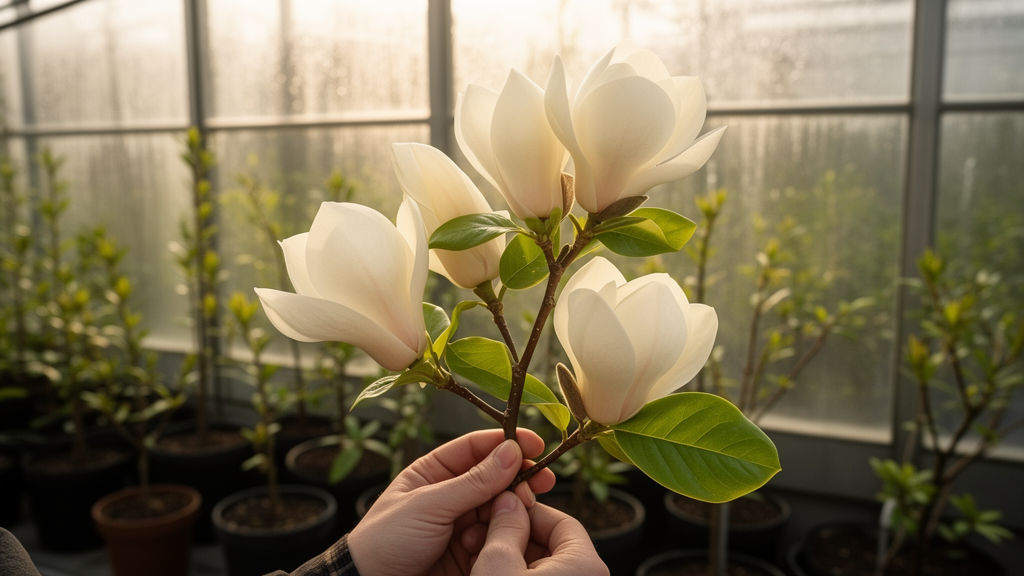
Three decades of botanical invisibility have ended for four rare Asian magnolias, after taxonomists demonstrated that they are genuine, distinct species rather than synonyms of a single Burmese tree. The research, published in the journal PhytoKeys, formally restores Michelia magnifica, M. pachycarpa, M. tignifera and M. uniflora to full species status, transferring each into the genus Magnolia in accordance with the modern classification of the family Magnoliaceae, and warns that the consequences of the original synonymy may have been catastrophic for the plants’ survival.
The problem dates to 1993, when the Dutch botanist Hans P. Nooteboom, writing in a landmark treatment of the Magnoliaceae of China co-authored with the late Chinese taxonomist Chen Bao-liang, reduced all four species to heterotypic synonyms under Michelia lacei, a species described by William Wright Smith in 1920 from central Burma, now Myanmar. For three of the four, no reason whatsoever was given for the synonymy. Only for Michelia pachycarpa was a justification offered, based on flower and fruit material, with Nooteboom stating that there was no doubt the species was synonymous with M. lacei. The new comparative work shows that statement to have been an error in judgement, not least because the flowers of the genuine Michelia lacei have never been described, and its fruit is strikingly unlike that of M. pachycarpa.
The four affected species had enjoyed long, uncontested careers before being sunk. Michelia uniflora, named in 1927 by James E. Dandy, the world’s then leading authority on the family, had been accepted for 66 years; Dandy’s M. tignifera of 1930 had stood for 63 years. Michelia magnifica, described in 1940 by Hu Hsien-hsu, the founder of modern plant taxonomy in China, had been recognised for 53 years, and M. pachycarpa, named in 1987 by Law Yuh-wu and Zhou Ren-zhang, for just six. Their synthesis under a single, poorly known Myanmar endemic meant that none of the four was ever independently evaluated in the wild, leaving their current populations a complete mystery.
The authors, Callaghan and Png, spent more than a decade combing herbaria and libraries across Australia, China, Singapore, America and Europe, examining images of roughly fourteen type and non-type specimens and compiling detailed comparative tables of morphological features. For Michelia magnifica alone, eleven distinguishing characters separate it from Michelia lacei, including indumentum on branchlets, stipules, peduncles and gynophores where M. lacei is glabrous throughout; oblanceolate rather than oblong-elliptic leaves with twenty instead of up to fifteen lateral vein pairs; ten rather than at least twelve ovules per carpel; and a recorded altitude of 1,550 metres compared with roughly 914 metres for the Burmese type collection.
The contrasts are equally decisive for the other reinstated species. Michelia pachycarpa is a very large tree reaching forty metres with a trunk up to 1.3 metres in diameter, thickly leathery leaves to 28 by 10 centimetres, nine or more tepals and a fruiting aggregate of seven to ten centimetres containing only four to six mature carpels, whereas Michelia lacei is a medium-sized tree to fifteen metres with thinly leathery leaves, about six tepals in two whorls and a four to five centimetre fruit with twelve carpels. Michelia tignifera differs in its hairy young twigs, nine tepals in three whorls, tomentose fruiting peduncles and a single flower borne on the branch tip, while Michelia uniflora, known only from an 1888 collection in the Southern Shan States, is a giant of thirty or more metres bearing powerfully scented flowers, one to a branchlet, at the shoot apex.
Because the family classification has now collapsed the formerly recognised segregate genera of Magnolioideae into a single genus, Magnolia, the reinstated species had to be transferred there. Three retain their epithets as new combinations: Magnolia pachycarpa, M. tignifera and M. uniflora. Michelia magnifica posed a nomenclatural puzzle, since the combination Magnolia magnifica is preoccupied by a Cretaceous fossil taxon named by Dawson in 1883. Under the International Code of Nomenclature for algae, fungi and plants, this would constitute an illegitimate later homonym, so the authors propose the replacement name Magnolia magnificentia, with a proposed Chinese name meaning magnificent fragrant magnolia.
The taxonomic confusion has spilled directly into conservation science. The IUCN Red List currently treats Magnolia lacei as Endangered, citing fewer than five localities, an estimated fifty to sixty mature individuals in China and fewer than 200 in Vietnam, but that assessment lumps all four synonymised species together with the true, Myanmar-restricted M. lacei. Since the descriptions of Michelia lacei in both Magnolias of China and Flora of China were largely copied from Hu’s account of M. magnifica rather than Smith’s original Burmese diagnosis, the authors argue that the true M. lacei is not even confirmed for Yunnan, and that the Chinese plants assessed under its name are actually other species entirely.
The implications reach beyond this one complex. A recent genomic study sampled twelve ex situ trees at Kunming Botanical Garden believed to be M. lacei, and found them genetically distinct from fifty-two wild trees in southeastern Yunnan. Callaghan and Png point out that the Kunming trees match the Flora of China description, which is effectively that of Michelia magnifica from western Yunnan, while the wild southeastern trees probably include Michelia pachycarpa and possibly M. tignifera, with the observed genetic mixing suggesting hybridisation. In other words, published molecular analyses may have inadvertently characterised the wrong species, a hazard that extends to phylogenomic studies generally whenever misidentified herbarium specimens are used for DNA extraction, something the authors have repeatedly observed on Chinese herbarium websites.
The wider picture is sobering. A 2007 evaluation by Botanic Gardens Conservation International found that over half of all Magnoliaceae species were threatened with extinction in the wild, and the authors believe that figure, already alarming, is most probably an underestimation once unsubstantiated synonymies are corrected. Their findings echo a study by researchers at Oxford University and the Royal Botanic Garden, Edinburgh, which concluded that as many as half of the world’s natural history specimens may carry the wrong name. Locking genuine species in synonymy also has costs for humanity: Michelia pachycarpa, for instance, produces an essential oil rich in elemene, used in national Class 2 anti-cancer capsules, a property that might never have been assessed had the species remained nameless.
The practical outlook is grim but not hopeless. Magnolia magnificentia is known from only about fifty to sixty wild individuals near its type locality at Luxi in far-western Yunnan, with low seed-setting and poor germination recorded, and may now be extinct there. Michelia pachycarpa survives in southeastern Yunnan, where surveys from 2014 to 2016 found just ten mature individuals attributed to M. lacei, and where a 2007 survey near Banzhai counted only two giant non-fruiting trees. Michelia tignifera is known from northern Vietnam and possibly Yunnan, while M. uniflora, absent from a 2025 updated checklist of Myanmar’s vascular plants and known only from its 1888 holotype, is apparently extinct or perilously close to extinction. The authors urge urgent IUCN assessments of all five now-independent species, in the wild and in cultivation, so that whatever still survives of these once-lost magnolias can be secured for the future.
Subject of Research: Restoration of four wrongly synonymised Magnoliaceae species and their transfer to Magnolia with conservation implications
Article Title: Unravelling the ill-conceived Magnolia lacei synonymy complex reveals the negative consequences of unsubstantiated synonymy to Magnoliaceae species
Article References: Callaghan, C. B., & Png, S. K. (2026). Unravelling the ill-conceived Magnolia lacei synonymy complex reveals the negative consequences of unsubstantiated synonymy to Magnoliaceae species. PhytoKeys, 279, 111-136. https://doi.org/10.3897/phytokeys.279.194847
Image Credits: AI Generated
DOI: 10.3897/phytokeys.279.194847
Keywords: Magnoliaceae, taxonomy, synonymy, Magnolia lacei, conservation, IUCN Red List, herbarium specimens, Yunnan, Myanmar, plant nomenclature, biodiversity, endangered species
Cite Scienmag News
Margaret Porter. (October 17, 2026). Four Magnolia Species Rescued From Taxonomic Limbo After 33 Years as Name-Only Synonyms. Scienmag. https://scienmag.com/four-magnolia-species-rescued-from-taxonomic-limbo-after-33-years-as-name-only-synonyms/
Margaret Porter. "Four Magnolia Species Rescued From Taxonomic Limbo After 33 Years as Name-Only Synonyms." Scienmag, 17 October 2026, https://scienmag.com/four-magnolia-species-rescued-from-taxonomic-limbo-after-33-years-as-name-only-synonyms/. Accessed 17 October 2026.
Margaret Porter. "Four Magnolia Species Rescued From Taxonomic Limbo After 33 Years as Name-Only Synonyms." Scienmag. October 17, 2026. https://scienmag.com/four-magnolia-species-rescued-from-taxonomic-limbo-after-33-years-as-name-only-synonyms/