


University of Leicester scientists are developing a method to shrink artificial intelligence algorithms, enabling smarter spacecraft.

Credit: University of Leicester
University of Leicester scientists are developing a method to shrink artificial intelligence algorithms, enabling smarter spacecraft.
It is one of more than 20 national space projects to be announced by DSIT Secretary of State Peter Kyle on the opening day of the Farnborough International Airshow. The projects, worth £33 million, come from the UK Space Agency’s National Space Innovation Programme – designed to invest in high-potential technologies, drive innovation and unlock growth across the UK.
REALM (Rapid information extraction for environmental remote sensing on board spacecraft through application of light Machine Learning models in payload computing systems) has received £690,000 funding and will be a multidisciplinary team effort by the University of Leicester, involving the School of Computing and Mathematical Sciences and School of Physics and Astronomy, as well as Space Park Leicester, the University’s pioneering £100 million science and innovation park.
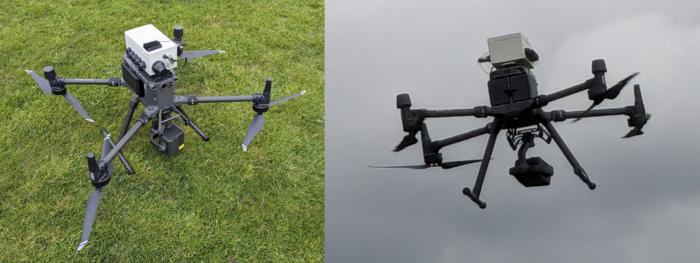
They aim to develop and demonstrate streamlined machine learning algorithms capable of complying with spacecraft power and computing performance requirements using drones. Current machine learning algorithms are too large and complex to be accommodated on the limited power and performance of spacecraft computing systems. This presents a significant barrier to enabling smarter spacecraft.
REALM aims to address this issue by using a novel sparse-split-parallelism (SSP) design framework that can compress a large multi-spectral remote sensing deep learning algorithm by at least 45% without any performance impact. The algorithm’s performance will be demonstrated on a small-scale space-compatible graphical processing unit (GPU) and its effectiveness will be validated by flying it on a drone equipped with a multispectral payload as a preliminary step towards space readiness in collaboration with commercial partners.
It is one of 15 ‘Kick Starter’ projects that will receive £9 million between them. These will support technologies and applications that are in an earlier stage of development and increase their readiness for use in commercial and scientific endeavours. The projects cover a wide range of space-related capabilities, from in-orbit servicing and manufacturing, as well as advanced material development and the use of satellite imagery. Eight further major projects will receive £24 million of the total amount.
Principal Investigator Professor Tanya Vladimirova from the University of Leicester School of Computing and Mathematical Sciences said: “To date, real-time information extraction with deep-learning level performance has not been achieved from space. Our novel approach to reduce algorithm size considerably while maintaining high accuracy performance provides a disruptive enabling technology poised to unlock a wide range of real-time services from space that previously would not have been possible due to their computational complexity.”
DSIT Secretary of State Peter Kyle said: “From combatting climate change to staying connected with loved ones, space technologies play an important role in many aspects of our day to day lives.
“But backing the growth of UK space companies is also essential for driving economic growth, boosting productivity, and creating wealth in every community.
“Our £33m investment in these projects highlights the huge potential of the UK’s space industry, especially as we collaborate with international partners.”
Dr Paul Bate, CEO of the UK Space Agency, said: “These new projects will help kickstart growth, create more high-quality jobs, protect our planet and preserve the space environment for future generations. They go to the heart of what we want to achieve as a national space agency that supports cutting-edge innovation, spreads opportunity across the UK and delivers the benefits of space back to citizens on Earth.”
Cite Scienmag News
Grant Pearson. (July 23, 2024). Over £600,000 for University of Leicester to shrink AI algorithms for smarter spacecraft. Scienmag. https://scienmag.com/over-600000-for-university-of-leicester-to-shrink-ai-algorithms-for-smarter-spacecraft/
Grant Pearson. "Over £600,000 for University of Leicester to shrink AI algorithms for smarter spacecraft." Scienmag, 23 July 2024, https://scienmag.com/over-600000-for-university-of-leicester-to-shrink-ai-algorithms-for-smarter-spacecraft/. Accessed 5 September 2026.
Grant Pearson. "Over £600,000 for University of Leicester to shrink AI algorithms for smarter spacecraft." Scienmag. July 23, 2024. https://scienmag.com/over-600000-for-university-of-leicester-to-shrink-ai-algorithms-for-smarter-spacecraft/

