


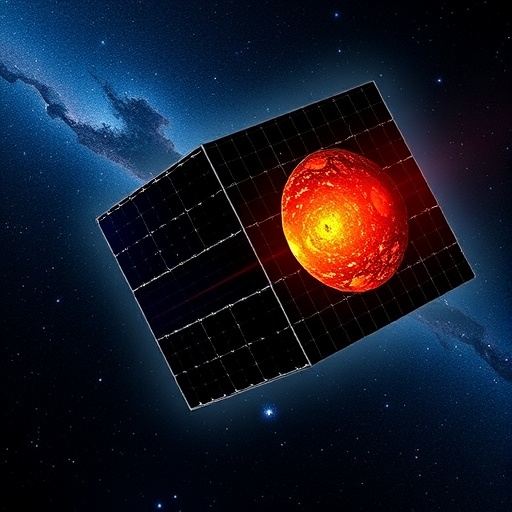
A proposed lunar mission could open an observational window onto one of the least explored chapters in cosmic history: the period between the afterglow of the Big Bang and the birth of the first stars. Called CosmoCube, the cost-conscious concept would use the radio-quiet environment on the far side of the Moon to search for faint signals from neutral hydrogen during the Universe’s “dark ages” and the beginning of “cosmic dawn.” The proposal arrives as astronomers increasingly view the redshifted 21-centimetre hydrogen line as one of the most powerful tools available for testing the origins of cosmic structure, the nature of dark matter and the conditions that existed before the first galaxies transformed the cosmos.
The dark ages began after recombination, roughly 400,000 years after the Big Bang, when electrons combined with protons to form neutral hydrogen and the Universe became transparent to light. At that stage, no stars or galaxies yet illuminated space. The cosmos was instead filled with a nearly uniform, cold hydrogen gas whose tiny density fluctuations were inherited from the early Universe. Over hundreds of millions of years, gravity gradually amplified those differences, drawing matter into increasingly dense regions. Eventually, the first stars ignited, ending the darkness and initiating cosmic dawn at approximately redshifts between 30 and 12, corresponding to around 100 million to 300 million years after the Big Bang.
Neutral hydrogen provides a natural beacon from this otherwise inaccessible era. Each hydrogen atom contains a proton and an electron whose spins can align or oppose one another. The transition between these two configurations releases or absorbs radiation at a wavelength of 21 centimetres, corresponding to a frequency of 1,420 megahertz in the local Universe. Because the Universe has expanded since the radiation was emitted, the signal is stretched to much longer wavelengths. Hydrogen from the dark ages would therefore appear at frequencies below roughly 45 megahertz, while later signals from cosmic dawn would occupy somewhat higher radio bands. Mapping those changes could reveal how matter assembled before stars and galaxies became visible.
The scientific payoff could be extraordinary. The 21-centimetre signal records how the temperature and density of hydrogen changed as the first structures emerged. It could test whether the standard model of cosmology correctly describes the growth of primordial fluctuations and could constrain the properties of dark matter, which does not emit light but whose gravity guides the formation of cosmic structure. The signal may also preserve evidence of unexpected interactions between dark matter and ordinary matter. Even subtle deviations in the hydrogen spectrum could point toward new particles, previously unknown forces or a thermal history different from the one predicted by conventional theories.
Yet the lowest-frequency Universe is almost impossible to observe from Earth. Human technology produces radio transmissions across much of the relevant spectrum, creating interference that can be millions or billions of times stronger than the cosmological signal. Television broadcasts, navigation systems, satellites, aircraft communications and other sources can overwhelm the faint hydrogen imprint. Earth’s ionosphere introduces another obstacle by absorbing, refracting and distorting long-wavelength radio waves. Together, these effects make observations below about 45 megahertz exceptionally difficult for ground-based instruments and effectively hide much of the dark-age signal.
The far side of the Moon offers a rare natural shield. With the Moon positioned between an instrument and Earth, its bulk can block terrestrial radio transmissions, creating the quietest known location in the inner Solar System for low-frequency astronomy. A spacecraft operating from the far side of the Moon’s orbit could also avoid many of the complications caused by Earth’s ionosphere. CosmoCube is designed around this advantage, proposing a compact lunar mission that could deploy radio sensors in space before the increasingly crowded radio environment makes such observations even more challenging.
Rather than relying on a large conventional telescope, CosmoCube would seek the broad, statistical signature of hydrogen across the sky. This approach is known as global-signal astronomy. The instrument would measure how the average radio brightness changes with frequency, searching for the characteristic absorption or emission features created as hydrogen interacted with the first radiation sources. The expected signal is extremely weak and would be buried beneath powerful emissions from the Milky Way, whose synchrotron radiation dominates the low-frequency sky. Separating the cosmological signal from these foregrounds would require exceptionally stable electronics, precise calibration and detailed models of the instrument’s response.
The mission concept is intended to be relatively economical and could potentially launch within a few years, according to its proponents. Its timing is significant because the far side of the Moon is not permanently protected from human-made interference in any absolute sense. Future lunar missions, relay satellites and commercial activity could gradually introduce new radio emissions near the very environment that makes the region scientifically valuable. Establishing a low-frequency observatory early could therefore preserve access to a unique cosmic laboratory before the lunar radio landscape becomes more crowded.
CosmoCube would not provide a simple photograph of the first stars. Instead, it would measure a subtle spectral fingerprint containing information about the entire young Universe. A successful detection could show when the earliest stellar radiation began heating the surrounding hydrogen, how rapidly that heating progressed and whether the first sources behaved as expected. It could also provide an independent test of observations from facilities studying the cosmic microwave background, galaxies and intergalactic gas. Together, these measurements could connect the conditions shortly after recombination with the emergence of the first luminous structures.
Major challenges remain before the concept can become a working mission. The spacecraft must maintain extraordinary control over electrical noise, thermal changes and antenna behaviour while operating far from Earth. Scientists must also distinguish a cosmological signal that may be thousands of times fainter than Galactic foregrounds and even more overwhelmed by residual spacecraft interference. Nevertheless, the CosmoCube proposal highlights a powerful idea: the Moon’s far side may be more than a destination for exploration. It could become humanity’s first platform for listening to the Universe before sunrise, revealing how darkness evolved into the star-filled cosmos observed today.
Cite Scienmag News
Grant Pearson. (August 14, 2026). CosmoCube Mission Will Probe Cosmic Dark Ages and Dawn via 21-Centimeter Signals. Scienmag. https://scienmag.com/cosmocube-mission-will-probe-cosmic-dark-ages-and-dawn-via-21-centimeter-signals/
Grant Pearson. "CosmoCube Mission Will Probe Cosmic Dark Ages and Dawn via 21-Centimeter Signals." Scienmag, 14 August 2026, https://scienmag.com/cosmocube-mission-will-probe-cosmic-dark-ages-and-dawn-via-21-centimeter-signals/. Accessed 4 September 2026.
Grant Pearson. "CosmoCube Mission Will Probe Cosmic Dark Ages and Dawn via 21-Centimeter Signals." Scienmag. August 14, 2026. https://scienmag.com/cosmocube-mission-will-probe-cosmic-dark-ages-and-dawn-via-21-centimeter-signals/


