


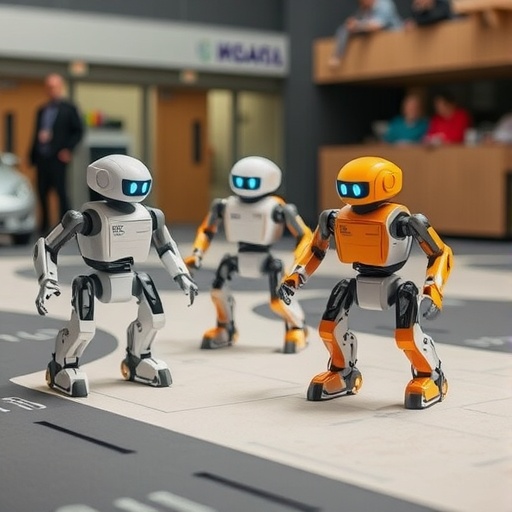
In the rapidly evolving landscape of robotic technology, researchers are making significant strides in advancing the capabilities of multi-robot systems. A groundbreaking study by Silva, Yu, and Hsieh, entitled “Probabilistic Multi-Robot Planning with Temporal Tasks and Communication Constraints,” published in the journal Autonomous Robots, delves into the complex interplay of task planning, temporal constraints, and communication limitations among robots. This research explores innovative methodologies that enhance the efficiency and efficacy of multi-robot systems, paving the way for more sophisticated applications in various fields.
The essence of the research is rooted in the need to optimize the collaborative efforts of multiple robots in real-world scenarios. Robotics operations often require a synchronized effort, especially in environments where tasks are not only dependent on timing but also influenced by the availability of communication among robots. This multi-faceted challenge presents unique obstacles that demand innovative solutions, making the findings of this study particularly relevant to engineers and designers in the field.
A central focus of the study is on the probabilistic nature of robot task assignments. Unlike deterministic approaches, which often yield rigid and inefficient outcomes, probabilistic planning allows for dynamic adjustment based on the uncertainties inherent in real-world environments. This adaptability is crucial when robots must respond to unexpected changes, such as sudden shifts in task priority or communication failures. By applying probabilistic models, the researchers enable robots to operate in a more fluid manner, thus enhancing their overall performance.
The authors also emphasize the importance of temporal constraints in robotic planning. Tasks in multi-robot systems often have defined timelines and deadlines, adding an additional layer of complexity to the planning process. The research outlines algorithms that effectively manage these temporal elements, ensuring that robots can prioritize tasks according to their time-sensitive nature. This capability is particularly valuable in scenarios such as search and rescue operations, where timely action can drastically affect outcomes.
Communication constraints further complicate the planning landscape for multi-robot systems. The researchers highlight how the reliability and bandwidth of communication channels among robots can significantly impact task execution and coordination. Their study introduces novel strategies that allow robots to function effectively even in low-communication scenarios, thereby maximizing their operational potential without relying on constant connectivity. This presents a paradigm shift in how robotic systems can be designed to be resilient in the face of communication challenges.
The integration of these various elements—probabilistic planning, temporal task management, and communication constraints—results in a cohesive framework that enhances multi-robot collaboration. The researchers employed simulations to validate their proposed methodologies, showcasing impressive advancements in task completion rates and overall efficiency when compared to traditional planning techniques. These results not only demonstrate the viability of their approach but also underscore the potential for widespread application in industries ranging from manufacturing to defense.
In addition to the technical advancements, the implications of this research extend to societal and ethical considerations. As robotic systems become increasingly autonomous, understanding their operational limitations and capabilities is essential. This study provides valuable insights that can guide policymakers and industry leaders in establishing regulations and safety standards that keep pace with technological advancements.
The potential applications of probabilistic multi-robot planning are vast. For instance, in agriculture, swarms of autonomous drones could optimize crop monitoring and pest control by coordinating their efforts based on real-time data. In logistics, fleets of delivery robots can effectively plan routes and manage time-sensitive deliveries without requiring constant oversight from human operators. Such advancements can revolutionize industries and create new opportunities for innovation and efficiency.
The researchers also discuss future directions for their work, suggesting avenues for further exploration that may include the integration of artificial intelligence and machine learning to enhance decision-making processes. As technology continues to advance, there is a need for ongoing research that aligns with the complexities of emerging robotic applications and societal demands.
In conclusion, Silva, Yu, and Hsieh’s research on probabilistic multi-robot planning unveils new horizons for robotic collaboration. By addressing the intricate challenges posed by temporal tasks and communication constraints, this study lays the groundwork for the next generation of autonomous systems. The implications of their findings extend beyond technical advancements, offering a glimpse into a future where robots collaborate harmoniously, adapting to evolving circumstances while efficiently achieving their missions.
The insights gleaned from this research are poised to inspire further studies, influencing both academic inquiry and industry practice. As we stand on the brink of unprecedented technological innovation, the importance of resilient, adaptive robotic systems cannot be overstated. The future of robotics beckons, and with research like this, we might just be witnessing the dawn of a new era in automation and collaborative task execution.
Silva, T.C., Yu, X. & Hsieh, M.A. Probabilistic multi-robot planning with temporal tasks and communication constraints.
Auton Robot 50, 2 (2026). https://doi.org/10.1007/s10514-025-10231-6
Cite Scienmag News
Denise Maddox. (January 18, 2026). Optimizing Multi-Robot Coordination Under Uncertainty and Constraints. Scienmag. https://scienmag.com/optimizing-multi-robot-coordination-under-uncertainty-and-constraints/
Denise Maddox. "Optimizing Multi-Robot Coordination Under Uncertainty and Constraints." Scienmag, 18 January 2026, https://scienmag.com/optimizing-multi-robot-coordination-under-uncertainty-and-constraints/. Accessed 4 September 2026.
Denise Maddox. "Optimizing Multi-Robot Coordination Under Uncertainty and Constraints." Scienmag. January 18, 2026. https://scienmag.com/optimizing-multi-robot-coordination-under-uncertainty-and-constraints/


