


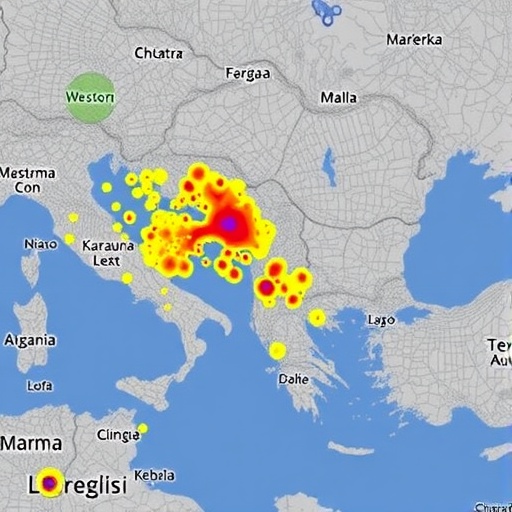
A few seconds can make the difference between standing safely in a doorway and being trapped by falling glass, furniture or masonry. A study published in Nature Communications examines how Android’s smartphone-based earthquake alerts performed during the 2025 Marmara Ereğlisi earthquake in Türkiye, and how people responded when warnings reached their phones. The research brings one of the world’s largest consumer technologies into the center of earthquake science: the ordinary smartphone.
Android Earthquake Alerts is designed to detect earthquakes through the accelerometers built into millions of Android devices. These sensors are normally used to track movement, rotate a screen or recognize physical activity. During an earthquake, however, the same hardware can register the distinctive horizontal and vertical shaking produced by seismic waves. When many phones in the same area detect similar motion at nearly the same time, algorithms can identify a possible earthquake, estimate its location and calculate an initial magnitude.
The system is based on the physical difference between earthquake waves. The faster-moving P waves generally arrive first but are weaker and less damaging. The slower S waves and surface waves follow, producing stronger shaking that can damage buildings and threaten lives. By analyzing early signals and transmitting an alert through the internet, the system may warn people in areas where severe shaking has not yet arrived. The available warning time depends on the earthquake’s location, the distance to the user, network conditions and the speed of the seismic rupture.
The Marmara region is one of the most closely watched earthquake zones in the world. It lies near the North Anatolian Fault, a major tectonic boundary where the Anatolian and Eurasian plates move past one another. Dense urban development, a large population and a history of destructive earthquakes make even a short warning potentially valuable. The 2025 Marmara Ereğlisi earthquake therefore offered researchers an opportunity to evaluate the alert system under real conditions rather than controlled laboratory tests.
Mousavi, Robertson, Allen and colleagues examined both sides of the technology’s performance. The first was technical: whether alerts were issued, how quickly they arrived, how accurately they reflected the earthquake and how closely the warnings corresponded to the shaking experienced by users. The second was human: whether people noticed the alerts, understood them, trusted them and changed their behavior. An alert can be scientifically accurate yet still fail to protect people if it is ignored, misunderstood or delivered too late.
This human factor is particularly important because Android alerts are not conventional news notifications. They are intended to interrupt normal phone use with a warning designed for immediate action. Depending on the expected shaking, users may receive information about the earthquake’s estimated location, magnitude and anticipated intensity. The system may also provide instructions such as moving away from windows, taking cover under sturdy furniture or preparing for strong shaking. These messages must be short enough to read quickly while conveying information that is technically uncertain in the first moments of an earthquake.
Earthquake early-warning systems do not predict earthquakes before they begin. They detect the first evidence that an earthquake is already happening and attempt to warn people farther from the rupture. This distinction is crucial. The system cannot prevent a quake, identify an unknown future event or guarantee that every user will receive a warning before shaking begins. In locations close to the epicenter, the strongest waves may arrive before an alert can be processed. In more distant areas, however, even a brief interval may allow people to stop driving, move away from hazardous objects or protect themselves indoors.
The study’s focus on user response reflects a broader shift in disaster science. Researchers increasingly measure not only whether an algorithm works, but also how people behave when it activates. Smartphone data can reveal the reach of an alert across a population, while surveys and user reports can show whether recipients experienced the warning as helpful, confusing or alarming. These reactions matter because repeated false alarms could erode trust, while overly cautious messages might cause people to dismiss future warnings. Effective systems must balance sensitivity, speed and credibility.
The Marmara Ereğlisi event also highlights the unusual scale of smartphone-based sensing. Traditional seismic networks rely on specialized instruments installed at carefully selected locations. Smartphones are less sensitive and less precisely calibrated, but they are distributed across cities, towns and homes in enormous numbers. That density can provide rapid information from places where conventional stations are sparse. At the same time, phone availability, battery status, connectivity, operating-system settings and user permissions can influence who receives an alert and when, creating technical and social limits that researchers must account for.
As earthquake-prone countries expand warning infrastructure, the findings offer a real-world test of whether mass-market technology can become part of public safety at national scale. Android alerts do not replace building codes, emergency planning, trained responders or robust seismic networks. Their value lies in adding another layer of protection—one that can reach people through devices they already carry. The 2025 Marmara Ereğlisi earthquake shows why that layer is attracting intense scientific attention: when the ground begins to move, a global smartphone network may become a rapidly assembled sensor array, an emergency communication channel and, for some users, a crucial few seconds of warning.
Cite Scienmag News
Violet Maxwell. (August 11, 2026). Android Smartphone Alerts’ Performance and User Responses During 2025 Marmara Ereğlisi Earthquake. Scienmag. https://scienmag.com/android-smartphone-alerts-performance-and-user-responses-during-2025-marmara-ereglisi-earthquake/
Violet Maxwell. "Android Smartphone Alerts’ Performance and User Responses During 2025 Marmara Ereğlisi Earthquake." Scienmag, 11 August 2026, https://scienmag.com/android-smartphone-alerts-performance-and-user-responses-during-2025-marmara-ereglisi-earthquake/. Accessed 3 September 2026.
Violet Maxwell. "Android Smartphone Alerts’ Performance and User Responses During 2025 Marmara Ereğlisi Earthquake." Scienmag. August 11, 2026. https://scienmag.com/android-smartphone-alerts-performance-and-user-responses-during-2025-marmara-ereglisi-earthquake/


