


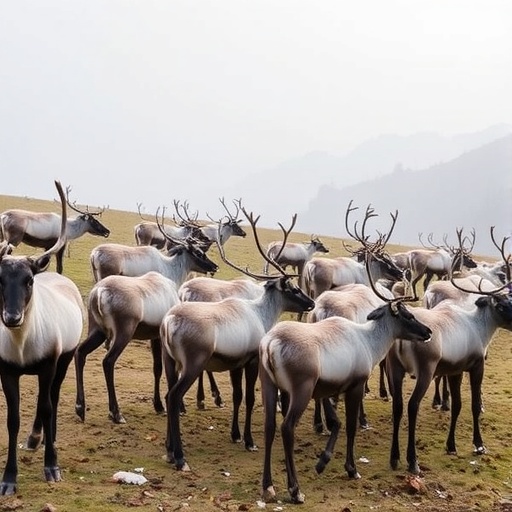
In the harsh and dynamic landscapes of Siberia, the Evenki peoples have thrived for centuries through their intricate reindeer herding practices. These nomadic communities, often referred to as Tungus, have developed a deep-rooted relationship with the environment and their herds, showcasing remarkable adaptation strategies that ensure their survival amidst changing climates and socio-economic pressures. A recent study delves into these adaptation strategies, illuminating both the resilience of the Evenki culture and the broader implications for understanding historical societal collapses, particularly the enigmatic decline of the Hongshan culture.
The research, conducted by Zhang and Wang, employs a multidisciplinary approach, combining archaeological evidence with ethnographic studies. It is through this dual lens that the researchers are able to decode the adaptive practices of the Evenki, which have evolved over time in response to environmental shifts, governmental policies, and market fluctuations. The result is a nuanced understanding of how indigenous cultures navigate the complexities of survival in a rapidly changing world, underscoring a crucial narrative often overlooked in the annals of history.
One of the salient themes emerging from the study is the Evenki’s ability to manage their reindeer populations sustainably. The researchers found that traditional knowledge passed down through generations plays a pivotal role in this process. The Evenki manage not just herds but entire ecosystems, employing a sophisticated understanding of seasonal migrations and grazing patterns. This ecological wisdom is complemented by contemporary knowledge, enhancing their adaptive capacity in the face of climate instability—an aspect sorely needed as global temperatures continue to rise.
Moreover, the study highlights the socioeconomic factors influencing reindeer herding practices. Historically, the transition from subsistence-based economies to market-driven ones has prompted significant changes in how the Evenki interact with their herds. While traditional practices remain vital, there is an increasing pressure to engage with external markets, leading to hybridization in their herding strategies. This adaptation to a market economy serves not only to meet immediate economic needs but also to preserve cultural identity in a landscape fraught with capitalist pressures.
The implications for the Hongshan culture are profound. The study posits that understanding the adaptive strategies of the Evenki can provide insights into the collapse of the Hongshan culture, known for its sophisticated metallurgy and enigmatic ruins scattered across northern China and Inner Mongolia. It suggests that the challenges faced by the Hongshan—climatic changes, resource depletion, and social strife—may mirror those confronting the Evenki today. Similar adaptation strategies could have been pivotal in the survival or demise of other cultures throughout history, raising questions about resilience in the face of unprecedented challenges.
Crucially, the research also addresses the role of governance in indigenous livelihoods. The policies enacted by modern nation-states often disrupt traditional practices, imposing regulations that can be at odds with the ecological wisdom of the Evenki. The study underscores the importance of integrating traditional knowledge into contemporary governance frameworks, advocating for a collaborative approach that empowers indigenous communities to thrive while contributing to broader socio-environmental goals.
Furthermore, the researchers examine the impact of global climate change on reindeer herding. As temperatures rise and weather patterns shift, the availability of grazing lands becomes increasingly unpredictable. The Evenki’s adaptive strategies include diversifying their herding practices and employing innovative techniques to maintain herd health and productivity. These adaptive measures not only enhance the resilience of the herding communities but also provide important lessons for other regions grappling with similar climate challenges.
Importantly, the study emphasizes the socio-cultural dimensions of reindeer herding beyond mere economic considerations. The spiritual significance of reindeer to the Evenki extends into their cultural identity, rituals, and community cohesion. This cultural lens is crucial for understanding the holistic nature of adaptation strategies. The interplay between economic viability and cultural preservation highlights the need for a multidimensional approach to sustainability that values indigenous knowledge systems alongside modern practices.
Zhang and Wang’s findings mobilize a broader discourse on cultural resilience. By exploring the Evenki’s adaptive strategies, the study invites a re-evaluation of narratives surrounding cultural collapse. Instead of viewing such phenomena as linear trajectories leading to extinction, the research posits that indigenous cultures often exhibit remarkable resilience, characterized by continual negotiation between tradition and change.
As the global community grapples with the accelerating impacts of climate change, the relevance of this study further solidifies. The case of the Evenki serves as a microcosm for understanding how human societies might learn from indigenous practices to foster sustainability. This research prompts a critical examination of our current pathways, urging policymakers, scientists, and cultural scholars to heed the lessons embedded within the adaptations of the Evenki.
Ultimately, the study not only enriches our understanding of the Evenki’s socio-economic strategies but also contributes to a larger dialogue about the fate of indigenous cultures in a modernizing world. The research acts as a clarion call for recognizing and respecting the wisdom of indigenous peoples, whose adaptive strategies might hold key insights for the future as we confront both environmental and cultural crises worldwide.
The research challenges the dichotomy between ancient and modern, suggesting that traditional knowledge is not relic of the past but a living practice, continuously evolving. It reinforces the notion that communities like the Evenki, through their unique cultural narrative, provide a template for resilience that transcends time and circumstance.
This pivotal study, scheduled for publication in Asian Archaeology in March 2025, signals a crucial intersection of archaeology, anthropology, and climate science, positioning the Evenki as central figures in the conversation about adaptation and resilience.
The extensive research detailed in this article paves the way for future inquiries into indigenous practices and their implications for modern societies, ensuring that the voices of communities like the Evenki are not only acknowledged but amplified in discussions surrounding sustainability and cultural continuity.
By unveiling the intricate tapestry of reindeer herding practices and the socio-cultural dynamics of the Evenki peoples, Zhang and Wang provide a compelling narrative that resonates far beyond the Siberian wilderness, offering vital lessons for an interconnected world poised at the edge of uncertainty and change.
Cite Scienmag News
Gavin Prescott. (January 18, 2026). Reindeer Herding Adaptation: Lessons from Hongshan Culture Collapse. Scienmag. https://scienmag.com/reindeer-herding-adaptation-lessons-from-hongshan-culture-collapse/
Gavin Prescott. "Reindeer Herding Adaptation: Lessons from Hongshan Culture Collapse." Scienmag, 18 January 2026, https://scienmag.com/reindeer-herding-adaptation-lessons-from-hongshan-culture-collapse/. Accessed 3 September 2026.
Gavin Prescott. "Reindeer Herding Adaptation: Lessons from Hongshan Culture Collapse." Scienmag. January 18, 2026. https://scienmag.com/reindeer-herding-adaptation-lessons-from-hongshan-culture-collapse/


