


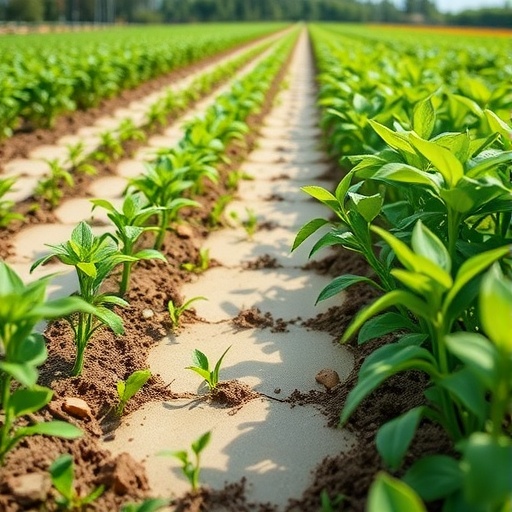
In the realm of agricultural innovation and resource management, the significance of water quality for irrigation cannot be overstated. With the ever-increasing pressures of climate change, population growth, and scarcity of water resources, the need for effective irrigation strategies has reached critical importance. A recent study published in Nature Resources Research sheds light on a groundbreaking approach that leverages predictive analytics to optimize irrigation water quality. This research, led by Reddy N.D.K., Diksha, and Praveen K., proposes a novel method employing genetic algorithms to efficiently manage water quality, presenting a transformative perspective on agricultural practices.
Water is the lifeblood of agriculture, and the quality of irrigation water directly impacts crop yield and soil health. Contaminated or suboptimal water can reduce agricultural productivity, leading to significant economic and environmental repercussions. The study identifies various contaminants commonly found in irrigation water, such as heavy metals, nitrates, and pathogens, which pose a threat not only to crops but also to human health. Thus, monitoring water quality is essential, and the researchers emphasize that traditional methods of analyzing water quality are not only time-consuming but often fail to provide real-time data.
In recognizing this challenge, the authors turn to predictive analytics as a solution. Predictive analytics uses statistical algorithms and machine learning techniques to analyze historical data and forecast future outcomes. This innovative approach facilitates better decision-making in water management by predicting potential contaminant levels and their impact on agricultural outcomes. The study investigates how genetic algorithms, a subset of machine learning, can be deployed to refine predictive models specifically for irrigation water quality.
Genetic algorithms mimic the process of natural selection, where the most effective solutions are iteratively selected for breeding in order to produce improved offspring. This methodology allows the research team to optimize the parameters involved in predicting water quality, accounting for numerous variables that can influence the presence of contaminants. By applying this technique, the researchers successfully developed a model that not only predicts water quality levels with high accuracy but also provides actionable insights on how to improve water treatment processes.
The results demonstrate significant advancements over traditional water quality monitoring approaches. The study’s models were evaluated against established water quality metrics, revealing a marked improvement in prediction accuracy. This innovation ensures that farmers and agricultural managers can make informed decisions, such as when to treat water or which sources to utilize, thereby promoting sustainable agricultural practices and conserving precious water resources.
Furthermore, the research underscores the importance of integrating technology into agriculture—a move that is increasingly vital in a world facing resource constraints. The authors advocate for functional collaboration among various stakeholders, including policymakers, agricultural scientists, and technology developers to foster a holistic approach to water management. This collaborative effort is crucial to ensure that the agricultural community remains adaptive and resilient while grappling with evolving climate challenges.
The implications of this research extend beyond agricultural productivity; they carry potential benefits for environmental sustainability. By optimizing irrigation water quality through advanced analytics, the study contributes to mitigating the environmental impact of agriculture. Reducing water contaminants not only enhances crop quality but also helps safeguard local ecosystems, preserving biodiversity and ensuring a healthier planet for future generations.
In addition to enhancing water quality, the authors discuss the economic implications of their findings. By improving efficiency in water usage and reducing the costs associated with conventional water testing and treatment, farmers can experience higher profitability. Moreover, optimizing water quality can lead to larger, healthier crop yields that command better market prices, thereby enhancing overall agricultural viability.
The study also acknowledges that the application of predictive analytics is in its infancy within the agricultural sector. While the results are promising, the researchers call for larger-scale field trials to validate their model and further refine its predictive capabilities. The team encourages the adoption of smart farming technologies, advocating for the integration of the proposed genetic algorithm approach with existing monitoring systems to create a seamless transition to data-driven enterprise resource planning in agriculture.
As the global focus pivots towards sustainable development, this innovative research aligns well with global initiatives aimed at ensuring food security and resource conservation. The advancement of predictive analytics through genetic algorithms embodies the forward-thinking essential for addressing future agricultural challenges. As farmers and researchers harness the power of technology, opportunities abound to redefine water management practices that support both economic growth and ecological health.
In conclusion, Reddy, Diksha, and Praveen’s pioneering work in predictive analytics for irrigation water quality serves as a beacon of hope in agricultural science. It emphasizes that the future of farming lies not only in traditional practices but also in embracing new technologies that enhance efficiency and sustainability. As the agricultural community looks towards the future, the study suggests that integrating advanced analytics into water management will pave the way for a more resilient and productive agricultural landscape.
The findings of this study represent a significant leap forward in understanding the interplay between irrigation water quality and agricultural success. In a world where water scarcity looms large, this research presents an invaluable framework for ensuring water quality meets the advanced demands of modern agriculture, ultimately leading to a more sustainable and secure food supply chain.
Cite Scienmag News
Alan Morgan. (December 22, 2025). Optimizing Irrigation Water Quality with Genetic Algorithms. Scienmag. https://scienmag.com/optimizing-irrigation-water-quality-with-genetic-algorithms/
Alan Morgan. "Optimizing Irrigation Water Quality with Genetic Algorithms." Scienmag, 22 December 2025, https://scienmag.com/optimizing-irrigation-water-quality-with-genetic-algorithms/. Accessed 4 September 2026.
Alan Morgan. "Optimizing Irrigation Water Quality with Genetic Algorithms." Scienmag. December 22, 2025. https://scienmag.com/optimizing-irrigation-water-quality-with-genetic-algorithms/


