


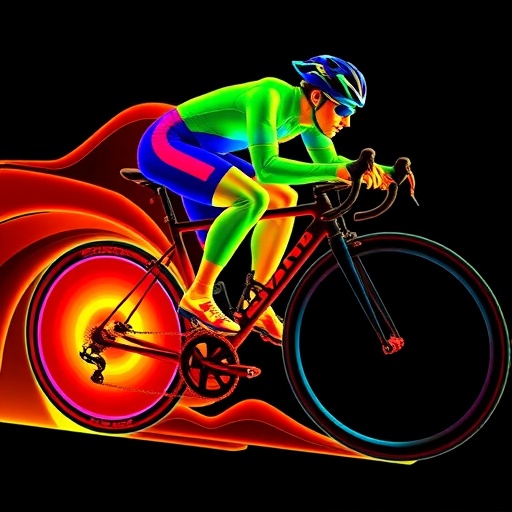
Recent advancements in computational fluid dynamics (CFD) are making waves in the world of sports science, particularly in cycling. A new study by Taylor et al. explores these innovations in the context of a cyclist’s performance during time trials. Time trials present unique challenges as athletes strive to achieve maximum velocity while contending with aerodynamic drag. The study provides critical insights into how the application of CFD can refine cycling techniques, enhance performance, and potentially reshape cycling training regimens.
The journey begins with an understanding of the fundamental principles of CFD. This technique evaluates fluid movements and interactions through numerical analysis, allowing researchers to simulate airflow around various objects. By applying CFD to cycling, scientists can visualize how air flows over a cyclist’s body, equipment, and the terrain, creating an intricate picture of aerodynamics that was once only achievable through expensive wind tunnel testing. This shift towards digital simulation heralds a new era of precision in performance analytics.
One of the standout aspects of this study is its focus on practical applications. While CFD has long been confined to theoretical realms, the authors present actionable insights that can be readily utilized by athletes and coaches. By modeling different cyclist positions, the research identifies optimal postures that minimize drag while maximizing speed. This critical parameter can be vital for competitive cyclists aiming to shave seconds off their race times, where even the smallest improvements can make a significant difference.
In their research, Taylor et al. also investigate the role of gear selection in time trials. The study highlights how bike setup, including wheel selection and frame configuration, interacts with aerodynamic profiles. By creating a detailed database of interactions between gear configurations and air resistance, the authors present evidence-driven recommendations that could change the way cyclists approach their equipment choices before races.
Another intriguing element of the study is the exploration of the cyclist’s physiological parameters. While equipment and positioning are essential, the human element cannot be overlooked. Combining CFD insights with physiological data can lead to holistic training methodologies. For example, understanding how a cyclist’s heart rate or power output correlates to different aerodynamic positions could enable trainers to optimize training loads and recovery strategies. This synthesis of data offers a more nuanced view of athlete performance and could lead to tailored training protocols that are backed by scientific evidence.
Furthermore, the researchers emphasize the importance of iterative testing and model refinement. CFD is not a one-time analysis but rather an evolving process that benefits from repeated simulations and data collection. The study advocates for regular assessments of a cyclist’s performance through CFD, which could help in identifying changes in aerodynamics due to various factors such as weather, course profile, or even slight modifications in technique. Monitoring these variables allows athletes to remain adaptive and responsive in their training regimes.
The insights from this research also extend beyond individual sports. The modeling techniques and findings can provide valuable lessons for other competitive sports where aerodynamics play a critical role, such as triathlons or speed skating. The principles of airflow and resistance are universally applicable, making the methodology a potential springboard for research in various disciplines. This cross-pollination of knowledge not only enhances the overall scientific understanding but also taps into a larger audience eager to optimize athletic performance.
As the growth of data-driven methodologies continues to influence sports technology, the study positions itself at the forefront of this transformation. Technologies that provide real-time feedback during training are becoming increasingly prevalent, and integrating CFD simulations into these tools could revolutionize the way athletes prepare for competition. By seamlessly combining historical data, individualized training metrics, and CFD predictions, cyclists could experience a new paradigm of tailored athletic preparation.
The potential implications for competitive cycling are substantial. Professional teams are always on the lookout for any competitive edge, and adopting CFD as a foundational aspect of training gives them a significant advantage. The ability to visualize and understand the nuances of aerodynamics empowers cyclists and their coaches to make informed decisions that can impact performance outcomes. As top-tier teams continue to embrace data analytics, those who integrate such advanced methodologies may gain a competitive edge that is difficult to replicate.
However, the adoption of CFD methodologies in cycling isn’t without its challenges. The need for continuous data updates and the technical expertise to interpret CFD results can be barriers to entry for many amateur athletes. Moreover, as with any emerging technology, the integration of CFD into regular training routines must be undertaken with caution. Misinterpretation of data or over-reliance on simulation results without appropriate contextual understanding could lead to flawed training strategies.
Despite these challenges, the study serves as a clarion call for the cycling community. The findings advocate for a more profound integration of scientific principles into athletic endeavors, emphasizing continuous learning and adaptation in pursuit of excellence. As sports science continues to break new ground in understanding human performance, the imperative will be towards leveraging these insights responsibly and effectively.
In conclusion, Taylor et al.’s research marks a significant step forward in the application of CFD to cycling. The insights gained extend beyond mere performance metrics and delve into the interconnectedness of equipment, physiology, and aerodynamics. As the cycling community embraces these advancements, the sport stands on the brink of a revolutionary transformation. The promise of improved performance through science is more apparent than ever, and as technology evolves, so too will the methods used to prepare athletes for competition.
This comprehensive study not only highlights the power of computational fluid dynamics but also ignites curiosity about the untapped potential waiting to be explored in the intersection of technology and sports science. As researchers continue to unveil the layers of complexity that define athletic performance, the future of cycling—and many other sports—looks to become not just faster, but smarter.
Taylor, M., Butcher, D., Crickmore, C. et al. Practical computational fluid dynamic predictions of a cyclist in a time trial position.
Sports Eng 27, 34 (2024). https://doi.org/10.1007/s12283-024-00475-3
Cite Scienmag News
Audrey Campbell. (August 31, 2025). Optimizing Cyclist Performance: CFD Insights Unveiled. Scienmag. https://scienmag.com/optimizing-cyclist-performance-cfd-insights-unveiled/
Audrey Campbell. "Optimizing Cyclist Performance: CFD Insights Unveiled." Scienmag, 31 August 2025, https://scienmag.com/optimizing-cyclist-performance-cfd-insights-unveiled/. Accessed 4 September 2026.
Audrey Campbell. "Optimizing Cyclist Performance: CFD Insights Unveiled." Scienmag. August 31, 2025. https://scienmag.com/optimizing-cyclist-performance-cfd-insights-unveiled/


