


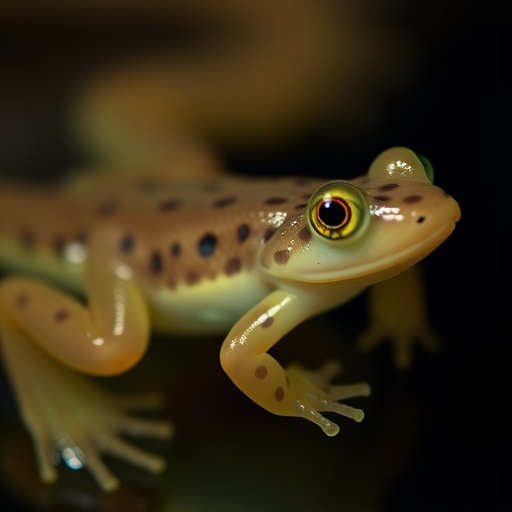
In a groundbreaking study conducted by researchers at Cornell University, a remarkable evolutionary pattern has come to light regarding the respiratory adaptations of tadpoles. The research reveals that tadpole species which have lost their lungs through evolutionary processes never regain them, even under environmental conditions where having lungs would seemingly offer significant survival advantages. This finding challenges the longstanding evolutionary principle that lost traits can re-emerge, particularly when the genetic architecture underlying these traits remains intact.
Tadpoles, the aquatic larval stage of frogs, utilize three primary mechanisms to obtain oxygen: aerial respiration via lungs, aquatic respiration through gills, and cutaneous respiration through their permeable skin. Unlike many amphibians, all adult frogs possess lungs, and their tadpoles typically develop these organs during larval stages. Despite this conserved developmental pathway, certain tadpoles have secondarily lost their lungs throughout evolutionary time, opting for alternative respiratory strategies in specialized habitats.
The comprehensive study, published on October 27, 2025, in the peer-reviewed journal Evolution, systematically investigates the evolutionary trajectories of lung loss across over 530 frog species representing almost every family and myriad genera. Among these, there are 28 distinct instances of lung loss identified. Globally, out of more than 5,000 frog species, only 95 are known to possess lungless tadpoles. The researchers employed advanced phylogenetic methods integrating genetic data and computational modeling to reconstruct ancestral states and to infer the ecological contexts under which lung loss occurred.
Analysis of these evolutionary events revealed striking ecological correlations. In fast-flowing stream environments, where water is consistently rich in dissolved oxygen, lungs may confer a disadvantage due to their buoyancy effects. Tadpoles with lungs might be inadvertently swept away by the current, reducing their chances of survival. Consequently, numerous lungless tadpoles have evolved specialized morphological traits, such as sucker mouths that enable them to cling to rocks and resist displacement in turbulent waters.
Interestingly, lungless tadpoles are not restricted to aquatic microhabitats within streams. Some species demonstrate terrestrial reproductive strategies whereby eggs are deposited in nests on land, often adjacent to moist zones near streams. These terrestrial tadpoles also display lung loss, underscoring a complex pattern of respiratory adaptation that transcends purely aquatic environments. Notably, despite the prevalence of pond habitats among extant frog species for tadpole development, evidence suggests that lung loss in pond-dwelling tadpoles has been a rare evolutionary event.
The findings prompt intriguing hypotheses concerning the selective pressures that drive lung loss. It is posited that the disadvantages of surface air-breathing—such as increased predation risk when surfacing or the energetic costs associated with traveling to the air-water interface—may create stronger selective constraints than the mere presence of lungs themselves. Thus, it might be more accurate to conceive lung loss as an indirect outcome of selective pressures against surface air-breathing behaviors.
From a developmental genetics standpoint, the conservation of lung developmental pathways in species with lungless tadpoles is particularly perplexing. This retention suggests that the genetic machinery required for lung formation remains latent but unused, and yet, evolution has repeatedly opted not to reactivate this developmental program even when beneficial. This empirical evidence complicates previously held assumptions that the re-emergence of lost traits is facilitated by the preservation of underlying genetic frameworks.
Moreover, this study underscores the unpredictable nature of evolutionary innovation. While the loss of complex organs like lungs appears to be evolutionarily “predictable” and repeatedly chosen under certain environmental contexts, the compensatory adaptations—that is, replacing lung function with alternative respiratory strategies—are varied and often unexpected. This diversity of adaptation illustrates the rich landscape of evolutionary solutions to similar ecological challenges.
The research methods involved synthesizing extensive phylogenetic trees constructed through DNA sequencing and molecular analysis, which enabled precise mapping of evolutionary trait changes over tens of millions of years. Coupled with ecological data on habitat preferences and physiological studies on oxygen acquisition efficiency, the study provides a comprehensive framework for understanding respiratory evolution in amphibians.
This study has broad implications for the field of evolutionary biology, particularly in understanding the constraints and opportunities in trait regain versus irreversible trait loss. It challenges the formerly held belief that evolutionary reversals are common and straightforward when the genetic and developmental substrates remain. Instead, it paints a picture of evolutionary pathways governed by a mixture of genetic potential, ecological demands, and selective pressures that may irreversibly close developmental options over time.
In conclusion, the lungless tadpole study illuminates the intricate balance between genetic retention and ecological necessity shaping amphibian evolution. It not only elucidates the mechanisms underlying respiratory adaptations in frogs but also informs larger questions about the evolutionary dynamics of trait loss and regain across diverse taxa. This research invites further inquiry into the molecular and environmental factors that prevent trait regeneration and enriches our understanding of how organisms navigate the evolutionary landscape.
Cite Scienmag News
Drew Townsend. (October 27, 2025). Once Tadpoles Lose Their Lungs, They Never Regrow Them, Scientists Find. Scienmag. https://scienmag.com/once-tadpoles-lose-their-lungs-they-never-regrow-them-scientists-find/
Drew Townsend. "Once Tadpoles Lose Their Lungs, They Never Regrow Them, Scientists Find." Scienmag, 27 October 2025, https://scienmag.com/once-tadpoles-lose-their-lungs-they-never-regrow-them-scientists-find/. Accessed 4 September 2026.
Drew Townsend. "Once Tadpoles Lose Their Lungs, They Never Regrow Them, Scientists Find." Scienmag. October 27, 2025. https://scienmag.com/once-tadpoles-lose-their-lungs-they-never-regrow-them-scientists-find/


