


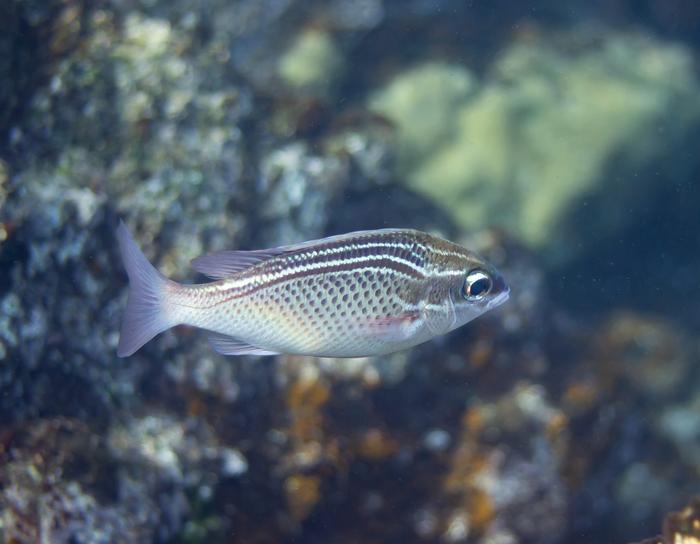
Abu Dhabi, UAE: July 1, 2024: A team of researchers have identified unexpected ways coral reef fish living in the warmest waters on earth, in the Arabian Gulf, have adapted to survive extreme temperatures.

Credit: Rebekka Pentti for NYU Abu Dhabi
Abu Dhabi, UAE: July 1, 2024: A team of researchers have identified unexpected ways coral reef fish living in the warmest waters on earth, in the Arabian Gulf, have adapted to survive extreme temperatures.
Led by Co-Principal Investigator at The Mubadala Arabian Center for Climate and Environmental Sciences (ACCESS) at NYU Abu Dhabi John Burt and Associate Research Professor, Hawaii Institute of Marine Biology Jacob Johansen, the team discovered adaptations in both metabolism and swimming abilities that help fish survive the conditions of the Arabian Gulf. Surprisingly, these fish did not follow leading theoretical predictions, which expected that the maximum size of fishes should be reduced due to limitations in metabolic oxygen-supply. Instead, these fishes demonstrated a capacity to maintain efficient oxygen supply to fuel performance even at elevated temperatures.
The warming of our oceans is anticipated to drastically affect marine life and the fishing industry, potentially upsetting entire ecosystems and economic structures reliant on these habitats. Current scientific models predict that by 2050, coral reef fishes could shrink by 14-39 percent in size due to increasing temperatures under climate change. The study’s findings challenge the prevailing view that oxygen supply limitations in larger fishes are the main reason for smaller fish in warmer waters – the so-called “shrinking of fishes phenomenon.” The species observed did not follow this pattern, suggesting that other factors are also at play. The study proposes a new theory that the decrease in fish sizes and their survival in increasingly warm oceans might be more closely related to an imbalance between how much energy fish species can obtain and how much they need to sustain themselves.
In the paper titled “Impacts of ocean warming on fish size reductions on the world’s hottest coral reefs” published in the journal Nature Communications, the researchers compared two species of fishes, Lutjanus ehrenbergii and Scolopsis ghanam, surviving under the elevated temperatures within the Arabian Gulf to those of similar age living in the cooler, more benign conditions in the nearby Gulf of Oman. Specifically, the researchers set out to determine what qualities reef fishes in the Arabian Gulf have that enable them to survive there, where typical summer water temperatures are comparable to worst-case ocean warming projections for many tropical coral reefs globally by 2100.
“The hottest coral reefs in the world are an ideal natural laboratory to explore the future impact of rising water temperatures on fishes. Our findings indicate that some fish species are more resilient to climate change than previously understood and help explain why smaller individuals are evolutionarily favored at high temperatures,” said Burt. “This has significant implications for our understanding of the future of marine biodiversity in a continuously warming world.”
# # #
About NYU Abu Dhabi
NYU Abu Dhabi is the first comprehensive liberal arts and research campus in the Middle East to be operated abroad by a major American research university. Times Higher Education ranks NYU among the top 30 universities in the world, making NYU Abu Dhabi the highest-ranked university in the UAE and MENA region. NYU Abu Dhabi has integrated a highly selective undergraduate curriculum across the disciplines with a world center for advanced research and scholarship. The university enables its students in the sciences, engineering, social sciences, humanities, and arts to succeed in an increasingly interdependent world and advance cooperation and progress on humanity’s shared challenges. NYU Abu Dhabi’s high-achieving students have come from over 120 countries and speak over 100 languages. Together, NYU’s campuses in New York, Abu Dhabi, and Shanghai form the backbone of a unique global university, giving faculty and students opportunities to experience varied learning environments and immersion in other cultures at one or more of the numerous study-abroad sites NYU maintains on six continents.
Journal
Nature Communications
Article Title
Impacts of ocean warming on fish size reductions on the world’s hottest coral reefs
Cite Scienmag News
Violet Maxwell. (July 1, 2024). NYU Abu Dhabi researchers identify unique survival strategies adopted by fish in the world’s warmest waters. Scienmag. https://scienmag.com/nyu-abu-dhabi-researchers-identify-unique-survival-strategies-adopted-by-fish-in-the-worlds-warmest-waters/
Violet Maxwell. "NYU Abu Dhabi researchers identify unique survival strategies adopted by fish in the world’s warmest waters." Scienmag, 1 July 2024, https://scienmag.com/nyu-abu-dhabi-researchers-identify-unique-survival-strategies-adopted-by-fish-in-the-worlds-warmest-waters/. Accessed 3 September 2026.
Violet Maxwell. "NYU Abu Dhabi researchers identify unique survival strategies adopted by fish in the world’s warmest waters." Scienmag. July 1, 2024. https://scienmag.com/nyu-abu-dhabi-researchers-identify-unique-survival-strategies-adopted-by-fish-in-the-worlds-warmest-waters/

