


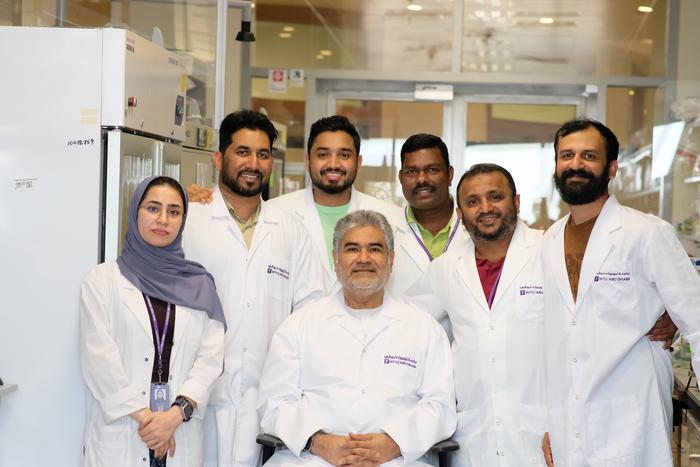
Abu Dhabi, July 22, 2024: A team of researchers at NYU Abu Dhabi, led by Professor Sehamuddin Galadari, has discovered that the tumor suppressor protein Prostate apoptosis response-4 (Par-4) can cause a unique type of cell death called ferroptosis in human glioblastoma – the most common and aggressive type of brain tumor – while sparing healthy cells. This new understanding has the potential to inform the development of novel treatments for various hard-to-treat cancers and neurodegenerative diseases.

Credit: NYU Abu Dhabi
Abu Dhabi, July 22, 2024: A team of researchers at NYU Abu Dhabi, led by Professor Sehamuddin Galadari, has discovered that the tumor suppressor protein Prostate apoptosis response-4 (Par-4) can cause a unique type of cell death called ferroptosis in human glioblastoma – the most common and aggressive type of brain tumor – while sparing healthy cells. This new understanding has the potential to inform the development of novel treatments for various hard-to-treat cancers and neurodegenerative diseases.
Ferroptosis is triggered by the iron-mediated production of reactive oxygen species (ROS) and subsequent lipid peroxidation, which plays a crucial role in shrinking cancerous tumors. This is the first time that Par-4, already known for killing cancer cells through apoptosis – a form of programmed cell death – has been shown to promote ferroptosis in glioblastoma cells.
The tumor suppressor protein Par-4 is widely expressed across species, but is often reduced, mutated, or inactivated in the presence of various cancers. In the study “Tumor suppressor Par-4 activates autophagy-dependent ferroptosis,” recently published in the journal Communications Biology, the researchers identified that Par-4 plays an unanticipated role in promoting ferroptosis-mediated cancer regression. They demonstrated that Par-4 triggers the activation of ferritinophagy (autophagic degradation of ferritin) through the nuclear receptor co-activator 4 (NCOA4). This activation is necessary for the accumulation of the labile iron pool, the production of ROS, and the subsequent lipid peroxidation, all of which lead to ferroptosis.
Ferroptosis plays a key role in various health issues, such as cancer, heart disease, brain damage, kidney failure, lung injury, and diseases like Parkinson’s, Huntington’s, and Alzheimer’s. The identification of Par-4 as a key player in ferroptosis is essential, as it is involved in the main processes and signals that make this alternative cell death pathway, ferroptosis, occur. Many types of cancer cells don’t respond to today’s treatments or have developed resistance to existing drugs therapies.
This research was a collaborative effort between Associate Professor Mazin Magzoub’s lab at NYU Abu Dhabi and Professor Vivek M. Rangnekar from the University of Kentucky, who discovered Par-4 in 1993.
“Our team’s discovery that Par-4 triggers ferroptosis is a breakthrough in the field of cancer treatment development,” said Galadari, who is the Senior Vice Provost for Research and Managing Director of the Research Institute at NYU Abu Dhabi. “Developing methods to activate alternative cell death pathways presents new opportunities for the creation of more potent and effective therapies for glioblastoma and other deadly and debilitating diseases.”
“Investing in research at institutions such as NYUAD is instrumental in transforming the UAE into a knowledge-based economy that attracts local, regional, and global talent – a symbiotic relationship that creates opportunities, knowledge, and wealth,” Galadari added.
ENDS
About NYU Abu Dhabi
www.nyuad.nyu.edu
NYU Abu Dhabi is the first comprehensive liberal arts and research campus in the Middle East to be operated abroad by a major American research university. Times Higher Education ranks NYU among the top 30 universities in the world, making NYU Abu Dhabi the highest-ranked university in the UAE and MENA region. NYU Abu Dhabi has integrated a highly selective undergraduate curriculum across the disciplines with a world center for advanced research and scholarship. The university enables its students in the sciences, engineering, social sciences, humanities, and arts to succeed in an increasingly interdependent world and advance cooperation and progress on humanity’s shared challenges. NYU Abu Dhabi’s high-achieving students have come from over 120 countries and speak over 100 languages. Together, NYU’s campuses in New York, Abu Dhabi, and Shanghai form the backbone of a unique global university, giving faculty and students opportunities to experience varied learning environments and immersion in other cultures at one or more of the numerous study-abroad sites NYU maintains on six continents.
Journal
Communications Biology
Article Title
Tumor suppressor Par-4 activates autophagy-dependent ferroptosis
Cite Scienmag News
Nathaniel Bowman. (July 23, 2024). NYU Abu Dhabi researchers discover tumor suppressor protein Par-4 triggers unique cell death pathway in cancerous cells. Scienmag. https://scienmag.com/nyu-abu-dhabi-researchers-discover-tumor-suppressor-protein-par-4-triggers-unique-cell-death-pathway-in-cancerous-cells/
Nathaniel Bowman. "NYU Abu Dhabi researchers discover tumor suppressor protein Par-4 triggers unique cell death pathway in cancerous cells." Scienmag, 23 July 2024, https://scienmag.com/nyu-abu-dhabi-researchers-discover-tumor-suppressor-protein-par-4-triggers-unique-cell-death-pathway-in-cancerous-cells/. Accessed 3 September 2026.
Nathaniel Bowman. "NYU Abu Dhabi researchers discover tumor suppressor protein Par-4 triggers unique cell death pathway in cancerous cells." Scienmag. July 23, 2024. https://scienmag.com/nyu-abu-dhabi-researchers-discover-tumor-suppressor-protein-par-4-triggers-unique-cell-death-pathway-in-cancerous-cells/

