


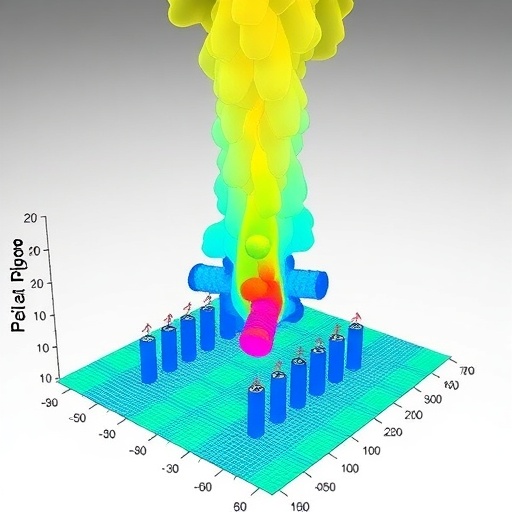
In the ongoing quest to transform carbon dioxide (CO₂) from an environmentally harmful greenhouse gas into valuable chemicals and fuels, scientists are increasingly turning to plasma technology. Recent advances in understanding the complex reactions occurring in low-temperature CO₂–H₂O plasmas offer promising pathways for efficient CO₂ conversion. A groundbreaking study published in ENGINEERING Chemical Engineering presents an exhaustive numerical simulation of atmospheric pressure non-equilibrium plasma discharges, shedding new light on reaction mechanisms that could revolutionize sustainable fuel production.
This study delves into the behavior of a CO₂–H₂O plasma in a needle-plate electrode configuration under atmospheric pressure, employing a sophisticated two-dimensional fluid model. The researchers utilized the PASSKEY solver framework, incorporating 26 distinct plasma species and 61 plasma chemical reactions, to simulate plasma dynamics at a granular level. Electron transport coefficients, pivotal for accurately capturing plasma behavior, were meticulously calculated using the BOLSIG⁺ software under the local mean energy approximation, ensuring precision in modeling electron kinetics.
A fundamental discovery of the research is the identification of a critical reduced electric field near 200 Townsend (Td). This threshold demarcates a transition in plasma operation: below 200 Td, electron energy dips below the dissociation energy of CO₂, significantly altering plasma characteristics. Within this regime, increasing the initial water vapor content from a trace 0.1% up to 10% triggers vigorous dissociative adsorption reactions between electrons and water molecules. This interaction sharply reduces electron density and energy, curtailing the plasma’s radial expansion and confining the discharge channel around the symmetry axis.
Conversely, when the reduced electric field surpasses 200 Td—corresponding to a mean electron energy of approximately 5.5 eV, sufficient to dissociate CO₂ molecules—the plasma dynamics shift conspicuously. Electron-impact dissociation and ionization dominate the processes, and remarkably, variations in water vapor concentration exhibit minimal influence on primary electron transport parameters. This delineation affirms the critical role electric field intensity plays in steering plasma chemistry, influencing both electron kinetics and reaction pathways.
Another vital aspect explored in the study is the effect of quenching pressure on photoionization efficiency—a parameter that profoundly impacts the propagation of plasma streamers. The researchers deployed a three-term Helmholtz model integrating experimentally-informed quenching pressure parameters to describe photoionization processes. As the quenching pressure increased from zero to theoretically infinite torr, the spatially averaged photoionization rate witnessed a substantial uptick. Simultaneously, the ratio of direct ionization to photoionization rates plummeted from around 426 to 11. Despite these shifts, direct electron-impact ionization remained the primary sustaining mechanism for plasma discharge.
Intriguingly, both elevating the quenching pressure and reducing the initial water vapor content favored streamer propagation. This insight offers significant practical implications for controlling plasma behavior by fine-tuning environmental conditions. Enhanced streamer dynamics are critical for sustaining plasma discharge and maximizing reaction efficiency, prerequisites for designing efficient plasma reactors.
The intricate network of chemical reactions unraveled by the simulations provides a comprehensive picture of how key product species form and decompose within the plasma. Carbon monoxide (CO), a valuable intermediate and feedstock, is primarily generated via two routes: electron-impact dissociation of CO₂ molecules and electron recombination with CO₂⁺ ions. The predominant pathway for CO consumption is electron-impact ionization, transforming CO into positively charged ions, thereby influencing overall plasma chemistry.
Hydroxyl (OH) radicals, crucial for downstream chemical processes, arise almost exclusively from electron-impact dissociation of water vapor. The primary sink for OH radicals is three-body recombination involving atomic hydrogen and third-body species (H + OH + M), highlighting the delicate balance of radical formation and loss within the plasma environment. This balance critically affects the plasma’s oxidative capacity and consequent product distribution.
A notable finding concerns the role of dissociative electron attachment reactions involving water molecules. Remarkably, even at a maximum water vapor content of only 10%, these reactions contribute significantly to electron losses, rivaling recombination reactions with CO₂⁺ ions. This reveals a crucial influence of water vapor on electron density and energy, underscoring the interplay between molecular composition and plasma characteristics.
The study’s simulative approach also elucidates the spatial and temporal evolution of peak OH density and its axial position within the plasma discharge, providing a dynamic understanding of radical distributions. Visualized by numerical models, these data points offer actionable insights for optimizing reactor geometries and operating conditions to maximize conversion efficiency.
Overall, this work furnishes a rigorous theoretical foundation and a predictive toolkit for optimizing atmospheric pressure CO₂–H₂O plasma discharge systems. By precisely controlling the CO₂/H₂O concentration ratio, electric field intensity, and quenching pressure, engineers can finely tune plasma behavior to favor desired chemical pathways. This capability advances the design of next-generation plasma reactors aimed at sustainable CO₂ conversion and clean fuel synthesis.
The comprehensive modeling framework presented transcends empirical studies by highlighting underlying physical and chemical mechanisms within plasma reactors. Such theoretical insights are indispensable for overcoming challenges in scalability, stability, and process efficiency inherent in plasma-driven CO₂ conversion. These advances guide both experimental studies and industrial applications towards a more sustainable energy future.
In sum, this seminal research represents a pivotal step in plasma science, providing granular mechanistic clarity and practical strategies to harness non-equilibrium CO₂/H₂O plasmas effectively. It propels the field closer to realizing plasma-assisted carbon recycling technologies capable of mitigating climate change impacts while generating valuable chemical commodities.
News Publication Date: 15-Mar-2026
Web References: http://dx.doi.org/10.1007/s11705-026-2641-y
Keywords
CO₂ conversion, non-equilibrium plasma, plasma chemistry, atmospheric pressure plasma, streamer dynamics, photoionization, electron transport, plasma modeling, hydroxyl radicals, carbon monoxide production, quenching pressure, numerical simulation
Cite Scienmag News
Russell Cooper. (May 8, 2026). Numerical Simulation Unveils Reaction Mechanisms in Atmospheric Pressure Non-Equilibrium CO₂–H₂O Plasma Discharge. Scienmag. https://scienmag.com/numerical-simulation-unveils-reaction-mechanisms-in-atmospheric-pressure-non-equilibrium-co%e2%82%82-h%e2%82%82o-plasma-discharge/
Russell Cooper. "Numerical Simulation Unveils Reaction Mechanisms in Atmospheric Pressure Non-Equilibrium CO₂–H₂O Plasma Discharge." Scienmag, 8 May 2026, https://scienmag.com/numerical-simulation-unveils-reaction-mechanisms-in-atmospheric-pressure-non-equilibrium-co%e2%82%82-h%e2%82%82o-plasma-discharge/. Accessed 4 September 2026.
Russell Cooper. "Numerical Simulation Unveils Reaction Mechanisms in Atmospheric Pressure Non-Equilibrium CO₂–H₂O Plasma Discharge." Scienmag. May 8, 2026. https://scienmag.com/numerical-simulation-unveils-reaction-mechanisms-in-atmospheric-pressure-non-equilibrium-co%e2%82%82-h%e2%82%82o-plasma-discharge/


