


How are rodents able to navigate pitch-black subway tunnels or other dark environments so adeptly, despite not being able to rely on vision?

Credit: Prof. Adam Zaidel, Bar-Ilan University
How are rodents able to navigate pitch-black subway tunnels or other dark environments so adeptly, despite not being able to rely on vision?
With the assistance of a novel motion simulator, researchers at Bar-Ilan University in Israel have discovered that rats rely on airflow to navigate their surroundings. When they move, the flow of air relative to their bodies provides crucial information, complementary to their sense of balance, to perceive their own motion in space. This might explain their agility in the dark as they scurry through pipes and tunnels, turn corners, and effortlessly travel from one location to another, all while knowing exactly where they’re headed.
In order to interact in the world, humans, and animals alike must consistently perceive where they are moving in space. Without this crucial ability, functioning, or even standing without falling would be virtually impossible. To accomplish this feat, the brain must perform a number of tasks, but how it does so remains an open question in scientific research.
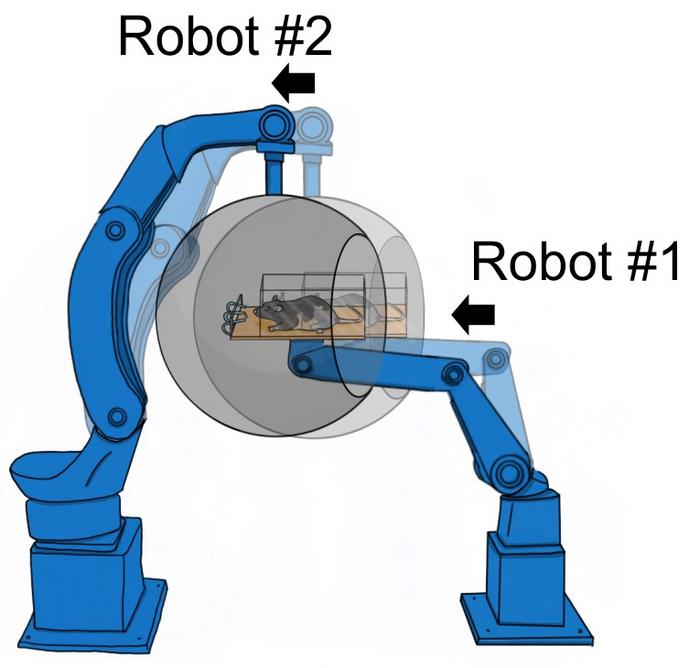
Prof. Adam Zaidel, head of the Multisensory Processing Lab at Bar-Ilan University’s Gonda (Goldschmied) Multidisciplinary Brain Research Center, MSc student Lior Polat, and lab manager and postdoctoral researcher Tamar Harpaz sought to understand the phenomenon and built the motion simulator, a one-of-a-kind system unique to Zaidel’s lab, using a pair of synchronized industrial robotic arms.
During the investigation the rodents experienced motion stimuli and were trained to report on their perceived direction of motion. The research revealed that rats are highly sensitive to small currents of air and use this sensory input, combined with their sense of balance, to enhance their perception of motion. This is the first time that airflow has been identified as a critical cue for self-motion perception in rodents. The findings were published on August 29 in the journal Current Biology.
“The new motion simulator builds on paradigms established for testing primates but offers complementary and distinct advantages by studying rodents,” says Prof. Zaidel. “The findings highlight the significance of airflow in self-motion perception, prompting further questions about the extent to which this cue is important for other species, including humans.”
Prof. Zaidel adds, “Air is all around us, and often goes unnoticed. We would not typically think of air as an important cue for perceiving self-motion in space. But, with these findings in mind, airflow likely plays a more important role in perception and navigation than previously considered.”
These findings mark a significant advancement in the study of sensory perception and brain function. As Prof. Zaidel and his team delve deeper, they hope to uncover further insights into the mechanisms within the brain that perform these functions.
This research was supported by grants to Prof. Zaidel from the Israeli Centers of Research Excellence and the Israel Science Foundation.
Journal
Current Biology
Article Title
Rats rely on airflow cues for self-motion perception
Article Publication Date
29-Aug-2024
Cite Scienmag News
Grant Pearson. (August 29, 2024). Novel motion simulator reveals key role of air flow in rodent navigation. Scienmag. https://scienmag.com/novel-motion-simulator-reveals-key-role-of-air-flow-in-rodent-navigation/
Grant Pearson. "Novel motion simulator reveals key role of air flow in rodent navigation." Scienmag, 29 August 2024, https://scienmag.com/novel-motion-simulator-reveals-key-role-of-air-flow-in-rodent-navigation/. Accessed 4 September 2026.
Grant Pearson. "Novel motion simulator reveals key role of air flow in rodent navigation." Scienmag. August 29, 2024. https://scienmag.com/novel-motion-simulator-reveals-key-role-of-air-flow-in-rodent-navigation/

