


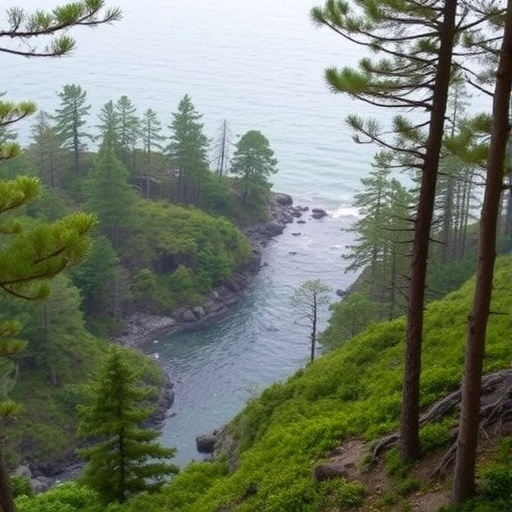
A groundbreaking study originating from William Paterson University reveals compelling insights into the resilience and vulnerability of coastal oak forests along the Northeastern United States in the face of powerful hurricanes and accelerating sea-level rise. This extensive research, recently published in the reputable journal Global and Planetary Change, casts light on how these critical ecosystems recover rapidly from hurricane damage, yet simultaneously face escalating threats due to climate-induced sea-level dynamics.
Scientists, spearheaded by environmental science professor Nicole Davi, undertook a meticulous examination of tree growth patterns over a historical timeframe spanning from 1858 to 2012. This longitudinal approach targeted three geographically and ecologically significant locations: Montauk and Mashomack in New York, and Newport in Rhode Island. These maritime forest stands are subjected to varying intensities of hurricanes — spanning categories 2 through 5 — providing a robust dataset on storm impacts interacting with coastal ecological processes.
The researchers employed a sophisticated dendrochronological methodology harnessing multi-parameter analyses of tree rings. This included scrutinizing total ring width, earlywood and latewood differentiation, alongside detailed wood anatomical structures at cellular resolution. These dendroanatomical techniques enabled the precise identification of stress signatures inflicted by major hurricane events on these trees, revealing a pronounced reduction in growth immediately following the storms.
Remarkably, the study found that coastal oak forests exhibit profound resilience: tree ring measurements frequently recover within just two years post-disturbance. Such rapid recuperation underscores an intrinsic adaptive capacity, highlighting the potential for these forests to rebound from episodic natural disasters with remarkable efficiency. The implications of these findings are substantial for forest management and conservation policies, signaling an avenue for leveraging natural resilience to sustain ecosystem services under increasing environmental stress.
Yet, despite this robustness to discrete hurricane events, the researchers caution that these coastal forests are not invulnerable. The acceleration of sea-level rise along the United States East Coast—a rate surpassing many other global regions—is imposing sustained pressure on these ecosystems. Prolonged inundation and saltwater intrusion are increasingly evident in the form of widespread mortality and morbidity among coastal tree populations, particularly in New Jersey maritime zones.
This duality of rapid recovery from acute hurricane damage contrasted with chronic degradation due to climatic sea-level rise paints a nuanced portrait of ecological vulnerability. Coastal forests fulfill indispensable ecological and societal roles—serving as natural storm buffers, stabilizers of dune systems, facilitators of groundwater replenishment, and bastions of biodiversity. The observed shifts towards dead and dying tree stands threaten these critical ecosystem functions and, by extension, the human communities they protect.
Professor Davi stresses the urgency of integrating these scientific insights into environmental policy frameworks and resource management strategies. “Given the critical role these forests play in protecting densely populated communities,” Davi emphasizes, “greater attention is needed to study and protect coastal forests through informed conservation and restoration efforts.” This call to action is particularly significant as climate models project intensifying hurricane events combined with ongoing sea-level rise.
Importantly, this integrative research incorporated a diverse, international collaboration, engaging dendrochronologists and ecologists from prestigious institutions including Columbia University’s Lamont-Doherty Earth Observatory, the Centre for Ecological Research and Forestry Applications in Barcelona, as well as research teams in Italy and the Harvard Forest. Such multidisciplinary engagement strengthens the study’s methodological rigor and contextual relevance.
The team also benefited from the involvement of William Paterson University alumni, who contributed to crucial aspects of the research—ranging from selecting impactful hurricane events to precise tree core sampling and data analysis. This engagement nurtures the next generation of scientists equipped to address complex environmental challenges.
Funded by the New Jersey Sea Grant Consortium with NOAA’s Office of Sea Grant support, this research marks a significant advance in our understanding of maritime forest ecology under contemporary and future climatic stressors. The multi-parameter dendrochronological approach showcased here provides a replicable model for assessing other vulnerable forest ecosystems globally.
As coastal communities grapple with escalating climate risks, this study serves as a vital scientific beacon. It illuminates both the promise and limitations of natural resilience in forest ecosystems while underscoring the exacerbating influence of long-term sea-level rise. The findings advocate for proactive, science-driven policies that balance the immediate recovery potential of forests with the need to mitigate sustained environmental degradation.
Ultimately, this research challenges the scientific community and policymakers alike to envisage coastal forests not merely as passive victims of climate change but as dynamic systems with intrinsic resilience capacities that require nuanced stewardship. Embracing such complexity will be critical for sustaining the ecological and protective functions of these vital natural landscapes in a rapidly changing world.
News Publication Date: April 10, 2026
Web References: Science Direct – Article
Cite Scienmag News
Russell Cooper. (April 14, 2026). Northeastern U.S. Coastal Forests Face Growing Threats from Hurricanes. Scienmag. https://scienmag.com/northeastern-u-s-coastal-forests-face-growing-threats-from-hurricanes/
Russell Cooper. "Northeastern U.S. Coastal Forests Face Growing Threats from Hurricanes." Scienmag, 14 April 2026, https://scienmag.com/northeastern-u-s-coastal-forests-face-growing-threats-from-hurricanes/. Accessed 4 September 2026.
Russell Cooper. "Northeastern U.S. Coastal Forests Face Growing Threats from Hurricanes." Scienmag. April 14, 2026. https://scienmag.com/northeastern-u-s-coastal-forests-face-growing-threats-from-hurricanes/


