


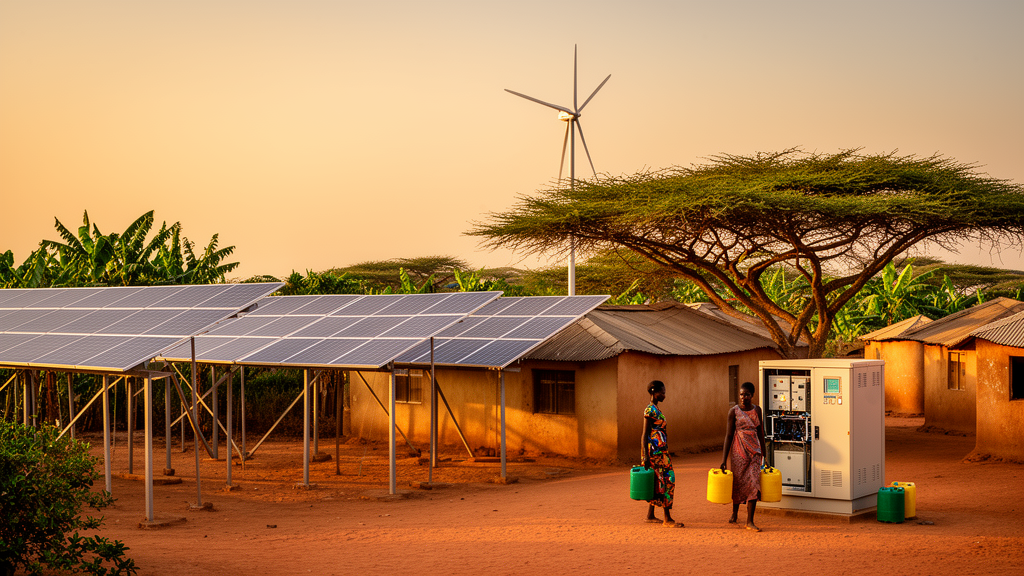
A study of annual Nigerian data from 1990 to 2023 found that green innovation and renewable energy transition were associated with lower climate pressure in both the short and long run, with stronger estimated associations at higher levels of climate pressure. The findings, summarized in the abstract of an open-access article published in Discover Sustainability on 7 October 2026, come from a quantile autoregressive distributed lag analysis of one African economy.
The researchers measured climate pressure as ecological footprint per capita, defined in the abstract as the biologically productive land and sea area needed to support a population’s consumption and absorb its waste. They used internet users as a share of the population as a proxy for green innovation and the share of renewable electricity generation as a proxy for renewable energy transition. The QARDL model was used to estimate short-run, long-run and error-correction relationships across the distribution of climate pressure rather than only at the mean.
The reported long-run elasticities varied across the distribution. For green innovation, estimates ranged from -0.087 at the tenth percentile to -0.198 at the ninetieth percentile. For renewable energy transition, they ranged from -0.054 to -0.141. These model-based estimates indicate that the negative associations were more pronounced in observations with higher climate pressure. The authors described the environmental gains as significant at those higher levels, but the estimates do not by themselves establish that either factor caused the modeled changes. A Toda-Yamamoto causality test suggested a unidirectional relationship from green innovation to climate pressure.
Because the available evidence is the article abstract rather than the complete study, it does not provide uncertainty intervals, detailed diagnostics, estimates for every quantile or a full account of the model’s robustness. The proxies also do not identify which specific dimensions of internet use or renewable electricity generation account for the estimated associations. The analysis relies on national annual data over 34 years and covers only Nigeria, limiting direct interpretation beyond that setting. The authors called for prioritizing digital infrastructure, clean technology and renewable energy deployment, particularly during periods of high environmental stress, but the abstract does not provide a direct evaluation of such policies.
Subject of Research: Quantile analysis of green innovation and renewable energy transition in relation to climate pressure in Nigeria
Article Title: Quantifying the heterogeneous impacts of green innovation and renewable energy transition on climate pressure in Nigeria
Article References: Iormom, B. I. (2026). Quantifying the heterogeneous impacts of green innovation and renewable energy transition on climate pressure in Nigeria. Discover Sustainability. https://doi.org/10.1007/s43621-026-04916-w
Image Credits: AI Generated
DOI: 10.1007/s43621-026-04916-w
Keywords: Nigeria, climate pressure, green innovation, renewable energy, QARDL, ecological footprint, quantile regression, causality testing, sustainable development, Quantifying, heterogeneous, impacts
Cite Scienmag News
Sloane Callahan. (October 20, 2026). Nigeria study finds stronger associations between green innovation, renewable power and lower climate pressure. Scienmag. https://scienmag.com/nigeria-study-finds-stronger-associations-between-green-innovation-renewable-power-and-lower-climate-pressure/
Sloane Callahan. "Nigeria study finds stronger associations between green innovation, renewable power and lower climate pressure." Scienmag, 20 October 2026, https://scienmag.com/nigeria-study-finds-stronger-associations-between-green-innovation-renewable-power-and-lower-climate-pressure/. Accessed 20 October 2026.
Sloane Callahan. "Nigeria study finds stronger associations between green innovation, renewable power and lower climate pressure." Scienmag. October 20, 2026. https://scienmag.com/nigeria-study-finds-stronger-associations-between-green-innovation-renewable-power-and-lower-climate-pressure/


