


Antimicrobial resistance has emerged as one of the most pressing public health challenges of the twenty-first century, threatening to render essential medicines ineffective against common infections. The World Health Organization has ranked this crisis among the top ten global health threats, with projections suggesting it could cause ten million deaths annually by 2050 if current trends continue. A significant driver of this resistance is the misuse and overuse of antimicrobials in agriculture, particularly within the poultry sector. In many regions, the intensive use of antibiotics for disease prevention, treatment, and growth promotion accelerates the evolution of resistant bacterial strains, which can then spread to humans through the food chain and environmental pathways. Understanding the behavioral factors that drive these practices is crucial for developing effective interventions to mitigate this global health risk.
A recent cross-sectional study conducted in Osun State, Nigeria, provides critical insights into the knowledge, attitudes, and practices regarding antimicrobial use among local poultry farmers. Published in the journal Discover Animals, the research was led by Sunday Charles Adeyemo and colleagues from Osun State University and other institutions. The study aimed to assess the awareness, knowledge, attitudes, and practices related to antimicrobial resistance among actively practicing poultry farmers in the state. By identifying specific gaps and barriers to responsible antibiotic use, the findings offer actionable evidence for Nigeria’s National Action Plan on Antimicrobial Resistance at the sub-national level, highlighting the complex interplay between education, access to veterinary services, and farming practices.
The study employed a rigorous multistage sampling procedure to select 289 poultry farmers across the three agricultural zones of Osun State: Osogbo, Ife/Ilesha, and Iwo. Data were collected between July and August 2025 using a pre-tested, structured, interviewer-administered questionnaire. The sample size was calculated using the Leslie Fisher formula, adjusted for an 11.5% non-response rate, ensuring statistical robustness. The questionnaire covered socio-demographics, awareness and knowledge of antimicrobial resistance, antibiotic use practices, attitudes toward stewardship, and barriers to responsible use. Reliability was established through test-retest methodology, yielding a Pearson correlation coefficient of 0.84, while internal consistency was assessed using Cronbach’s alpha, with values ranging from 0.74 to 0.82 for different sections of the survey.
The results revealed a high level of awareness among the surveyed farmers, with 89.6% reporting that they had heard of antimicrobial resistance. Notably, 92.3% of those aware cited veterinary doctors as their primary source of information, underscoring the critical role of veterinary professionals as educators and gatekeepers in antimicrobial stewardship. Overall, 77.2% of respondents demonstrated good knowledge of antimicrobial resistance, defined as scoring at least 70% on a 12-item knowledge scale. However, the most commonly misunderstood concepts were antimicrobial stewardship and the role of the environment in resistance transmission, indicating specific areas where educational efforts may need to be targeted to improve understanding among the farming community.
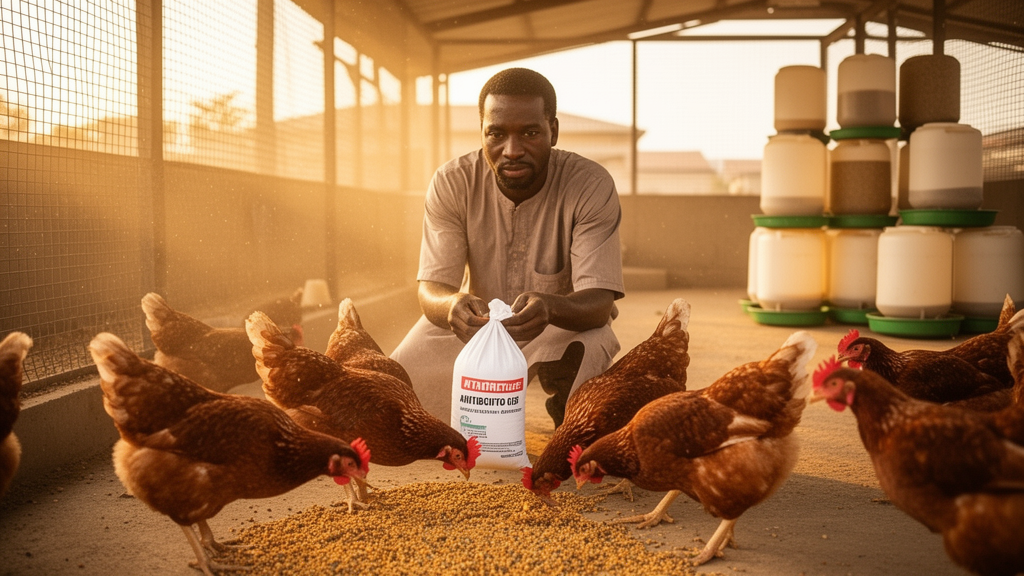
Despite this high level of awareness and knowledge, significant discrepancies emerged in actual farming practices. Among the 89.6% of farmers who used antimicrobials within the last 12 months, 64.5% relied on personal experience rather than veterinary advice to select antibiotics. Only 32.0% reported following veterinary prescriptions, while others used antimicrobials for growth promotion or disease prevention without professional guidance. This reliance on informal knowledge systems is a persistent challenge in low- and middle-income countries, where limited access to affordable veterinary services often leads farmers to prioritize experiential learning over professional consultation, thereby accelerating the selection of resistant bacterial strains.
The study also examined the attitudes of farmers toward antimicrobial stewardship, finding that 84.4% held a positive attitude, with 57.8% considering the reduction of antimicrobial use very important. Approximately 71.6% of farmers implemented biosecurity measures, such as restricted farm access, foot baths, and regular disinfection of coops, which are essential for reducing disease incidence and the subsequent need for antibiotics. However, persistent challenges such as bird mortality, the cost of drugs, and the prevalence of fake medicines remained significant barriers to responsible antibiotic use. These structural and economic constraints highlight the need for a multi-pronged approach that addresses not only behavioral factors but also the systemic issues affecting poultry production in the region.
Statistical analysis revealed strong associations between knowledge, attitude, and practice. Chi-square tests indicated significant relationships between knowledge and practice, as well as between attitude and practice, with Cramer’s V values of 0.59 and 0.63, respectively. Multivariable logistic regression identified good knowledge, positive attitude, and prior antimicrobial resistance training as independent predictors of good practice. Specifically, farmers with good knowledge were 4.21 times more likely to demonstrate good practice, while those with a positive attitude were 5.63 times more likely. Prior training was also a significant predictor, with an adjusted odds ratio of 2.45, suggesting that targeted educational programs can effectively promote responsible antimicrobial use among poultry farmers.
The findings underscore the critical importance of targeted educational interventions and improved veterinary oversight in mitigating antimicrobial resistance risks in poultry farming. The study highlights a clear policy opportunity, as all farmers who had never received antimicrobial resistance training expressed interest in participating in such programs. This universal interest suggests that agricultural extension programs and veterinary-led training workshops could be rapidly deployed to reach a receptive audience. Furthermore, the results emphasize the need for stricter regulatory enforcement, including the prohibition of over-the-counter antibiotic sales and the requirement of veterinary prescriptions for antimicrobials, to ensure that farmers have access to professional guidance and are held accountable for responsible use.
As Nigeria continues to grapple with the challenges of antimicrobial resistance, this study provides valuable insights into the behavioral and socio-cultural dimensions of antibiotic use in the poultry sector. The data suggest that while awareness is high, translating this knowledge into consistent, responsible practice requires addressing the underlying structural barriers and enhancing access to veterinary services. By integrating poultry farmers into national surveillance systems and promoting alternatives to antimicrobials for disease prevention and growth promotion, Nigeria can better protect the health of its animals and people. The study’s findings contribute to the broader One Health framework, which recognizes the interconnectedness of human, animal, and environmental health, and offers a roadmap for sustainable poultry production in the face of growing antimicrobial resistance threats.
Subject of Research: Knowledge, attitudes, and practices regarding antimicrobial use, resistance and stewardship among poultry farmers in Osun state, Nigeria
Article Title: Knowledge, attitudes, and practices regarding antimicrobial use, resistance and stewardship among poultry farmers in Osun state, Nigeria
Article References: Adeyemo, S. C., Olarewaju, S. O., Faramade, I. O., Awodele, K., Olabode, E. D., Towoju, O. P., Adeoye, O. E., Are-Daniel, O., Ajayi, A. R., & Opeyemi, O. (2026). Knowledge, attitudes, and practices regarding antimicrobial use, resistance and stewardship among poultry farmers in Osun state, Nigeria. Discover Animals, 3(1), 104. https://doi.org/10.1007/s44338-026-00260-5
Image Credits: AI Generated
DOI: 10.1007/s44338-026-00260-5
Keywords: Knowledge, attitudes, practices, regarding, antimicrobial, resistance, stewardship, poultry, farmers, Osun, state, Nigeria
Cite Scienmag News
William Thompson. (October 18, 2026). Nigeria Poultry Study Reveals Gap Between Antibiotic Awareness and Use. Scienmag. https://scienmag.com/nigeria-poultry-study-reveals-gap-between-antibiotic-awareness-and-use/
William Thompson. "Nigeria Poultry Study Reveals Gap Between Antibiotic Awareness and Use." Scienmag, 18 October 2026, https://scienmag.com/nigeria-poultry-study-reveals-gap-between-antibiotic-awareness-and-use/. Accessed 18 October 2026.
William Thompson. "Nigeria Poultry Study Reveals Gap Between Antibiotic Awareness and Use." Scienmag. October 18, 2026. https://scienmag.com/nigeria-poultry-study-reveals-gap-between-antibiotic-awareness-and-use/


