


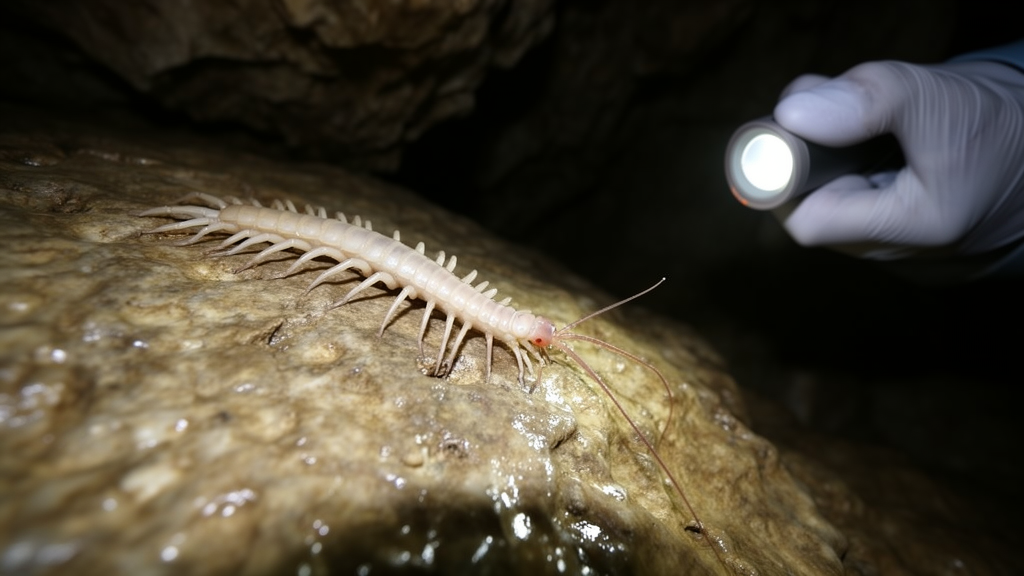
Deep in the limestone of Romania’s Locvei Mountains, close to the banks of the Danube, researchers have confirmed the presence of a centipede species never before verified in the country. Lithobius peregrinus, a centipede with a remarkable talent for turning up in unexpected places, was found living in Gaura cu Muscă Cave, and the discovery is now published in the journal Subterranean Biology. The find settles a decades-old taxonomic mystery, because a nineteenth-century report of the species from Bucharest was later shown to have been based on a misidentified specimen of the commoner Lithobius nigripalpis.
Over three years of fieldwork, from 2022 to 2024, the team sampled 39 specimens of L. peregrinus from the cave, encountering the species on every one of five visits. The animals were collected by hand with tweezers and preserved in 70 percent ethanol, then examined under stereomicroscopes with detailed imaging and measurement software. Most individuals proved to be mature, with only one immature specimen and a single early anamorphic stage carrying just ten pairs of legs. The specimens now reside in the centipede collection of the Emil Racoviță Institute of Speleology in Bucharest.
Gaura cu Muscă Cave is a relatively short system of 254 meters on the left bank of the Danube Gorges, its entrance facing the river about three kilometers downstream from Coronini. The cave hosts a permanent underground stream that feeds a system of galleries on its left side, and the researchers concentrated their sampling in the aphotic Water Gallery, the Bat Chamber with its rich guano deposits, and the deeper sections beyond. Four bat species inhabit the cave year-round, including the greater horseshoe bat and Schreibers’s bent-winged bat, and their guano forms the energetic base of the cave’s invertebrate food web.
The morphological survey revealed striking variability. Adult body lengths ranged from 19 to 25.9 millimeters, and the number of antennal articles spanned 39 to 53. Ocelli, the simple eyes arranged in rows along each side of the head, numbered between 17 and 23 in most specimens, with a maximum of 26. One individual carried an ectopic ocellus, an extra eye positioned above the upper row and beyond the antennocellar suture, a developmental oddity rarely documented in the genus. The teeth on the forcipular coxosternite, the venom-bearing first segment’s biting apparatus, varied from five to eight in typical epimorphic stages but reached ten on one side when abnormal ectopic teeth appeared.
Statistical analysis of directional asymmetry, the consistent difference between left and right sides, produced one of the study’s most intriguing results. Only the antennae showed a significant rightward bias, with a mean asymmetry of minus 1.93 articles and a standard deviation of 3.64, significant at the one percent level by paired t-test. In contrast, ocelli, coxosternal teeth, coxal pores, and the spine patterns of the legs, known as plectrotaxy, showed no statistically significant directional bias. The researchers suggest that discrepancies of up to seven antennal articles between sides exceed natural variation and likely reflect breakage and regeneration, possibly from predation, hinting at a subtle left-sided handedness in how these animals use their sensory organs.
Teratological findings added further drama. The team documented bifid spines clearly divided at their tips, doubled spines in unusual positions, and female gonopods with a single pair of spurs instead of the typical two pairs. Most spectacular was specimen CH1980, which bore a spine-covered outgrowth on the prefemur of its left fifteenth leg, likely a schistomely, a split appendage formed during regeneration after injury. A dark scab-like scar beneath the structure indicates the wound was at least five days old. The authors believe this is only the second case of schistomely recorded in the genus Lithobius and the first to affect the ultimate legs.
Behavioral observations revealed a strong affinity for water. The centipedes were frequently found on stones surrounded by water, sitting at the water’s edge with their antennae nearly touching the surface. When disturbed during collection, individuals plunged into the water and hid in limestone cracks or under submerged stones. Two females were observed laying eggs in July 2024, and juveniles in anamorphic stages were spotted near fissures, suggesting these crevices serve as developmental nurseries until the young grow large enough to hunt in the main galleries. The researchers propose that this aquatic comfort may underpin the species’ extraordinary dispersal ability, which has carried it to Panama, Bermuda, South Africa, Tasmania, New Zealand, and Australia, far beyond its presumed native range in southeastern Europe.
Microclimate data collected continuously from March 2020 to January 2021 revealed significant warming compared with historical measurements taken in the 1960s. The Bat Chamber, located about 45 meters from the entrance, averaged 14.79 degrees Celsius over the logging period, but July 2020 readings averaged 17.97 degrees with peaks of 21.7 degrees, and September averaged 18.1 degrees. Historical records from the same months in the 1960s showed temperatures between 15.5 and 15.8 degrees. Relative humidity also fluctuated more widely, dipping as low as 47.6 percent in September. The authors suggest these altered conditions may have influenced the species’ subterranean adaptations and its persistence in the cave.
The biogeographic picture points toward a natural relict population at the northern edge of the species’ range rather than a recent introduction. The Banat Mountains experience a pronounced sub-Mediterranean climate with oceanic influences, making the region prone to aridity, and the species’ preference for stable, humid environments aligns with patterns seen in other arthropods that colonize caves during hot summers. Similar behavior has been documented in the harvestman Paranemastoma sillii, which established permanent cave populations after seasonal colonization. The researchers also examined historical museum collections from the institute, re-examining specimens previously labeled as L. piceus or L. nigripalpis, but none proved to be L. peregrinus, confirming the cave population as genuinely new to the Romanian fauna.
Beyond the centipede itself, the surveys documented a rich community of cave-dwelling arthropods, including spiders such as Metellina merianae and Porrhomma convexum, the endemic opilionid Paranemastoma ancae, isopods including Mesoniscus graniger, and the diplopod Nopoiulus kochii. The rare Eupolybothrus tridentinus was recorded at only its eighth Romanian location, and the first in an artificial cavity. Molecular analyses planned for the future will help determine whether the Romanian population is a natural relict or an introduced lineage, and whether the morphological variability observed here reflects the prolonged lifespans and reduced seasonality characteristic of cave-dwelling arthropods. For now, the discovery adds a new name to Romania’s centipede checklist and underscores how much remains to be learned from the country’s subterranean frontier.
Subject of Research: First record of the troglophilic centipede Lithobius peregrinus in Romania, with morphological variability, asymmetry, teratology, and behavior of a cave population
Article Title: The troglophilic population of Lithobius peregrinus Latzel, 1880 ( Chilopoda , Lithobiomorpha ) from Gaura cu Muscă Cave – first record of the species in Romania: morphological variations, asymmetry, teratology and behaviour
Article References: Baba, Ș. C., Giurginca, A., Plăiașu, R., Opran, R., Mîrleneanu, A., & Pacioglu, O. (2025). The troglophilic population of Lithobius peregrinus Latzel, 1880 (Chilopoda, Lithobiomorpha) from Gaura cu Muscă Cave – first record of the species in Romania: morphological variations, asymmetry, teratology and behaviour. Subterranean Biology, 52, 69-102. https://doi.org/10.3897/subtbiol.52.154132
Image Credits: AI Generated
DOI: 10.3897/subtbiol.52.154132
Keywords: Lithobius peregrinus, centipede, Chilopoda, cave biology, troglophilic, asymmetry, teratology, Romania, Banat Mountains, Gaura cu Muscă Cave, Subterranean Biology, morphological variation
Cite Scienmag News
Gavin Prescott. (October 18, 2026). Cave-dwelling centipede recorded in Romania for the first time reveals striking asymmetries. Scienmag. https://scienmag.com/cave-dwelling-centipede-recorded-in-romania-for-the-first-time-reveals-striking-asymmetries/
Gavin Prescott. "Cave-dwelling centipede recorded in Romania for the first time reveals striking asymmetries." Scienmag, 18 October 2026, https://scienmag.com/cave-dwelling-centipede-recorded-in-romania-for-the-first-time-reveals-striking-asymmetries/. Accessed 18 October 2026.
Gavin Prescott. "Cave-dwelling centipede recorded in Romania for the first time reveals striking asymmetries." Scienmag. October 18, 2026. https://scienmag.com/cave-dwelling-centipede-recorded-in-romania-for-the-first-time-reveals-striking-asymmetries/


