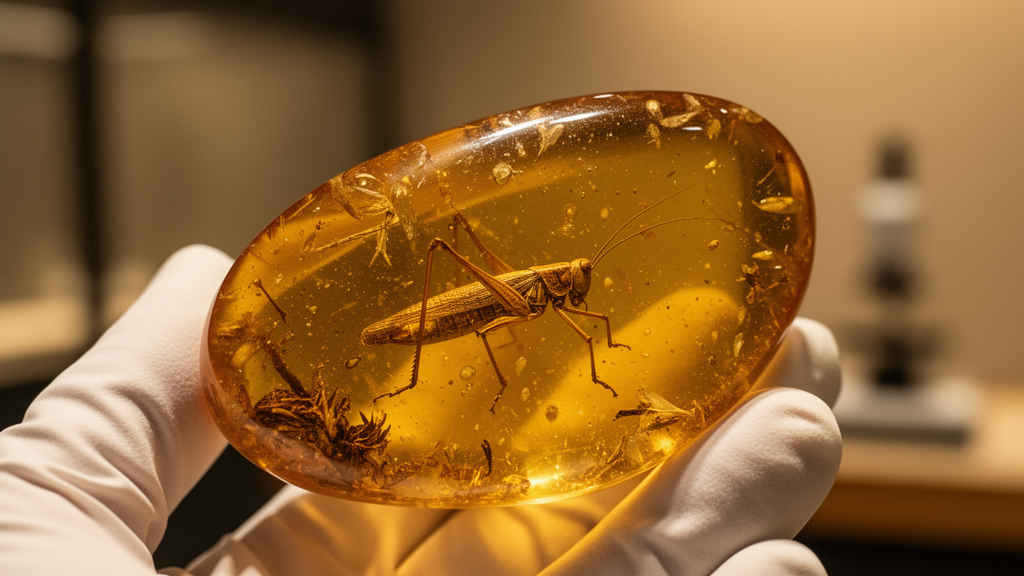
Two new genera and species of Elcanidae, a family of insects closely related to modern grasshoppers and crickets, have been described from mid-Cretaceous Burmese amber. The findings, published in the Journal of Orthoptera Research, introduce Adelphellca simplicissima and Kolymbelcana phantasma, adding significant detail to the understanding of orthopteran diversity during the Mesozoic era. These specimens, preserved in resin that hardened into amber approximately 99 to 110 million years ago, offer a rare glimpse into the morphology and evolutionary relationships of extinct insect lineages that have largely vanished from the modern fauna.
The Elcanidae are a group of Orthoptera primarily known from the Mesozoic fossil record, with some putative occurrences reported in the Permian and Paleocene periods. They possess an almost global distribution, with species reported from all modern continents except Africa. Characterizing features of the family include large metatibial spurs of varying morphology, both wing pairs with a long pterostigma, and a general wing morphology similar to Caelifera. However, other aspects of their appearance, such as the shape of the ovipositor and antennae, suggest they may be placed closer to Ensifera, making their phylogenetic placement within Orthoptera a subject of ongoing scientific debate.
The new species are assigned to the subfamily Elcaninae, which is mainly characterized by the fusion of specific forewing veins, namely 1A, CuPb, and CuPaβ. Adelphellca simplicissima is based on a well-preserved forewing and metathoracic leg featuring leaf-like metatibial spurs. The genus name derives from a fusion of the ancient Greek term for sister and the name of another elcanid genus, Ellca, referring to the close resemblance between the two. The species name refers to the simple wing morphology of the specimen, which lacks the patterns of coloration often found in other Elcanidae. The holotype is a male specimen deposited at the LIB Hamburg, with an accession number of GPIH07019.
Adelphellca simplicissima exhibits a forewing length of 11.5 mm, with the veins 1A, CuPb, and CuPaβ fused. The anal margin between CuA + CuPaα and MP makes up 24% of the total forewing length. The pterostigma is dark and sclerotized, without cross veins, a feature common in Burmese amber Elcanidae but not reported from other origins. The metatibial spurs are leaf-like, and the metatibia is significantly shorter than the metafemur, approximately 20% shorter. The wing venation suggests a close phylogenetic relationship with Ellca, differing mainly in the type of metatibial spurs, which are spine-like in Ellca.
The second new genus, Kolymbelcana, is represented by the species K. phantasma, described based on an almost complete female specimen. The genus name derives from the ancient Greek term for dive, associated with the hypothesized aquatic affinity of some Elcanidae species. The species name, meaning ghost or phantom, recognizes the peculiar state of preservation of the specimen, where one side is dark black with a whitish glimmer where the body cuts the amber. The holotype is a female specimen deposited at the LIB Hamburg, with an accession number of GPIH07020, and includes several Diptera as syninclusions.
Kolymbelcana phantasma has forewings 9.5 mm long, featuring two dark spots, the anterior being approximately double the diameter of the posterior. The dark colored wing margin is up to 1.5 mm broad and does not extend all the way to the tip of the forewing. The metafemur is slightly longer than the metatibia, measuring 5.8 mm and 5.4 mm, respectively. The metatibial spurs are leaf-like, and the ovipositor is sword-shaped, at least 3.3 mm long. This sword-shaped ovipositor distinguishes Kolymbelcana from Adelphellca, which has a scythe-shaped ovipositor, suggesting different sites of oviposition and possibly different habitat preferences.
The study also suggests that the previously described species Probaisselcana zhengi should be removed from Probaisselcana and placed in the new genus Adelphellca. This reclassification is based on its long anal margin between CuA + CuPaα and MP and a pterostigma without cross veins, which excludes it from Pseudoprobaisselcana. The wing features of P. zhengi show a strong resemblance to those of Adelphellca, supporting the new generic placement. This taxonomic revision highlights the complexity of Elcanidae classification and the importance of detailed morphological analysis in resolving phylogenetic relationships.
Burmese amber, dated to the mid-Cretaceous age of 98 million years, has been a rich source of Elcanidae fossils since 2007. The species from this Lagerstätte differ from their relatives by having a longer anal margin of the forewing and a pterostigma without cross veins. These features are omnipresent in Burmese-amber Elcanidae and have not been reported from any other origin. The new species increase the number of Elcanidae from Burmese amber to 19, with the family now comprising 15 genera. This increase in diversity provides valuable insights into the evolutionary history and ecological niches of these insects during the Mesozoic era.
The scientific use of amber originating from Myanmar is debated due to human rights violations in some mining areas, particularly in Kachin State. However, the authors argue that material already present in collections should not be ignored for scientific examination. The conflict and ethical issues surrounding amber fossils of Burmese origin are discussed in depth in previous literature. The specimens used in this study were discovered in mining sites near Tanai village or Hkamti village in the Kachin State, Myanmar, with the age of the two amber sites differing by approximately 10 million years. The amber from Tanai is estimated to be 98.79 ± 0.62 million years old, while the amber from Hkamti is approximately 110 million years old.
The description of these new genera and species contributes to the overall understanding of Elcanidae diversity, specifically from the amber forest. The detailed morphological analysis, including wing venation, metatibial spurs, and ovipositor shape, provides critical data for phylogenetic studies. The findings underscore the importance of Burmese amber as a source of fossil insects and highlight the ongoing efforts to classify and understand the evolutionary relationships of extinct orthopterans. As more specimens are discovered and analyzed, the picture of Mesozoic insect diversity continues to become clearer, offering new perspectives on the history of life on Earth.
Subject of Research: Description of two new genera of Elcanidae from mid-Cretaceous Burmese amber
Article Title: Two new genera and species of Elcaninae ( Orthoptera , Elcanidae ) from mid-Cretaceous Burmese amber
Article References: Schall, O.-K. O., Kotthoff, U., & Husemann, M. (2025). Two new genera and species of Elcaninae (Orthoptera, Elcanidae) from mid-Cretaceous Burmese amber. Journal of Orthoptera Research, 34(1), 63-68. https://doi.org/10.3897/jor.34.130082
Image Credits: AI Generated
Keywords: Elcanidae, Burmese amber, Orthoptera, mid-Cretaceous, new species, fossil insects, wing venation, taxonomy, Mesozoic, Myanmar, genera, species
Cite Scienmag News
Gavin Prescott. (October 18, 2026). Ancient Grasshopper Relatives Revealed in Burmese Amber. Scienmag. https://scienmag.com/ancient-grasshopper-relatives-revealed-in-burmese-amber/
Gavin Prescott. "Ancient Grasshopper Relatives Revealed in Burmese Amber." Scienmag, 18 October 2026, https://scienmag.com/ancient-grasshopper-relatives-revealed-in-burmese-amber/. Accessed 18 October 2026.
Gavin Prescott. "Ancient Grasshopper Relatives Revealed in Burmese Amber." Scienmag. October 18, 2026. https://scienmag.com/ancient-grasshopper-relatives-revealed-in-burmese-amber/